The new pricing for the JoyYou card comes into effect in April, and the local media have been making a big fuss about it.
It’s very simple: if the fare is HK$10 or less, you will continue to pay HK$2 and the government will pay the rest to the transport operator. If it’s more than HK$10 you pay 20%, and again the government pays the rest.
Most bus, minibus and MTR journeys are less than HK$10. The maximum is around HK$30, so for that the JoyYou fare would be HK$6. Meaning that if you are currently paying HK$2 for a long journey on the MTR, it could triple.
But that is roughly 60p (UK) / 80c (US). In London, buses are £1.75 and the minimum fare on the Underground is £2.20. So, by international standards it’s still very reasonable.
The problem (as I pointed out earlier) is that bus and minibus fares are normally based on taking the bus to to its terminus even if you are just travelling a short distance. It has been like that for a long time, and everyone ought to be aware of it, but I suppose that if you’d been paying HK$2 for a while (potentially 14 years) you might possibly have forgotten. But it makes sense to discourage people from taking long-distance routes for short journeys.
In 1995 the Chinese Communist party (CCP) hosted China’s first modern-day national seminar of rainwater utilisation in Lanzhou, a dry northern city that abuts the Gobi desert. In the following decades, URWH started to be incorporated into official engineering codes, with the 2008 Olympics being the perfect opportunity to showcase these designs. As Yu’s “sponge city” concept grew in popularity in the 2010s, and was adopted as an official strategy by the Chinese government in 2014, URWH became fundamental to China’s national planning. Now, the government’s official target is for 70% of rainfall in sponge cities to be reused.
I suppose I shouldn’t expect Hong Kong to be mentioned, but it has been a pioneer in this for over 60 years.
This article says that “seawater supply (is available) to about 85% of the population of Hong Kong and it has a map showing that it covers the areas where most people live. This pdf (sorry) says that “85% of Hong Kong’s population uses seawater for toilet flushing” (which might not be correct) and advocates a switch from seawater to recycled – which does seem to be in place
As the above article explains, that needs a separate system of pipes to be installed, but that’s been a requirement for new buildings since 1965 (pdf) – if seawater or recycled is not available you have to pay for fresh water (there’s no charge for seawater).
I’ve always thought that personalized number plates are a terrific idea. Only very smart people will pay extra to have a funny or clever number plate for their vehicle.
So imagine my surprise when I saw a people carrier (because who needs a mere car when you can have a mini bus) with the topical number plate “HNY” having run into the car in front and stopped discussing why this had happened.
Typepad has closed down, so this site has been migrated to WordPress and it all seems to have gone smoothly (the security certificate went missing, but is now working).
However, some things may well be broken, and feel free to point out anything particularly bad and I’ll try to fix it.
Buying “expat” food in Hong Kong (and probably most other places in Asia) is very hit and miss. Sales volumes are usually really low, which makes it difficult for the retailers to know how many to order. Prices are high, because of the combination of low volumes and the cost of air freight.
I always feel slightly conflicted when these products are reduced (close to the sell-by date), because that may well mean that they won’t reorder it.
Except that it can take a while – one supermarket used to stock French goats cheese and I’d estimate that less than 10% was sold at full price, and a lot was bought by me at a big discount (sell-by dates are just a guideline it’ll probably be fine a week or two later). Yet they kept re-stocking it – though they have finally stopped now.
Popular(ish) products also randomly disappear. So it’s possible that (1) their algorithm is broken, or (2) it’s just someone with a spreadsheet who happened to notice (or not).
Sometimes the product is available at another branch of the supermarket or just randomly re-appears, at which point I am strongly tempted to buy it in an effort to persuade them to keep stocking it. Which is probably delusional given the randomness noted above.
For example, I was bemused by the occasional appearance of Waitrose sausages in the Taste supermarket in Kowloon Tong. Someone clearly hadn’t worked out that by the time they get off the plane and in to the store it is just a few days before the sell-by date, and so they have to reduce the price almost immediately. They seem to have figured that and I haven’t seen them recently.
Incidentally, M&S now freeze things like sausages to have better control over sell-by dates.
Many years ago there was a blog run by two expatriate gentlemen in Hong Kong (Mr Tall and Mr Balding). Amazingly, it seems to have survived (in archived form), including this article on how much food costs in Hong Kong. It’s obviously out-of-date, but the comparison between a normal supermarket and the high-end stuff is really astonishing.
Off-the-shelf food items
Mid-budget
High-budget
White rice, 1 kg
HK$7.60 Kam Heung (Thai)
HK$49 Organic (USA)
Spaghetti, 500g
HK$10.80 Vetta (Italy)
HK$68.50 Italian organic
Flour, white 1 kg
HK$18.20 Betty Crocker (USA)
HK$23.50 Marriage’s organic (UK)
Cheese, imported 250g
HK$34.50 Mainland (NZ) cheddar
HK$70.00 Farmhouse cheddar (UK)
And yet…whilst I’m sure that there are highly-paid foreigners who go crazy buying the really expensive stuff (albeit probably fewer now than in 2007), there’s no need for that. A little bit of shopping around pays dividends: ParknShop has good quality imported products, albeit scattered somewhat randomly across its various different supermarkets (Great, Taste, Fusion, International, etc.) and Dairy Farm have “Market Place” (previously Jason’s Market) alongside the regular Wellcome stores. Or there’s HKTVmall.
Taking the list above (2007 prices remember), I am quite happy with organic pasta from the French supermarket Casino that is available in PnS for around HK$20.
And yes, you could go to CitySuper and pay a small fortune for some organic cheddar or you could find Waitrose own-brand in Great (but not in Taste recently) or try M&S (and they don’t freeze the cheese).
The new(ish) Market Place in The Wai (next to Tai Wai station) is huge and very confusing, with (for example) one small display of cheeses in a prominent position and then another in a different section with a better choice. I suppose they were offered this over-large unit because the MTR want their new shopping mall to look good, but I’m not convinced there’s enough business – though that might change when all the residential units are sold.
Market Place also has an interesting policy on changing prices on its 200gm blocks of cheese under the Meadows brand: these cycle round from 35p to 40p to 45p quite predictably. By Hong Kong standards, 35p for 200g is good value, even 45p is acceptable, but of course I’m going to wait for the price drop.
You do have to shop around, because some supermarkets will charge crazy prices for some products and sensible prices for others. And even CitySuper, which has plenty of crazy prices, does also have some products at reasonable prices (e.g. its own brand organic or free-range eggs from Spain).
I guess there are people who are willing to pay high prices for imported products without bothering to shop around, but that can certainly pay off if you have the time!
Fortunately, we have (eventually) ended up with a good solution.
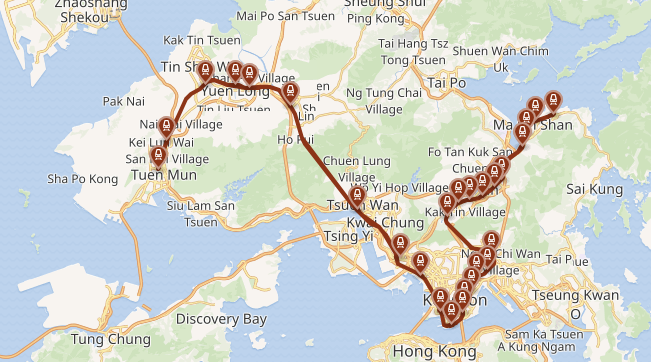
The southern terminus of East Rail is now Admiralty, which has 8 platforms (lucky) for 4 lines (ayeeah), meaning that you can continue your journey by going east, west or south. Most interchanges are fairly easy (if you can deal with the large crowds), and it certainly does make it more convenient to get from the New Territories East to Hong Kong Island. The only downside is shorter trains (First Class has survived, rather to my surprise), and yes I have written about that.
There's also the new Exhibition station, which maybe not quite as convenient for the Hong Kong Convention and Exhibition Centre (HKCEC) as you might have hoped, but obviously it's much easier than walking from Wan Chai station. I had forgotten that it was originally planned to be an interchange with the North Island Line, which is why the platforms are on different levels, but that ain't happening any time soon.
There are also new platforms at Hung Hom, which were heavily delayed due to problems with construction. This is an interchange with the other part of the SCL Project: the Tuen Ma line, which opened in June 2021 (see here). For nearly a year there was a really inconvenient interchange between the old East Rail platforms and new Tuen Ma Line platforms, but now they are in the same place (albeit at different levels).
The Tuen Ma Line was previously known as the East-West line because it goes from the New Territories East (Ma On Shan / Sha Tin) to the New Territories West (Tsuen Wan, Yeun Long, Tuen Mun) via Tsim Tsa Tsui. It's by no means a straight line and can be a bit confusing when the southbound service is heading for somewhere that is very much North West of where you are.
Seems to me that it would be helpful to announce the intermediate station (e.g. Tuen Muen via TST) where that is appropriate, as they do on the Circle Line in London.
By Hong Kong standards it's not very frequent (every 5-6 minutes off-peak) though they enhance that when there are events at the new Kai Tak stadium. It also has two interchanges with the (KCR) East Rail, one at Tai Wai (easy for southbound connections because this section of the Tuen Ma Line has the two lines the "wrong" way round) and the new Hung Hom station.
There are more rail projects planned and under construction, the most significant being the Northern Link, which will go from the Kam Sheung Road station (on the Tuen Ma line) and a new Kwu Tung station (on the Lok Ma Chau section of East Rail). There is also a plan for a new line from HKU through Cyberport and Aberdeen to Wong Chuk Hang, that may be started in 2027.
They did finally link it up to the main terminal (in 2022), using a bridge. And yet…
The first problem is that the maps of Terminal 1 that you will see when you get through security don’t show the North Satellite Concourse at all – on closer inspection that’s because they show the lounges, and the NSC doesn’t have one. Probably because it only has 9 gates, all for the smaller A320 / A321 single aisle planes.
What a strange decision to make with the map, though, given that probably 95% of passengers won’t be looking for a lounge, they’ll be wanting to know where to find their gate. In case you’re wondering, look for gate 12 and then you’ll find the wonder bridge.
And, no, I don’t want to use the terrible map on the HKIA website. There is a decent pdf map (of course there is) here – found via this webpage which explains the changes to gate numbering, including the fact that these NSC gates used to be 501-510.
But, hey, apparently this is all a splendid thing:
The bridge is 28 metres high – quite a long way up and down again the other side. So passengers and aircrew have to use the escalators to get there. There is a lift but it’s only available for the disabled, presumably because it’s too small.
So everyone has to take their cabin luggage (including small suitcases) on these fairly steep escalators. Which seems strange because almost everywhere else in Hong Kong (and beyond) the advice is not to do that, and to use the lift instead. But not here, oh no.
I’m sure there’s a good reason for building a bridge rather than a tunnel. Presumably it’s cheaper?
When you get there, the facilities are not great. The Starbucks was being renovated when I was there, and there were queues for water and the toilets. As far as I know, you can’t go back to the main concourse.
Is this all temporary? Will it be abandoned when Terminal 2 opens?
The concept is that you use one payment platform (e.g. WeChat Pay) to enter the MTR and another (e.g. AlliPay) to leave, and rely upon not having anyone check whilst you are travelling (which in my experience never happens in standard class and is extremely rare even in First Class).
I've never used these payment methods, but the article claims that there is a way to manually enter your entry or exit station in the app. Which is convenient but seems very obviously open to abuse.
If you use an Octopus card and you managed to get into the system without it being recorded you won't be able to use the automatic gates to exit and have to go to the Customer Service Centre first for them to fix it.
In London, you can always exit from the station with Contactless or an Oyster card but incomplete journeys are charged at the maximum fare – however, you can apply online to get a refund.
If they removed the feature in the two apps and charged for incomplete journeys (as in London) surely that would stop this abuse? If I have understand the Alipay app (MTR Press Release) they do tell you the fare you have been charged, so people could go to the Customer Service Centre to complain and maybe get a refund.
My question here is who is enabling this, and how much money are they making out of it? And how do they avoid being detected by the MTR? All very strange.
One other thing I have noticed with Alipay is that it seems not to apply sectional fares on minibuses. So at the start of the journey the fares are the same, but while the price on the Octopus reader drops as you get nearer to the destination, nothing changes on Alipay. Not that I have ever seen anyone use them!
It's more complex in London because there is daily capping, and TfL calculate the total spend for the day and deduct that early the next morning. So you will only know about the "incomplete journey" charge by logging on to the website or checking in the TfL Go app the next day (though you ought to be alerted by a larger than expected payment going out from your account). It's actually easy to request a refund but you do have to enter some details and there are some limits on how many refunds you can request each month.
Another problem in London is that if you tap in using a physical card and out using the same card on Google Pay or Apple Pay this creates two incomplete journeys! Which are easily reconciled by TfL if you contact them.
I have always suspected that a lot of people in London either don't realize that they have been charged for an incomplete journey or never get round to claiming a refund. Which is supported by this FOI request stating that were 40 million incomplete journeys in 2023 at a total cost of £231 million (average charge of £6.39). Only around 42,000 requests for refunds were received – which is around 0.1%. That's staggeringly low!
Back in 2014, the SCMP reported on the “painfully slow process” of installing platform screen doors on what were the KCR East Rail and Ma On Shan line (now the MTR East Rail Line and Tsuen Ma Line).
They returned to the subject in 2023 (paywall) and RTHK reported in February 2024 that work would be complete by the end of the year. Being the year 2024, of course.
There’s an update on the project here and the target completion date is now “in 2025”
The project team has overcome various challenges by learning from experience during the process, hence some of the works could be completed ahead of schedule. The progress of works is satisfactory so far.
Satisfactory, you say? Completed ahead of schedule?
It’s now April 2025, and the southbound platform at University Station has been started but there’s no obvious sign of it being completed (northbound was done some time ago). At Mong Kok East, the two main platforms are complete but not platform 1 (where southbound trains sometimes terminate in the rush hour if they still do that).
I suppose these two are a bit more difficult because the platforms are curved, but that SCMP report was 11 years and yet it’s still not finished [and I haven’t been to Lo Wu to check on progress there]
I previously wrote about this in January 2018 and Transit Jam reported on one suicide at Kowloon Tong last year (but work there was completed shortly afterwards) and another case happened in January 2025 at University station (The Standard).
And yes, other cities worldwide have a very long way to go to catch up with Hong Kong on this.

 Ordinary Gweilo