• I was walking through a shopping mall on Sunday afternoon and the big screen was showing football.

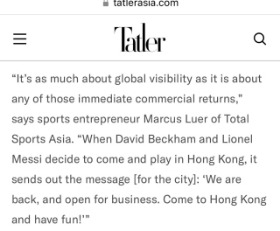
    Open for BusinessHong Kong is back back back.  Inter Miami CF are in town.  The game is a sell-out. The government is delighted, and have grand plans to show Lionel Messi around the city.  Chief Executive Lee Ka-chiu will be at the game to meet Messi.

    We are told that Messi is guaranteed to play at least 45 minutes. 

    Unless he is injured. 

    And what are the chances that a 36 year-old footballer would miss a pre-season friendly due to injury?  No need to worry about that.

    Except that…Messi turns out to be injured.  Oh no.  And Luis Suarez spends the game standing on the touchline.  

    Never mind, lots of other footballers are playing for Miami.  There are goals, scored by Robert Taylor, Lawson Sunderland, Leonardo Campana and Ryan Sailor.  No, me neither.

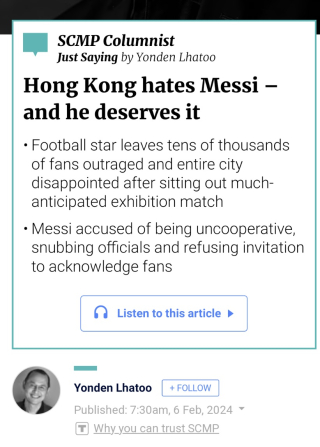
    After the game, naughty old Leo runs away and avoids shaking the hand of Lee Ka-chiu.  He also declines to be shown around the city.

    A few days later, Messi and Miami are in Toyko for another pre-season friendly.  It's not a sell-out, the government is not involved, and Suarez plays 75 minutes and Messi manages 30 minutes.

    SCMP Messi

    I've never gone to a game to watch just one player, though I did take a small person to the 2007 Premier League Asia Trophy (in Hong Kong), and the presence of David James was very exciting for him (especially when he saved two penalties).  

    But, of course, that tournament wasn't promoted almost entirely on the back of one player.

    …who is 36 years old.

    …and who has been on a world tour, traveling to El Salvador, Dallas, Saudi Arabia, Hong Kong and Tokyo playing meaningless matches.

    If I had paid all that money for a ticket based on a promise that Messi would play, I think I would want at least a partial refund.  However, it seems that the organizers didn't have any real guarantee that Messi would play and so they will not be getting any money back.

    Certainly the government is not happy, as per the SCMP

    The Culture, Sports and Tourism Bureau said Hongkongers would be “baffled by this”, and said the city’s residents deserved “a reasonable explanation”.

    “The coach of Inter Miami said Messi could not play in Hong Kong because of an injury, but he looked fine in the match in Japan, and was running around for a decent amount of time,” the bureau said.

    But real football fans "hating" Messi for not playing?  Don't think so.


  • Sad to hear of the death of Ho Kwok Wing, an Australian who came to Hong Kong many years ago and became the most famous gweilo actor on TV.  This follows the death of his wife a few months ago.

    I remember that he used to have a blog writing about his life in Hong Kong, some of which is available on the Internet Archive / Wayback Machine

  • Well, Hong Kong has finally abandoned the requirement to wear masks. 

    You may remember that people in Hong Kong started wearing masks back in January 2020, though initially the government was absolutely not in favour of this (having made it illegal a few months ago during that thing we don't talk about anymore).

    It was only in July 2020 that it was made compulsory everywhere indoors, and then within a few days it applied outdoors as well.  This was when the government also announced a total ban on eating in restaurants  for 7 days – which was swiftly abandoned. 

    The rules for restaurants have changed many times over the last three years.  At one time we had the bizarre spectacle of families spread across two or three tables (because of the maximum of two per table), and tables split in two with a glass (or perspex) screen so that larger groups could be accommodated without breaking the rules.  There have been a lot of changes since then, and according to this list the maximum number of people per table was increased to 12 in October 2022, and of course the LeaveHomeSafe QR code scanning requirement ended in December.  

    But those mask rules have remained in place for more than two and a half years, even after Mainland China abandoned them, with only one concession (no need to wear one when taking exercise).  

    You might have expected that everyone would stop wearing masks when the restrictions ended. 

    But, no, the vast majority of people are still wearing masks on public transport and in shops and shopping centres.  

    Even outdoors, a lot of people are wearing them.

    Probably there is a certain amount of peer pressure that encourages people to wear them rather than being the odd one out.  Maybe that will gradually change, but it seems that people are quite comfortable wearing masks in public. 

    Which begs the question: was it really necessary to have laws to make them compulsory everywhere  for everybody for nearly 1,000 days?

  • I have previously written about Wrong MTR station names and the Hong Kong Free Press has an interesting article on a similar theme

    Foreign influence Part 1: Lost in translation

    [..] Mong Kok is another prime example. The former coastal region was named after the overgrown silvergrass found in the area 芒角 mong4 gok3, (‘corner of silvergrass’).

    When the government reclaimed the bay and developed the area in the early 1900s, the Chinese name was changed to 旺角(wong6 gok3) which means “Prosperity Point.”

    The English name was never updated.

    I remember being told that 芒角 meant "busy" place, but that seems to be another Chinese character 忙with the same Pinyin romanization, which is an understandable error for anyone who didn't check a 19th Century map.  

    The author of the HKFP piece seems to be Chinese, so predictably makes a better job of this than I did!


  • The full Tuen Ma line will open on June 27.  SCMP predictably came up with a strange headline: Hong Kong MTR: key section of costly Sha Tin-Central link to open by June 27 after repeated delays

    A key stretch of the long-overdue Sha Tin to Central link, Hong Kong’s most expensive rail project, will fully open on June 27 after repeated delays and cost overruns, the city’s transport minister has said, while pledging the government will learn lessons from the saga.

    Long overdue, yes, but the section of track (from Kai Tak to Hung Hom) actually connects Tuen Mun and Ma On Shan, not Sha Tin and Central.  I may have mentioned this a few times over several years.

    RTHK got it right with its headline: MTR’s Tuen Ma Line to get going on June 27 (yes, the name comes from the districts at the two ends), whilst HKFP had a rather oblique headline: Two new MTR stations to open next month, forming Hong Kong’s longest metro line.  I think the word you may be looking for is “completing”.  Or, more accurately, joining the Ma On Sha Line with West Rail.

    I still think this is not a great name – at one stage there was a suggestion that it would be the East-West line, because it goes from the Eastern New Territories to the Western New Territories (and for part of it you’d only have to add a few letters at the start of the name, so that would save money).  It would avoid confusion with the Tsuen Wan line.  Or is that just me?

  • Hong Kong has one of the best COVID vaccines (Comirnaty from BioNTech in Germany) freely available. 

    Or if an mRNA vaccine with 91.3% efficacy isn’t to your liking, you’re in luck because the Sinovac vaccine, with an efficacy rate of just 50.7% is also available. 

    Political theatre is never far away and all true patriots are choosing the vaccine from the PRC (though there’s another, more practical reason – if you need to travel to the PRC). 

    Both vaccines offer remarkably good protection against severe disease and death, and side effects are minimal, but the vaccination centres are not operating anywhere close to capacity.

    There are many reasons why people are not choosing to get vaccinated.image

    • Is it because Hong Kong has had less than 12,000 cases in total and only 210 deaths? 
      • Probably yes.  The risk of getting COVID here is very low
      • Singapore has had more cases than Hong Kong (but far less than many places) and more than 80% are willing to take the vaccine and they are way ahead on the number of jabs.
    • Could it because the media here report on deaths of people who have had the vaccine?
      • That certainly doesn’t help. 
    • Maybe it’s because many medical professionals don’t seem keen on the vaccines. 
      • I have to say that I find this fairly shocking
    • Clearly it can’t be because people don’t trust the government. 
      • We all know that the National Security Law is a good thing and those pesky demonstrators should all be in prison.  Glad we’ve cleared that up.

    Here’s a Twitter thread with a link to an article with more information:

    image

    Or there’s this article from HKFP: Don’t trust the science or don’t trust the gov’t? Why many Hongkongers are shunning Covid vaccination.

    Meanwhile, the government has been applying a super abundance of caution in quarantining so-called “close contacts” and almost everyone arriving in Hong Kong.

    The definition of “close contact” was extended to everyone living in the apartment blocks of variant cases, because, well, just because.  This led to thousands of people being sent to one of the government camps for 21 days. 

    They did back down on this after numerous complaints and no actual cases being detected.  Oh, and some dodgy food.  They also reduced the number of days quarantine for anyone who is fully vaccinated.  But there are still quite a lot of people being sent into quarantine.

    There has been a minor relaxation for quarantine of arrivals.  Recently, the UK was moved from group A2 to B, meaning that if you are fully vaccinated you “only” have to stay for 2 weeks in one of the approved hotels.  Australia and New Zealand are currently in the lowest group (14 or 7 days) but this list keeps being reviewed so you can never be certain.

    Last year the default was home quarantine with electronic monitoring:  they gave you a bracelet to wear and you had to install an app on your mobile phone.  This option was withdrawn for the UK in October, and for almost everywhere else in late December, so you have to pay to stay in a hotel room with no fresh air (and lousy food in many cases).  There is a choice of hotels, but many are fully booked, particularly in the coming months when students will be returning from studying overseas.

    Apparently the Joint Scientific Committee recommended that home quarantine should be re-introduced, but this was vetoed by the CHP.

    Some interesting comments from Ben Cowling (Professor at the School of Public Health, University of Hong Kong), who proposes that the government should:

    set a timeline to end quarantines-on-arrival, say, after September. That means Covid-19 will find its way back into the community sooner or later — and if that happens without vaccine coverage it means more restrictions and social distancing, except for those who are vaccinated. And at the same time, we immediately allow vaccinated people to skip quarantine.

    Seems logical enough.

  • The latest cluster of cases in Hong Kong comes from…dance clubs.  

    Who'd have guessed that a lot of people not wearing masks in an enclosed space could cause the spread of COVID-19?  

    Well, maybe anyone who remembered the several large clusters earlier in the year from banquets where groups of people were dancing without masks. 

    That also seems to be happening again, though possibly on a smaller scale (and maybe with less dancing).  Of course they follow the law by having the guests all seated in tables of four (or six previously), but people move from table to table without putting on masks.

    On the other hand, it was very noticeable on Sunday that there were fewer people out and about, so there is some hope.  Well, that and the vaccines, of course.

  • Some real posters seen in Hong Kong:

    Hot Promotions

    Ready to school?  No, no, no.

    In the same vein, we have this:

    image

    This is one of a series.  The first is “Sense of Chic”, but someone got over-confident after that and decided that prepositions are fully interchangeable, so we have the meaningless “Savor of Joy” and absurdity that is “Smart of Kids”.

    This next one is from the same company (SHKP), and verges on the surreal:

    “Aspire to inspire the new one”.  It’s just a jumble of words, but it would be greatly improved by removing the “one” at the end.  Meaningless, but not quite so offensive to pedants.

    All three are from large companies, who must surely have access to native speakers, but maybe part of the problem is that Microsoft Word finds nothing wrong with any of these phrases:

    image

    Really, Microsoft – what are you checking?

  • Traders baffled as Next Digital shares skyrocket after arrest of founder Jimmy Lai on suspicion of breaking security law

    Yes, totally baffling.  Why would Hong Kong people buy shares in Next Digital when Jimmy Lai has been arrested and charged under the National Security Act, and 200 police have searched the company’s offices.

    I can’t think of any reason at all why people would buy shares in a media organization that publishes one of the few newspapers that opposes the government.

    No, nothing at all.

    This is the story

    Shares of Next Digital, the parent company of Hong Kong newspaper Apple Daily, skyrocketed in frenzied trading on Monday, after police arrested its founder Jimmy Lai Chee-ying under the new national security law.

    Next Digital, formerly known as Next Media, soared by as much as 344 per cent in the afternoon, before paring some of the gains to 183 per cent to close at HK$0.255.

    It marks a dramatic turnaround for the stock in a roller-coaster day of trading. It had fallen 17 per cent in the morning session to a record low of HK$0.075, after news about the arrest first broke.

    Traders and analysts were left scratching their heads over the reasons behind the sudden surge in the stock price. Some pointed to speculation that the company could sell its listed entity as a “shell” for other firms to acquire in order to achieve a back-door listing, a common practice among small-cap companies listed in Hong Kong facing dimming prospects.

    Aha.  They have updated the headline and the story!

    Shares of Jimmy Lai’s Next Digital skyrocket after arrest, amid backing from supporters, speculation about sale of listed entity 

    Oh, so that's the explanation.  Some people in Hong Kong support Jimmy Lai and Apple Daily.

    How unlike the SCMP to miss that angle, though I suppose we have to give them credit for getting there in the end.

  • So, how’s it going on another very hot (and wet) day in Hong Kong?

    Hongkongers dine on the roadside [Hong Kong Free Press]

    Across the city, Hongkongers were forced to eat outdoors as the government ban on dine-in services at restaurants kicked in. Photos from local media and the internet showed many people – especially construction workers – sitting on the sidewalks, in gutters and in parks finishing their lunchtime takeaway meals.

    [..] “During the sweltering summer, asking workers to eat under the sun and rain is not only inhumane, it also leads to different kinds of hygiene issues. The situation is worrying,” the Construction Site Workers General Union said on Tuesday.

    The government’s latest dine-in ban was criticised by both pro-democracy and pro-establishment lawmakers. Democrat Claudia Mo told HKFP that two-persons per table at eateries should be allowed: “Miserable, unthinking, unfeeling bureaucrats taking Hong Kong down the drain.”

    For kitchen-less Hong Kongers, new ban on restaurant dining is a bitter pill [Reuters]

    Hundreds of thousands of Hong Kongers live in subdivided tiny apartments, shared by multiple families and which often do not have kitchen facilities or even if they do, are too cramped to be used often.

    “Many people don’t cook or cannot cook. Lots of old people cannot cook. Most of my friends don’t have kitchens – they eat out for every meal,” said a car driver who gave his surname as Chong as he walked through the bustling Wan Chai district where food stalls line the streets.

    For the seven-day duration of the ban, people without a kitchen will have to make do with takeout or food purchased at supermarkets.

    RTHK offers this response from the government:

    With a ban on dine-in services now in effect, health authorities also addressed concerns about some employees, such as construction workers, forced to eat outdoors – sometimes under pouring rain and in groups. Dr Chuang Shuk-kwan from the the Centre for Health Protection (CHP) said even though she doesn’t see an outbreak at construction sites, she urged people to maintain good hygiene and not to talk much while having meals.

    But, to be fair, the government are doing something:

    Cable TV News reported per source that HK gov will open 19 heat shelters for people to have meals.
    What’s the difference between eating in restaurant and eating in restaurants? More disposable table wares generated? https://t.co/39vwN4c9RH
    — Xinqi Su 蘇昕琪 (@XinqiSu) July 29, 2020

    There’s more analysis:

    Hong Kong was a pandemic poster child. Now it’s a cautionary tale [Washington Post]

    At the start of this month, restaurants here had waiting lists , bars were overflowing, and beaches were dotted with umbrellas and sand seekers. Three weeks had elapsed since the last locally transmitted novel coronavirus case, and the pandemic appeared to be down, if not entirely beaten .

    All of that progress has come to a halt, as government missteps and a mutated strain of the coronavirus that some scientists believe is more contagious have led to the most severe wave of infections in Hong Kong since the onset of the crisis in January.

    So, yes, it’s all going very well.