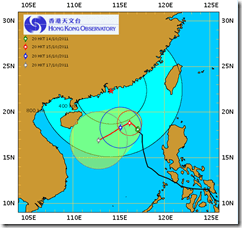
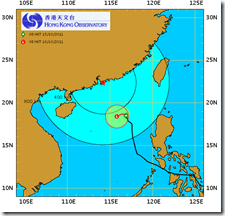
Tropical storm Banyan is heading for Hong Kong….it’s heading to Vietnam…oh no, it isn’t…and now it’s a low pressure area.

It's not big and it's not clever, it's just a Brit in Hong Kong writing (mainly) about Hong Kong
Tropical storm Banyan is heading for Hong Kong….it’s heading to Vietnam…oh no, it isn’t…and now it’s a low pressure area.
The Book Depository is a UK-based website that offers a decent alternative to Amazon for international customers. Anyone who has ordered books from Amazon will know that international delivery charges are prohibitive, with the possible exception of expensive books that are reduced by 50% (or more). The Book Depository don’t charge extra for delivery, and although they do charge customers outside the UK more, their prices are still normally quite reasonable (typically a discount of around 10% on cover prices), especially compared to the 20% markup that usually applies in Hong Kong.
The question is whether that will change if Amazon are allowed to acquire The Book Depository. They made an offer, which has been accepted by the company, but it has been referred to the Office of Fair Trading.
From The Bookseller:
The Office of Fair Trading has said it now expects to announce its decision on the Amazon takeover of The Book Depository by late October.
On a notice posted on its website this morning (19th September), the OFT said the expected decision date on the merger is 24th October. The decision was originally due on 2nd September. An OFT spokesman gave no specific reason for the delay but added: "In general it can be because some cases are more complex than others, some require more information from the parties or the OFT needs time to analyse the data . . . No inference should be made about the likely outcome of the case."
Amazon announced the deal with The Book Depository in July. The Booksellers and Publishers Associations, the Independent Publishers Guild and the Bookseller Group all oppose the merger.
Given that company appears to be doing well (Book Depository's sales rise 20%) and Amazon is already so dominant, one might think that there would be grounds for blocking the deal on competition grounds.
If it does go through, will Book Depository continue to operate independently and offer a better deal to overseas customers than Amazon? I guess we just have to wait to find out.
UPDATE 2: Amazon closes down Book Depository

Amazon now have a “Kindle Daily Deal”: one title at a reduced price, usually at $0.99 or $1.99, for exactly 24 hours.
So far, so good.
Except for readers outside the United States. Sometimes the title is simply not available, which is quite annoying, and sometimes we are allowed to buy it – but only at a higher price.
Not just the ridiculous $2.00 extra charge for nothing (I don’t have a Kindle 3G, so the cost of delivering a title to me in Hong Kong through the Internet is the same as delivering it to a customer in the US).
No, today’s Kindle Daily Deal is less than $2 for US customers but a whopping $11.20 for those of in the rest of the world. Which is even more expensive than yesterday’s price ($9.99). So I don’t think we are saving 44%:

The problem with the “debate” about the ESF on the letters page of the South China Morning Post is that most of the correspondents stick to whatever is their chosen line of argument, and fail to engage with their opponents. Here’s a prime example (from Thursday):
ESF must accept level playing field
Letters in support of the English Schools Foundation's (ESF) subvention are written characteristically without regard to relevant facts and their moral significance.
Good start.
Jonathan Leung ("ESF schools contribute to international character of city", September 5) omits the fact that 35 per cent of the ESF's subsided places are occupied by selective non-residents who are not entitled to public subsidies.
Really? 35% of the students are not Hong Kong residents? Or not permanent residents? All Hong Kong residents have to pay tax, and their children are entitled to attend government schools and DSS (Direct Subsidy Scheme) schools. Oh, and the ESF website says “About 70% of [ESF] students have parents who are permanent residents of Hong Kong”.
Despite his predilection for "international" character, he seems unaware that international norms censure linguistic discrimination such as that perpetrated by the ESF, and which is outlawed in all native English-speaking countries.
We could really end the letter here. Cynthia Sze (and others) simply object to the idea of having schools that give priority to non-Cantonese speakers. It’s easy to make that sound outrageous until you consider that English is an official language of Hong Kong, and the local school system is (unsurprisingly) designed to cater for Cantonese speakers, and so that’s why we have the ESF. And although a large number of Cantonese-speaking students still find their way into ESF schools there are plenty of parents who are outraged that their children weren’t granted an interview – or worse, were not offered a place.
Richard Di Bona's complaint about the government not providing adequate educational opportunities in English, an official language, shows his disregard for Hong Kong's internationally acclaimed universal education ("ESF fills role government should play", September 2). English is the medium of instruction of many local schools. Local secondary graduates readily gain admission to native English-speaking universities overseas and satisfy their language requirements.
Local schools prepare students for public examinations which are markedly more stringent than the overseas exams taken by ESF students. That's why ESF students don't take local exams whereas local students readily take overseas exams.
ESF students take the IGCSE and IB Diploma examinations. Not English GCSEs and A levels.
The ESF's popularity is due largely to its extraordinary staff benefits and unusually student-friendly programme. Its hyped "international" appeal is warped and vacuous. Social justice requires that the ESF, a subsidised institution, must align its staff benefits and admission practice fairly with social norms.
Mr Di Bona should realise that the English which the Basic Law provides as an official language is local English and not native English, just like Cantonese, which is local Chinese, is the de facto official Chinese language of Hong Kong. If local English fails to become socially functional like Singlish in Singapore, the use of English as an ancillary official language will decline naturally and should discontinue in 2047.
Good plan. Teach students “local Hong Kong English” (which isn’t very useful) and then we can drop it as an official language.
Hong Kong will always be Cantonese-speaking because the Chinese are not hegemonic like the English who have obliterated the Celtic and the Romance languages in Britain. Promotion of native English will render Hong Kong an accomplice in the hegemony of the English language. We need a unified language policy for minorities of various mother tongues.
I see. So China isn’t trying to promote Putonghua as the national language to replace local dialects. And someone should tell her how much government funding is provided to support the Welsh language.
The objective of public education is to promote social coherence which can't be achieved if we continue the divisive policy of the bygone colonial administration and segregate our students into local English schools, native English schools, schools for non- native English-speaking minorities, and so forth.
Cynthia Sze, Quarry Bay
A mischievous sub-editor put this next letter immediately after Cynthia Sze’s diatribe:
Puzzled by opposition to English
As a non-native English speaker I am often baffled by the anti-English sentiments in some quarters of Asia's world city.
Furthermore it is fascinating to see that while English has an aura of "cool" to youngsters all over the world (including mainland China) this does not seem to be the case here.
I foresee that in 10 years' time the whole world will speak (a sort of) English except for one pocket in the southeast of China: Hong Kong.
Josephine Bersee, Mid-Levels
Strange article in today’s (new improved $8) SCMP:
Point of no returns
Peter Guy
Aug 22, 2011Recent events have created sharp market declines and volatility, tempting investors to put their investment ideas to work through exotic products like leveraged exchange-traded funds (ETFs).
[..]
A leveraged ETF is repositioned at the close of market, which means the fund provider will rebalance the assets to align the fund with the new shape of the market. This is done for logical reasons. The provider promised to provide leverage returns and it must take positions – adjusted daily – for it to pay out on this commitment. It cannot be caught out if the market moves against it. But, every time the oil index drops, the base for returns also falls. The leveraged basis for returns is greater on the downside than it is on the upside.
Let’s take the example of a three-times leveraged long ETF linked to an oil index. Say the oil index falls 5 per cent in a single day. An initial HK$100 investment in the ETF would take that 5 per cent drop and multiple it times three, for a loss of 15 per cent (or HK$15).
The ETF is now worth HK$85. Say the oil index then goes up 5 per cent, back to its original level. The investor is entitled to a leveraged 15 per cent gain, but now the base for calculations is HK$85. Fifteen per cent times HK$85 is HK$12.75, leaving the fund with a value of HK$97.75, and the investor out of pocket by HK$2.25.
Er, excuse me, but if oil goes down 5% and then up 5% it most definitely does NOT go “back to its original level”. That’s very basic stuff for “a former investment manager with 15 years’ experience” to get wrong.
A perfect pop single (if they still have such things).
Is he upset about something?
We must smash the hoax that English is indispensable for success in HK
South China Morning Post, Wednesday July 27 2011
Sam Wong rightly observes that the city's middle class is generally against English Schools Foundation subvention ('Government must end ESF subsidy', July 21). Opposite opinions in the debate expose prejudice and insecurity.
Reuben Tuck ('English has always been an integral part of Hong Kong's international trade', July 20) claimed that the city 'was built, from the beginning, on international trade, much of it British and most conducted in English'.
A 1908 document of the colonial office held that the opium trade was Hong Kong's “raison d’être, and was controlled by a few large trading firms with strong political support in the United Kingdom. To interfere with their activities would have threatened the very foundations of the colony.”
Like opium, the English language isn't indispensable. Long after English recedes to its rightful place as a minority language in Hong Kong, the city without 'native English' pretending as the language of masters will continue to be multiracial, welcoming foreigners on reciprocal terms.
Mr Tuck mistook Cynthia Sze's caution against overplaying the importance of the English language as a call to remove foreigners ('If English is so important, firms should move to Belfast or Glasgow', July 15). He failed to realise that many expatriates don't enjoy speaking English and that those with substantive abilities don't need English to excel. Only those with English-speaking skills as their only specialty are afraid of the call to de-emphasise English.
Uncompetitive expatriates need subsidised education. They hardly pay any tax. Expatriates who pay tax should consider the levy as payment for the right to work, just like America's worldwide tax which offshore residents pay for the right to live in the US, and not for any exclusive right.
Mr Tuck referred to Amy Ho, a recruitment specialist who urges the city to employ downsized western banks' redundancies ('Making Hong Kong a home for talent', July 15).
Why are we supposedly deficient of banking talents and in need of sourcing downsized ex-bankers from the breeding grounds of financial upheavals, despite our internationally acclaimed students and universities, and the long history of major international banks' operations in the city?
To become a real international financial centre like Switzerland, we must develop our own financial institutions based on the natural strengths of local talents and smash the hoax that the English language is indispensable for success in all endeavours.
Pierce Lam, Central
So many things to love about a letter written in English to an English language newspaper by someone who uses an English name… random historical references, absurd generalizations and the rather splendid idea that multi-lingual Switzerland should be our role model.
Last year I highlighted the appalling delays on flights between Shanghai and Hong Kong, but things have improved – as the SCMP belatedly reports
Authorities give Cathay Shanghai connections a lift
Surprise boost to air traffic flow shows what officials can achieve with determination, says airline chief
Anita Lam
Jun 29, 2011The number of on-time Cathay Pacific flights between Hong Kong and Shanghai has risen more than sixfold in the past seven months after mainland authorities introduced a new air traffic control policy, the airline's chief executive said yesterday.
At a lunch to lobby support for Hong Kong International Airport building a third runway, John Slosar said the improvement illustrated how efficient mainland officials could be when they put their minds to resolving important issues – such as freeing up the mainland's congested airspace.
"One day in November, I was looking at the on-time performance rate for China, and it suddenly went way up, to 65 per cent. A few months earlier it would have been 10 per cent," he said.
"China is interesting in that way: they don't tell us about things [beforehand] – they just happen."
I can’t imagine why Slosar thinks that the change happened in November. If so, why were things still bad in early-December? Of course, you might think that the SCMP would have their reporters covering the story and know when things improved…
Incredibly stupid story from the SCMP. Now TV have purchased the rights to the Rugby World Cup and will be charging viewers between nothing and HK$388 to watch the tournament. Well, what did anyone expect?
Broadcaster tells home viewers and publicans they will have to pay more to watch code’s flagship event
John Carney
Jun 11, 2011Rugby fans and publicans are angry over PCCW’s plans to televise this year’s Rugby Union World Cup after learning they will have to pay extra for the privilege of seeing it.
It was one of Hong Kong sport’s worst-kept secrets that PCCW had the rights to broadcast the World Cup on Now TV and yesterday the broadcaster said it would screen the tournament, which will take place in New Zealand from September 9 to October 23, on Now TV channel 686, with four deals available.
There is a one-off package fee of HK$388 or an early-bird offer of HK$288 for those subscribing before June 30. Existing customers who just have the Setanta Sports Channel, and not PCCW’s full Mega Sports Pack, can pay a one-off HK$198, while new or existing customers who have the Mega Sports Pack can get the event free but only if they extend their current contracts for another 18 months.
Now TV will be running an advertising campaign on its channels from today to promote the new deal. However, critics say PCCW is only using the competition to make some quick cash out of rugby fans.
"This tournament only goes on for six weeks and the first three weeks’ play isn’t worth watching," teacher Brian Hastings said. "No one in their right mind is going to subscribe for this."
Accountant Denis Browne agreed, saying: "PCCW must think we are all stupid if they think rugby fans here will spend their money on this. I’ll just go to the pub and watch the games."
However, pubs will also have to pay a commercial fee to show the matches on their premises. The fee has yet to be announced, but bar owners are fed up with having to pay regularly for particular sporting events like this.
"This is a complete joke," said Noel Smyth, publican of the Dublin Jack in Lan Kwai Fong. "Just to show Setanta Sports Channel that’s on Now TV costs us an extra HK$1,000 a month. Now it’ll be the same for a competition that will last for only six weeks. It’s like PCCW has a licence to print money."
PCCW’s Now Sports vice-president, Lai Yu-ching, denied the allegations and said the company had done its utmost to provide customers with the best possible deal.
"Initially we had hoped that the World Cup could be shown on the Setanta Sports Channel free of charge, but this did not happen," he said. "We then had to negotiate with the International Rugby Board. We’re unlikely to make a profit, but we were determined to televise the event, as there are so many rugby union fans in Hong Kong."
The 2007 World Cup was broadcast by Cable TV and Lai said that the rival broadcaster had been in the running for the 2001 rights.
"As far as I’m aware, Cable TV also put in a bid to buy the television rights for it in Hong Kong as they know how popular the sport is here," he said. "But our deal proved to be a better one than theirs."
I’m a bit late with this, but good to see that Australia is doing something constructive to dissuade people from smoking:
Ignore big tobaccos absurd fight against plain packs
New Scientist 02 May 2011 by Simon Chapman
Australia's bold plan to remove all branding from cigarettes and their packaging is a triumph for public health
EARLIER this month the Australian government released draft legislation that promises to be a landmark in the global fight against tobacco. If passed, from January 2012 cigarettes and hand-rolling tobacco will have to be sold in plain, unappealing olive-brown packs plastered with large, graphic health warnings. The only thing distinguishing one brand from another will be the name written in a standard font on the top, bottom and front of the pack, below the health warning. This is a world first.
The legislation also proposes that cigarettes themselves should be completely plain. That means no branding, no coloured or flavoured papers, no gold-banded filters and no different gauges like slimline and mini cigarettes.
With this bill, the Australian government is sending out an unambiguous message that cigarettes are exceptionally dangerous. Future generations will grow up never having seen the finely crafted elegance of a cigarette box sitting alongside confectionary and groceries in their local shop.
 Ordinary Gweilo