• Top work by Now TV. They had the final of the French Open live (and in HD), and they showed the after-match interview with (runner-up) Francesca Schiavone, and then cut away to an advert break before (winner) Li Na got to speak.  They returned in time for several minutes of waffle by the commentators before the presentation of the trophies.

    Two points here:

    1. Li Na is the first Chinese winner of a grand slam tennis tournament.  Ever.
    2. The adverts were for other channels on Now TV.

    Also, and I know this is not Now TV’s fault, but someone should tell the director that having the camera swooping in from far away to focus in on the server at the start of every game is just not clever.  It’s annoying.

  • The French cheese market in Tsim Sha Tsui turns out to be rather less spectacular than advertised:

    Come savor and buy over two hundred types of cheeses at the beautiful Hullett Courtyard, in traditional French-market style–the first time these were ever brought to Hong Kong!

    Actually a small room in a small hotel, with a couple of tables loaded with French cheese.  All nominally priced at HK$48 per 100g, which is pricey, but this actually seems to translate into HK$48 for each piece of cheese (even if weighs a bit more than 100g).

    No name labels on the cheese (beyond the name of the animal), and generally a bit chaotic, but they do have good quality cheese that is very much fresher than anything you can buy in local supermarkets.

  • Small mistake in the news highlights email that the SCMP send out every day:

    image

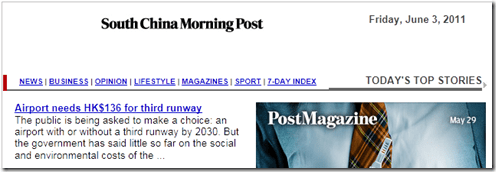
    I think that should be HK$136bn

  • Congratulations to AFC Wimbledon.  Nine years ago, the Football League allowed the owners of Wimbledon FC to move the club to Milton Keynes.  The fans set up their own club, but they had to start in the Combined Counties League.   Five promotions later they are in the Football League:

    AFC Wimbledon beat Luton on penalties to reach the Football League

    As football’s reputation continues to be tarnished by soaring debt, political scandal and superinjunctions, proof is needed that the sport retains a soul. Step forward AFC Wimbledon. Under dark Manchester skies, the club formed by supporters for supporters produced a golden moment on Saturday, overcoming Luton on penalties to win the Blue Square play-off final and seal their place in the Football League.

    "It only took nine years," bellowed the delirious fans in blue, moments after Wimbledon’s captain and top scorer, Danny Kedwell, had crashed in the spot-kick that gave his team a 4-3 victory following the 120 minutes of stalemate. The chant rose in volume and fervour from the end where the drama had eventually unfolded and told of the story that has captivated football romantics.

    It’s hard not to feel sorry for Luton fans.  Their club suffered three successive relegations – from the Championship through Leagues One & Two to the Blue Square Premier, in part because of points deductions imposed by the Football League for financial irregularities. 

  • From today’s re-designed SCMP:

    Facebook does have some risks

    Facebook has become popular globally.

    It can benefit people as it enables them to chat with friends and it can help them to relax.

    However, it does have some drawbacks. Some people will misuse it and internet users should take care when communicating with strangers. They should think about what information they disclose online. Also, students must avoid becoming obsessed with Facebook. If they stay up late, it could affect their performance in school.

    Cecilia Yeung, Kwai Chung

    Er, thanks for that good advice.

  • Ah, the FA Cup Final.  Used to be the only club game played at Wembley, and the only one that was live on TV.  Now we have the FA Cup semi-finals at Wembley, play-off finals, the League Cup, the Charity Community Shield and I don’t know how many other matches played there.  And hundreds of games live on TV.

    There was a time when winning the FA Cup was also special because it provided entry to the Cup Winners Cup, but today it gives entry to the interminable Europa League, and the place usually goes to the runners-up (when the FA Cup winners are a big club who have qualified for the Champions League).

    It also used to mark the end of the football season, but now we always have play-off finals after the FA Cup final, and this year there’s another set of Premier League fixtures coming up  next weekend – but worse than that we actually have four Premier Leagues matches being played at lunchtime today, including the game that will most likely see Manchester United being confirmed as champions, so you could argue that the FA Cup Final isn’t even the biggest game being played today.

    Still, at least we have “It’s a Cup Final Knockout” on BBC One.  Surely?

    Er, no:

    1.30 pm Cash in the Celebrity Attic
    2.15 pm Bargain Hunt Famous Finds
    3.00 pm Father of the Bride
    4.40 pm Don’t Scare the Hare
  • An odd article in the SCMP about Cathay Pacific possibly introducing Premium Economy:

    Cathay eyes roll-out for new cabin class

    An option of 'premium economy' seats likely to be ready by end of the year

    Anita Lam
    May 09, 2011

    The remodelling of Cathay Pacific's business-class seats is completed and the airline is hoping to finalise the roll-out of new "premium economy" seats by the end of this year. The new cabin class announced last year aims to offer an option for passengers wishing to trade down from business class – for reasons of cost-cutting – as well as those who don't want economy class.

    Remodelling is completed?  But only a handful of planes have the new seating (as they confirm later in this same article), and I don’t think they’ll complete the rollout this year.scan0001
    Details of the new seating configuration have not yet been revealed, but people familiar with the situation said the new seats would be 20 to 30 per cent larger than existing economy seats in terms of floor area. The cheapest seats of Hong Kong's flag-carrying airline are 44cm wide and rows are spaced 81cm apart in the economy section. With an enlargement of 25 per cent, the width and so-called seat pitch will be roughly 53cm and 1 metre respectively.

    That will put the seats in line with, if not better than, the same class of seats offered by other airlines such as Virgin Atlantic and British Airways.

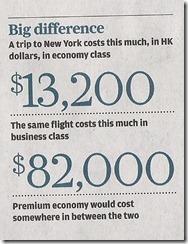
    But this is all speculation -  "20-30% larger" is incredibly vague, and does anyone expect Cathay to offer anything very different to BA or Virgin?   Then there’s one of those stupid number boxes telling us the Premium Economy fare to New York will be between $13,200 and $82,000.  Well, yes, it probably will.  But more likely it will be in the range of HK$20,000 – HK$25,000.

    Cathay Pacific chairman Christopher Pratt said earlier he hoped the new seats could be rolled out by next year to capture a clientele looking to trade down from business class, and those who don't want to be in economy class, because despite a return in passenger traffic and prices for business class, passenger yield had yet to return to 2007 levels.

    At a ceremony to mark the reception at Boeing's delivery centre in Seattle last month of a 777-300ER – the third aircraft fitted with Cathay's latest business-class seats – the airline's chief executive, John Slosar, said four seats were cut to make the new product more spacious. But he said the sacrifice in space would be rewarded by a higher loading.

    The reviews I have read say that the new seats don’t provide any extra space, but just a different configuration.  However, the SCMP reporter has no doubts:

    A test of the new business class cabin by a South China Morning Post reporter confirmed that it is not only wider but also more comfortable than the cabin it will replace, particularly its sleeping configuration, which is more spacious.

    The new seats enable passengers to look out of their windows without the need to turn their heads at a right angle, and the two middle seats are angled towards each other, allowing travelling couples to be closer. Passengers wanting more privacy can use a cabin door equipped with a mirror as a partition.

    Attention is also paid to finer details.  The new seats have a recess at their base which may be used as a step to help smaller air hostesses and passengers to load and unload luggage from their overhead racks. Small lights next to the recess are intended to alert cabin crew during take-off and landing that the seats have not been fully restored to the upright position.

    OK, the steps are a clever feature, but where's the objectivity?
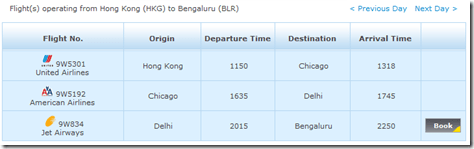
  • I’m not keen on the Dragonair flight from Hong Kong to Bangalore, but I can’t help feeling that it may have some advantages over this option from Jet Airways:

    image

    I’m thinking that it doesn’t take 1 hour from Chicago to Delhi.  So that would be the next day.  Surely there’s a faster way from Hong Kong to Delhi…

  • Cory Doctorow in The Guardian (How do you persuade people to pay?) on the muddled strategies of the entertainment industry:

    The seemingly straightforward act of purchasing a good or service is fraught with mystery […] and the complexity is multiplied by purchases in the digital world. In the physical realm, there’s real danger in taking a good without paying for it (you might be arrested and sent to jail); in the digital realm, that danger is much lower. So much lower, in fact, that the majority of media that changes hands online does so for free and without authorisation.

    This fact has occasioned much hand wringing, hair pulling, and legal manoeuvring, and a great deal of rhetoric about why the public "should" buy stuff they can readily get for free.

    This rhetoric is often muddy and confused, and at odds with the strategies deployed by the companies and individuals who employ it. For example, the ads shown before film exhibitions and DVDs warn that pirate DVDs are of poor quality and may not play back reliably. At the same time, the manufacturers of DVDs have been going to ever-greater lengths to degrade the quality of legitimate video purchases – lengthy, unskippable adverts; arbitrary geographic playback limitations; even the mandatory installation of "anti-copying" software that hijacks your PC to stop you making an unrestricted copy of the movie.

    [..]  I often hear from parents who download unauthorised cartoons for their kids because the DVDs come with long, unskippable (or difficult-to-skip) adverts, the worst of which deploy "pester power" tactics intended to get kids to nag their parents to buy something. As far as these parents are concerned, spending money gets them a product that much worse than the free version.

    Well, indeed, and in Hong Kong we often get noisy and irritating propaganda messages that are supposed to persuade us to buy legitimate DVDs.  Whereas the illegal download cuts straight to the chase. 

    I notice that Disney are now marketing something called “Easy DVD”.  Could this be a step in the right direction?  I don’t know, because it is only available in Chinese – and if I read the label correctly it is only in 4:3 format so it doesn’t look promising,

  • Another piece of well-argued rhetoric from Pierce Lam in the SCMP.  Hemlock argues back here.

    Official status of English in HK is ancillary

    I refer to your one-sided editorial ("Worrying language trend in press release", March 28).

    The use of English for official purposes is governed by the Basic Law (Article 9) which does not provide the English language a full official status, but only that it "may also be used" as an official language. The purposeful "may also be" stipulation is meant to limit the use of English to only where it is appropriate. The English language’s official status is ancillary; it must not be misconstrued to rank pari passu with the Chinese language.

    English stays as an ancillary official language for historical reasons that are fast becoming irrelevant, and not because it is essential for Hong Kong’s development. The Chinese language is fully capable of sustainable development for effective use for all human endeavours. For example, anyone who has read mainland universities’ Chinese translations of English legal textbooks will appreciate the versatility of the Chinese language.

    Demographically, Hong Kong is predominately Chinese, comprising 95 per cent of Chinese, about four per cent of foreign domestic helpers and expatriates from non-English-speaking countries, and one per cent of native English speakers. It is ridiculous for any city with Hong Kong’s high degree of homogeneity to embrace the mother tongue of its one per cent foreign minority as a development strategy.

    Its foreign population is comprised of migrant workers who are here for economic reasons. They will depart if better economic opportunities can be found elsewhere.

    Those who stay should adopt the language of the people who give them the best opportunities of their lives. Native English-speaking residents should be grateful for the special administrative region’s bilingual policy which is much more generous than is needed for Hong Kong’s developmental need.

    A comparison of historical developments of foreign languages in homogenous Chinese communities shows that the English language has never attained in Hong Kong the kind of social acceptance as the Japanese language in pre-war Taiwan. Hong Kong people have resisted thorough immersion in the English-language milieu. No responsible government of a highly homogenous community would enforce the popularisation of a foreign language.

    Hong Kong is ill-advised to pursue "international" goals through the use of the English language.

    In the European Union, English is rightly recognised as a national language without any international pretension or advantage over other languages. In the Americas, where the use of English is confined to Canada and the US, English can’t even claim to be a trans-continental language, let alone an international language.

    Hong Kong people have no obligation to support the status quo where English unfairly dominates in all professional fields. They have every reason to develop and promote the use of their mother tongue both locally and internationally.

    Pierce Lam, Central