Ordinary Gweilo

It's not big and it's not clever, it's just a Brit in Hong Kong writiing (mainly) about Hong Kong

  • I see that City Super is 15 years old.  Back when they started (the first branch was in Times Square), there were the two big supermarket chains (Park’n’Shop and Wellcome), a couple of branches of Olivers, and the food hall in Hong Kong Seibu.

    Now Park’nShop have a whole range of sub-brands.  Great in Pacific Place is a one-off (in the space that was previously the Seibu food hall in Pacific Place, and with prices to match). The original Taste was in Kowloon Tong, but there are now several more around Hong Kong, and they offer a much bigger selection than the average PnS supermarket.

    I’m not sure that I understand the difference between Taste and Fusion, but maybe the former is more aimed at foreigners and the latter more at locals.  Or perhaps it’s just that the Fusion stores are smaller?  Too confusing, lah.

    Then we come to International.  This seems to be basically a normal ParknShop with more imported products, and annoying shelf labels proudly reminding you that those Italian tinned tomatoes come from Waitrose in the UK.  Er, thanks.

    There’s also Gourmet.  What’s that, then?

    Meanwhile, the Dairy Farm group (Wellcome) now have Marketplace by Jasons for some of its more upmarket locations, and a couple of branches of ThreeSixty (with an emphasis on expensive organic stuff) and just the one Olivers.  Thirty years old, apparently.

    Which is all very well, but who can afford to pay the prices in Olivers, ThreeSixty, Great, and CitySuper?  Very ordinary products are sold at double or triple the price you would pay in a UK supermarket.  I can understand high prices for premium products, but not everyday stuff being sold at ridiculous prices.

    But at least we do have more choice.

  • Identical, but from UPS…

    Dear customer.

    The parcel was sent your home address.
    And it will arrive within 7 business day.
    More information and the tracking number are attached in document below.

    Thank you.
    © 1994-2011 United Parcel Service of America, Inc.

  • Three spelling mistakes and poor grammar.  And sent to an email address I never use.

    Dear customer!

    The parcel was send your home address.
    And it will arrice within 7 bussness day.
    More information and the tracking number
    are attached in document below.
    Thank you.
    2011 DHL International GmbH. All rights reserverd.
  • The MTR have started painting feet on the escalators to show passengers where to stand (yes, really), and it seems that they are now encouraging people to stand still rather than walking up or down in that reckless way favoured by some:

    Smiley®World Character dressed as Penguin to Promote Escalator Safety

    MTR cares about your every journey. To enhance awareness of escalator safety, the Smiley®World character is back as a MTR ambassador with a new look to remind passengers how to ride the escalator safely to ensure a smooth and pleasant journey.

    This time, the Smiley®World character appears as a penguin to encourage passengers to "Hold the handrail and stand still". Passengers are also reminded to "Stand still and keep away from the edge" when riding the escalator.

    Through this Escalator Safety Campaign, MTR hopes that the smiley penguin will not only put a smile on your face, but also remind passengers how to ride escalators safely.

    Smiley®World?  Penguin?  What’s going on?  There has been a flurry of correspondence in the SCMP:

    Pointless plea on escalators

    As we go up and down MTR escalators, the public address system dins in our ears that we should, "Please hold the handrail."

    Holding the handrail is what people instinctively do if they are in danger of losing their balance; I have never seen or heard of accidents occurring because they are not held. Therefore, there is no need to constantly remind us to do so.

    An exhortation much less frequently heard on escalators, if heard at all, is that passengers should "stand on the right". That in contrast is something people do need to be reminded of, or if they are strangers to orderly society, to be informed about.

    It seems to be more the rule than the exception for couples or knots of people to occupy both sides of the escalator, so blocking the way of others who might be in a hurry, or just want exercise.

    If the benefit of the travelling public, rather than self-protection, were top priority for the MTR Corporation, we should hear far less about holding handrails and far more about standing on the right.

    David Pollard, Tai Po

    And another a couple of days later:

    Puzzling policy change by MTR

    I read the letter from David Pollard ("Pointless plea on escalators", February 7) with interest and probably about the same level of confusion as he has, although on a different note.

    I have noticed for some time that the MTR Corporation has been focusing on asking people to hold the handrail, but with the addition of asking passengers not to walk while on the escalator.

    I have wondered if the MTR Corp is trying to move away from the original "stand on the right and walk on the left", by hoping people will just stand and not walk on the escalators at all.

    I am sure there are safety reasons for this, and have certainly noticed that some escalators now have painted feet on the treads so that we stand and are not tempted to walk.

    It is a bit confusing to Hongkongers who have been used to one way, and then have it changed without it being explicitly made clear.

    Perhaps the MTR can comment further.

    Callan Anderson, Quarry Bay

    Never fear, we have Peter Lok to tell us that we foreigners should do as we are told:

    Aim is to avert serious accident

    David Pollard’s view on MTR announcements is outmoded ("Pointless plea on escalators", February 7).

    The latest advocated practice is no longer to stand on the right and let those in a hurry overtake, but for everybody to stand still and hold the handrail, so as to prevent the domino effect of people piling onto those in front in the event of a sudden stoppage of the escalator.

    Especially on a long downward stretch, such as the one leading from the Taikoo Shing shopping mall to the MTR station, the result of someone not holding the handrail while being shot forward in the event of such a stoppage could be disastrous.

    The plea is therefore, "Do not walk" as well as, "Hold the handrail". So, Mr Pollard, when in Rome, please do as the Romans.

    Peter Lok, Chai Wan

    But if this is the new policy, the MTR could at least make it completely clear.  Surely that wouldn’t be so difficult?  And maybe treat us like adults, eh?

  • The iPad 2 will be "thinner, lighter and will come with a faster processor, more memory and a more powerful graphics processor."  Right.  If it was thicker, heavier or slower that would be news.

    I still don’t want one, though I realize that resistance is futile and one day I will succumb.

  • Wishing you a happy and prosperous Year of the Rabbit.

    Yes, I'm still here..


  • So it’s Russia in 2018, and, er, Qatar in 2022.

    There has been entirely predictable outrage in England about the failure of the World Cup bid. Apparently some delegates promised they would vote for England, but then voted for someone else! Well, who could possibly have expected that?

    The Sun (predictably) has another angle: It’s a fix – Russians knew World Cup bid result, because when the same delegates told the Russians that they were voting for them, they were telling the truth

    There has been criticism of the Sunday Times (for exposing the willingness of some FIFA delegates to accept bribes) and the BBC (for reporting that other FIFA delegates had taken bribes in the past). Prior to that, Lord Triesman was recorded by the Daily Mail repeating rumours about other naughty things done by Johnny Foreigner.  And those foreign FIFA delegates didn’t vote for the English bid.  Life really is full of surprises.

    Then Qatar won the right to stage to 2022 tournament. Why would FIFA want to stage the World Cup in a tiny but incredibly wealthy state. Oh, right…

    Surely it is now time for the English FA to stop wasting time and money on World Cup bids. The money they spent on this one would have been much better used on projects that would bring immediate benefit and maybe even give England a chance of winning the trophy. 

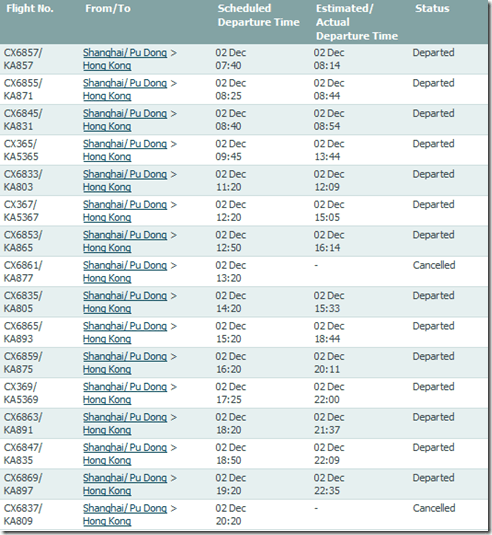
  • Cathay Pacific and Dragonair yesterday – Hong Kong to Shanghai. Two cancellations, and delays of 2-3 hours on most flights in the afternoon, and even worse coming back to Hong Kong, with delays of 3-4 hours:

    imageimage

  • So the Beatles catalogue is finally available from the iTunes music store. Which is all very exciting. Or maybe not…

    OK, there might be a few people with iPods who haven’t worked out how to place their Beatles CDs into the CD drive of their computer and then import them into ITunes. It’s really not that hard, but maybe some people can’t manage it.

    There might even be a few Beatles fans who haven’t got round to buying the albums 30+ years after they came out, but who would like to have them on their iPods. Or who just want to buy "Hey Jude".

    But it’s certainly not big news for people in Hong Kong, because we still don’t have access to the iTunes music store.

    Which begs another question: since it is now ridiculously easy to download any music you might want without paying for it, all this announcement really means is that people now have a way to pay. And pay rather a lot, with individual tracks priced at $1.29 and albums at $12.99.

    I really don’t understand this pricing. If I buy a physical CD (or a book) it has to be manufactured, it has to be shipped to the retailer (who has to pay rent and salaries), etc., etc. But the marginal cost of an MP3 (or the proprietary Apple format) is effectively zero. Likewise the cost of a Kindle "book".

    In a world where items that cost nothing to produce are available free, what is the logic of having a high price for those who choose to pay, and why make it so difficult to buy?

    Yes, I know there are ways to buy music from the iTunes store, and I’m sure that it’s possible to get around the restrictions that make some titles for the Kindle unavailable in Asia Pacific, but why should I bother? If they don’t want my money, then that’s their problem and not mine.

    See also this earlier post on a similar subject

  • It amazes me that cities are still so keen to stage events such as the Olympics.  Far from increasing the number of visitors it actually drives them away.  Hotels put up their prices and most people assume that flights will be either unavailable or very expensive, so they go somewhere else.  Locally we had this nonsense for the handover – hotels started out offering rooms at ridiculous prices, then cut prices and finally found out that they couldn’t fill their rooms whatever they did. 

    Here’s a warning about the likely effect on London of the Olympics in 2012. 

    ‘Toxic’ Olympics effect may hit UK visitor numbers, warns tourist body

    The trade body representing tour operators has warned that expectations of a boost in tourism from the London Olympics may not be met, after unveiling research that suggested previous games had a "toxic" effect on visitor numbers. The European Tour Operators Association, which held a seminar on the subject today, released research that showed previous hosts had invariably overestimated the number of foreign visitors and the duration of their stay.

    The Sydney games in 2000 anticipated 132,000 visitors and received 97,000 for the games period, while Athens hoped for 105,000 per night in 2004 and received fewer than 14,000. In 2008, Beijing anticipated more than 400,000 foreign guests and received 235,000 for the whole month of August.

    The average number of hotel beds occupied in Beijing during the Olympics was 39% down on the previous year, the ETOA report showed. It said that while the Beijing Games may have been a "triumph of planning and showmanship", for the tourism industry they were a "toxic event that crushed normal demand, both business and leisure". The report said that while tourism chiefs and organisers had recognised that the Olympics would create some displacement, with visitors arriving for the games replacing those put off by the fact it was taking place, they still tended to talk in terms of a large overall boost.

    Will people ever learn?