• So the Beatles catalogue is finally available from the iTunes music store. Which is all very exciting. Or maybe not…

    OK, there might be a few people with iPods who haven’t worked out how to place their Beatles CDs into the CD drive of their computer and then import them into ITunes. It’s really not that hard, but maybe some people can’t manage it.

    There might even be a few Beatles fans who haven’t got round to buying the albums 30+ years after they came out, but who would like to have them on their iPods. Or who just want to buy "Hey Jude".

    But it’s certainly not big news for people in Hong Kong, because we still don’t have access to the iTunes music store.

    Which begs another question: since it is now ridiculously easy to download any music you might want without paying for it, all this announcement really means is that people now have a way to pay. And pay rather a lot, with individual tracks priced at $1.29 and albums at $12.99.

    I really don’t understand this pricing. If I buy a physical CD (or a book) it has to be manufactured, it has to be shipped to the retailer (who has to pay rent and salaries), etc., etc. But the marginal cost of an MP3 (or the proprietary Apple format) is effectively zero. Likewise the cost of a Kindle "book".

    In a world where items that cost nothing to produce are available free, what is the logic of having a high price for those who choose to pay, and why make it so difficult to buy?

    Yes, I know there are ways to buy music from the iTunes store, and I’m sure that it’s possible to get around the restrictions that make some titles for the Kindle unavailable in Asia Pacific, but why should I bother? If they don’t want my money, then that’s their problem and not mine.

    See also this earlier post on a similar subject

  • It amazes me that cities are still so keen to stage events such as the Olympics.  Far from increasing the number of visitors it actually drives them away.  Hotels put up their prices and most people assume that flights will be either unavailable or very expensive, so they go somewhere else.  Locally we had this nonsense for the handover – hotels started out offering rooms at ridiculous prices, then cut prices and finally found out that they couldn’t fill their rooms whatever they did. 

    Here’s a warning about the likely effect on London of the Olympics in 2012. 

    ‘Toxic’ Olympics effect may hit UK visitor numbers, warns tourist body

    The trade body representing tour operators has warned that expectations of a boost in tourism from the London Olympics may not be met, after unveiling research that suggested previous games had a "toxic" effect on visitor numbers. The European Tour Operators Association, which held a seminar on the subject today, released research that showed previous hosts had invariably overestimated the number of foreign visitors and the duration of their stay.

    The Sydney games in 2000 anticipated 132,000 visitors and received 97,000 for the games period, while Athens hoped for 105,000 per night in 2004 and received fewer than 14,000. In 2008, Beijing anticipated more than 400,000 foreign guests and received 235,000 for the whole month of August.

    The average number of hotel beds occupied in Beijing during the Olympics was 39% down on the previous year, the ETOA report showed. It said that while the Beijing Games may have been a "triumph of planning and showmanship", for the tourism industry they were a "toxic event that crushed normal demand, both business and leisure". The report said that while tourism chiefs and organisers had recognised that the Olympics would create some displacement, with visitors arriving for the games replacing those put off by the fact it was taking place, they still tended to talk in terms of a large overall boost.

    Will people ever learn?

  • The combination of the lower price and improved contrast won me over.  After thinking about buying one of the earlier Kindles but never quite being convinced that it  was a good idea, I really couldn’t resist the new Wi-Fi only model at US$139 (plus US$21 for delivery to Hong Kong).

    However, there is a problem.  When Amazon started selling the Kindle internationally they added a flat charge of US$2 per book to cover the cost of using the mobile phone network wherever you happen to be.  Which seems somewhat unfair considering that Hong Kong has probably the lowest cost of voice and data anywhere.  But, OK, maybe Amazon were never going to set different prices for each country.

    What is much more ridiculous is that even for the Kindle 3 model with Wi-Fi but not 3G, Amazon still insist on adding $2 to the price of most titles.  For no service at all.

    The pricing is strange in other ways, with plenty of Kindle books priced virtually the same as – or even higher than – the physical book.  How can that be?  How can it possibly cost more to make a digital copy than to print a book and ship it first to the Amazon warehouse and then to your home? 

    Yes, of course, it is almost always cheaper to buy a Kindle book (even with the $2 international surcharge) than to pay for delivery to Hong Kong, but that’s not really the point.  I understand that international couriers charge to ship books, but it costs virtually nothing to create a Kindle book and send it to me through the Internet, so what justification can there be for some of the ridiculously high prices they charge?

    There are still a lot of titles available for US$9.99 US$11.99, though some only get to that price after an initial period at a higher price. Tony Blair’s autobiography was priced at $17 (+ $2.00, of course) before they dropped it to $9.99/11.99 (when it made it on to the New York Times bestseller list).  Who is going to pay the higher price, and how would you feel if you paid that and then saw it reduced a few days later?  Madness. 

    image Then there’s the fact that international customers can only buy from the US store.  I can buy physical books from either the UK or the US stores, so why can’t I buy Kindle books from both?  Actually, it’s worse than that because some titles are in the US store but are not available internationally, and at times this seems totally random – with one book from a series unavailable whilst the rest are available.

    There are some free books available, and some very low cost editions of out-of-copyright titles, though when you have to pay $2.00 for most of the “free” books it obviously makes them less attractive.  If I have to pay, then I’d rather pay a bit more and get a better quality edition without typographical errors and with proper navigation. 

    There are also some limited-time offers, but I don’t know how to find them.  Searching for free books produces hundreds of old titles and a lot of rubbish, and I can’t be bothered to search through all of that for something worthwhile.

    But what about the Kindle itself?  I have read a few very negative reviews (of the previous versions), but the Kindle 3 reproduces pictures fairly well, and the only real problem is with big charts or diagrams that either don’t fit on the page or which get separated from the text.  Apart from that, it’s fine.  On balance I think I’d still prefer to read a physical book, but the convenience of being able to carry dozens of books in one really small unit more than makes up for that.

    Now, Amazon, about that $2 charge for nothing at all…

  • imageAnother piece of stupid website design. 

    This is the UPS Hong Kong website.  It’s in Chinese, which is fair enough, but surely there must be an English version.  Common sense would dictate that there would be a button marked ‘Language’or ‘Eng’or something similar.  In English.  Nope, can’t see that anywhere.

    Yes there is an English version, but you have to be able to read Chinese to find it.  Click on the correct button and a little drop-down appears and gives you the choice of Chinese or English:  image

  • Well, better late that never, I suppose.  Not a flight from Shanghai to Hong Kong, but a story in the South China Morning Post about the frequent delays on that route (subscription required):

    Flights to and from mainland airports have been delayed for up to eight hours. About four out of every 10 Dragonair flights are taking off late and the average delay for flights by all airlines has climbed to 48 minutes. Most are made to wait on the tarmac with passengers on board before being given clearance for take-off.

    The Hong Kong Civil Aviation Department confirmed that delays caused by "flow control" issues are on the rise. The number of flights affected between April and June was more than four times the number in the corresponding period last year. It has raised the matter with mainland aviation authorities.

    Pilots say police had to be called to board a grounded flight in Hong Kong to deal with one irate passenger. They warn morale is slumping among cabin crew who bear the brunt of passengers’ ire.

    Anyone who has flown that route (or almost any other between Hong Kong and China) will be aware of the serious delays. The SCMP even published a letter about it a few weeks ago, but it has taken them a long time to get round to writing a story about it.

    image Flight statistics circulated to pilots show that around four out of 10 Dragonair flights took off more than 15 minutes late over a two-week period last month. A management report said military exercises caused the closure of some airways, adding to the already heavy backlog of flights due to "flow control" and causing severe disruption.

    Pilots say passenger anger is being stoked by the need for planes to be fully boarded with doors closed before clearance for take-off can be requested. Only then are cockpit crew informed of hold-ups. Almost invariably, they are told the reason for the delay is "undetermined".

    Pilots now seem to be much more outspoken, and will tell passengers about the frustration they feel about flights being delayed by 2-3 hours without any proper explanation. 

    A Dragonair spokesman said: "Dragonair is aware of the problems over delays on flights to and from China. For most days in general, delays range from 15 to 20, 30 minutes. There could be some bad days as a result of bad weather and flow control issues, which happen roughly two to three times a month [and] in which delays could be to up to six, seven or eight hours.

    "We are aware that IATA [the International Air Transport Association], on behalf of the industry, is working actively on this matter with the relevant Chinese authorities.

    "The problem is one of airspace capacity and affects all carriers who operate to China."

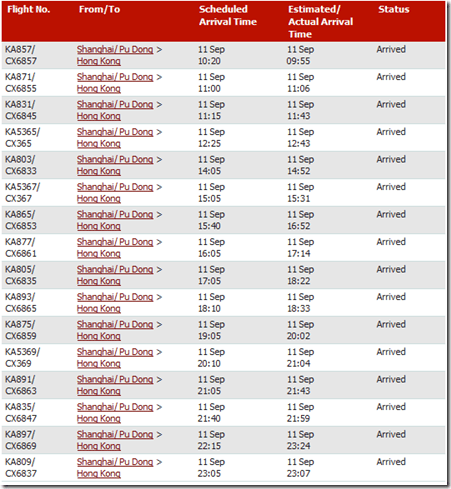
    Friday’s Dragonair flights from Shanghai to Hong Kong are shown right, and nearly half (7 out of 16) were around an hour late landing in Hong Kong, and two more were about 45 minutes late.  Remember that it should take 2 hours flying time, but is scheduled for around 2 hours 40 minutes, so a flight that is officially one hour late has taken 3 hours 40 minutes. 

    Admittedly, Friday didn’t see any of the really long delays that are common on this route, but landing at 11.30 pm rather than 10.15 is still very frustrating.

  • A couple of weeks ago there was an advert in the SCMP for ESPN HD and ESPN News, but with no mention of Now TV.  Which seemed a bit odd.

    Today’s SCMP explains that the contract between PCCW’s Now TV and ESPN Star Sports expired last Tuesday, and so far there is no deal in place for a renewal.  Which means that the channels could soon be available on Cable TV (ESPN used to be on Cable TV, but Star Sports was a free-to-air channel at the time), or even disappear completely – as the SCMP rather melodramatically speculates:  

    Sports fans face threat of TV viewing drought

    John Carney
    Sep 05, 2010

    The prospect of blank television screens is looming large for Hong Kong sports fans, as protracted contract talks between ESPN Star Sports and PCCW (SEHK: 0008) go down to the wire.

    An exclusive six-year deal between the two companies to broadcast some of the world’s biggest sporting events ended on Wednesday, and if a deal isn’t struck coverage will end this week. The sides suspended cancellation of programmes to undertake 11th-hour discussions to broker a new agreement.

    "This has been dragged out over the past few weeks," an executive with detailed knowledge of the negotiations said. "The talks have all but collapsed. It’s been ongoing for weeks, but the situation is in limbo and there’s been no progress. It was public knowledge that they had a six-year exclusive deal which has finished, but now they’re in these talks and they’re just not reaching an agreement. There are some frantic negotiations now taking place."

    If an agreement is not found it will mean a viewing drought for many armchair sports fans.

    ESPN Star Sports provides a range of sports from live coverage of Formula One, cricket internationals, golf majors and tennis grand slams, to top American sports like the NBA Finals, Baseball’s World Series and the Super Bowl in American football.

    ESPN Star Sports would have to find another carrier for its channels to be shown in the city. If the deal with PCCW collapses, it would have to strike a deal with Cable TV or Hong Kong Broadband Network.

    "At this stage our official comment is that we are committed to work in the best interest of sports fans in Hong Kong and we continue to work closely with PCCW [towards a deal]," ESPN Star Sports said.

    PCCW was also tight-lipped, as the negotiations continued.

    However, the executive insider said discussions were on their last legs. "It could easily happen that they’re not going to reach an agreement and that the partnership with PCCW will end," the executive said.

    "ESPN Star Sports and Star Cricket channels would no longer exist, along with other new sports packages they had hoped to open to the Hong Kong market – some of these have already been promoted in the region, like ESPN HD, ESPN 24-hour News, and ESPN Player."

    This year has been a tough one for Hong Kong fans, especially as, in November, PCCW’s Now TV lost the rights to screen live English Premier League matches to Cable TV, leaving many soccer fans in the lurch.

    Industry insiders said Cable TV paid more than US$200 million to obtain the rights. It had lost them to Now TV in 2007 when the broadband-television operator paid US$180 million for a three-year deal.

    Cable TV winning the rights back prompted an angry response from viewers and bar owners faced with having to sign contracts with both television operators.

    Now TV had to reduce the price of their “Now Sports megapack” when they lost the rights to the EPL, so what will they do if they also lose ESPN & Star Sports?

  • PVG 2010-08-25

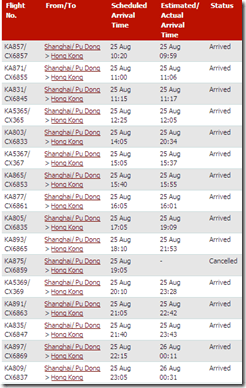
    Dragonair’s main USP is that it’s the Hong Kong airline that flies to China.  Which is also its main problem.  The table on the right is from the Dragonair website, and shows the scheduled and actual arrival times of flights from Shanghai to Hong Kong on one day (Wednesday 25 August).

    The day starts off so well, with flights leaving on time and arriving on time (or early, which is possible because they schedule the flight at around 2hrs 40 minutes when it really only takes 2 hours).  CX365 and KA857 both managed to arrive 20 minutes earlier than scheduled.

    The next three flights to depart were also quite good (one was four minutes early, the other two arrived less than half an hour late). 

    Ah, but what about KA803, you may ask.  This was over six hours late leaving, and six and a half hours late landing.  Which must mean that it spent nearly an hour after leaving the gate taxiing around before it actually took off.   Just what you need after a six hour wait (though I assume that most of the passengers were switched to earlier flights).

    Things didn’t get any better after that.  Out of the eight flights scheduled to depart after 2pm, the "best" performances are from two that <only> had a delay of 90 minutes, and the worst a staggering 3 hours and 45 minutes late arriving.  Then there’s a Cathay flight weighing in with a 3 hour 20 minutes delay – and there’s quite a big difference between landing at 8.10pm and 11.30pm as your evening completely disappears.

    Oh, and KA875 was cancelled.

    Of course it’s not all Dragonair’s fault, but rather a result of the vast number of flights down the east coast of China – from Beijing, Shanghai Pudong and Honqqiao, Nanjing, Hangzhou (and a few more besides) down to the Pearl River delta (Hong Kong, Guangzhou, Shenzen and Macau), and don’t lets forget the flights between Shanghai and Beijing, and even Hong Kong to Guangzhou for people who really hate trains.

  • It doesn't seem that long ago that we only got one EPL game live on Saturday night.  Then it became two of the 3pm kick-offs, and then (3 years ago) every single game.

    Perhaps even more amazing is that we now get up to 3 live games on Saturday from the Championship (the second tier of English football) courtesy of Goal TV, which has recently been added to the Now Sports package.

    Goal TV also has selected programmes from the club channels of Chelsea, Liverpool, Real Madrid and Barcelona, including full matches (but recorded rather than live).

    MUTV (Manchester United’s channel) is no longer available through Goal TV but has become a standalone channel on Now TV – for which you have to pay extra.  They seem to show their EPL games a few hours after they have finished.

    So what is available? 

    • English Premier League – Cable TV has the live rights
      • MUTV (Manchester United TV) – Now TV
      • Chelsea TV, Liverpool TV – Goal TV (Now Sports) 
    • Champions League and Europa League – Cable TV
    • Italian Serie A – Cable TV and Now Sports
    • Spanish La Liga – Now Sports
    • German Bundesliga – Cable TV
    • French Ligue 1 – Now Sports
    • Scottish Premier League -  Goal TV
    • Dutch League -  Goal TV
    • English FA Cup – Star Sports (Now Sports)
    • English Football League -  Goal TV

    As ever, updates and corrections are very welcome.

  • Some recent comments:

    So nice to study your perfect weblog on the spare time. Your write-up brings me different type of feeling about the literature.

    You have a good understanding of China! Deeply the Chinese people I admire you! Thank you for your love! We will be better in China

    You have a good understanding of China! Deeply the Chinese people I admire you! Thank you for your love! We will be better in China

    These articles are fantastic; the material you show us is interesting for everybody and is truly excellent written. It’s just great!!6.These articles are fantastic; the specifics you show us is interesting for everybody and is really wonderful written. It’s just outstanding!!

    These articles are fantastic; the material you show us is interesting for everybody and is truly excellent written. It’s just great!!6.These articles are fantastic; the specifics you show us is interesting for everybody and is really wonderful written. It’s just outstanding!!

  • imageJust watching The Hotel Inspector on BBC Lifestyle, and I was puzzling over what had been blurred out.   BBC Lifestyle has been known to blur out all manner of fairly innocuous things lest they offend sensitive viewers.

    Turns out that it was a dalek (unblurred image shown right)…

    It did seem odd that there were numerous references in the programme to the dalek in the entrance hall, that somehow we never saw it, and apparently it was for copyright reasons rather than for reasons of decency.

    Thanks, by the way, to the person at Now TV who finally figured out that it is now being broadcast in widescreen and made the necessary changes so that we didn’t have wide bands at the top and bottom and a squashed picture.  You might want to do the same thing on BBC Knowledge.