• Prudential still seem to be struggling with the takeover of AIA.  They had a run-in with the Financial Services Authority in the UK, but that has been resolved, and now they have published the prospectus.
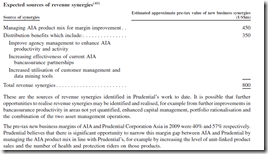
    imageThey claim that they can deliver $800m of revenue improvements by (amongst other things) making AIA’s agents more productive.  They have figures to back this up – from last year (2009).  Hands up anyone who can think of anything that might have adversely affected AIA sales last year.  Yes, that’s right, AIG had come close to collapse and been rescued by the US government.  So this is not a meaningful comparison, as has been pointed out:

    Prudential’s AIA revenue claims disputed by study 

    Pi Financial Services Intelligence, a Singapore-based consultancy, said that Pru and AIA agents showed similar productivity levels before the financial crisis. Simon Drimer, Pi FSI managing director, told the Financial Times the analysis the consultancy had conducted showed there was ‘no material difference between the two companies’ agent productivity levels’.

    But Prudential stood by its claims that it would deliver higher productivity. It said that based on 2009 figures, its agents were more productive compared with AIA in nine out of 10 regional markets, with AIA holding the upper hand in Thailand alone.

    Yes, 2009 figures.  We all know why AIA struggled in 2009, and why AIA’s agents are already becoming more productive. This trend is confirmed by the figures for the first three months of this year, but of course Prudential use them to argue that they have got a bargain, and conveniently ignore the implied productivity growth.

    Barry Stowe of Prudential Asia is quoted as saying that Prudential can “restore AIA to its former greatness” by offering its agents more and better products.  Yeah, right.  So why is AIA much bigger and more successful than Prudential in Hong Kong and much of the rest of Asia?  Why indeed does Prudential want to buy it?  Perhaps Mr Stowe should think about that before commenting.

    I know nothing about the “products” sold by AIA or Prudential, but I can guarantee that the management of both companies know each other’s products very well indeed, and if Prudential have a successful product then AIA can easily create something very similar.  These are not physical products that can be patented, and they are not even intellectual property that can be copyrighted.  So it’s highly unlikely that Prudential’s “superior products” are going to help AIA to make more money.

    This brings us back to one of the fundamental problems with this deal.  The prospectus states that:

    …the Acquisition is primarily a growth focused transaction, although cost synergies will also be sought.   Prudential intends that the Enlarged Group will use both the Prudential and AIA Group brands, maintain separate agency forces and strengthen both agency forces by the sharing of best practices.

    So you have to question whether Barry Stowe is wise to make all this noise.  It may be possible to “strengthen both agency forces” but not if you drive AIA agents away by telling them that Prudential is so much better than AIA (especially when the evidence suggests otherwise). 

    Is Prudential paying less than AIA is really worth?  Because that is the only reason Prudential shareholders should approve the deal. 
  • In amongst the usual dross there are sometimes a few words of wisdom in the SCMP letter column:

    Parents sending wrong message on trains

    Hong Kong parents have a very annoying habit when travelling on the train with their children.

    They let their two- to three- year-olds occupy a seat in a crowded train when the child can sit in the parent’s lap and let another weary passenger rest his feet.

    These "little darlings" clearly do not need the seat, judging from the way they restlessly fidget, squirm and kick, and worst of all, tramp their dirty shoes all over the seat.

    I have only seen this kind of behaviour being tolerated in Hong Kong.

    Parents do not seem to appreciate that this is very unhygienic. When you ask the parents to remove the child’s shoes or move the child from the seat, you either get no response or you get a look of irritation.

    Presumably these are the same adults who will, in a few years’ time, be allowing their young sons and daughters to rush onto crowded trains and grab a seat in front of passengers who have queued in an orderly fashion.

    Nina Cheung, Sha Tin

    Very true, and only this afternoon I was travelling on the MTR and saw a small child standing on a seat, exactly as described. I fear that Hong Kong suffers from “Little Emperor” syndrome – some parents are apparently quite unaware of how selfish they are being.

    You see the same thing in swimming pools: a complete lack of consideration for other users of the pool, and this absurd habit of allowing children to stand on the benches in the changing room because the floor is wet or dirty – which duly makes the benches both wet and dirty for everyone else. 

  • Sky News have been making the most of the lengthy post-election negotiations, and they even have (or had) a helicopter flying around London to try to make it all more exciting. On Monday when Gordon Brown was making his first resignation speech of the week you could clearly hear it overhead. It was a curious speech, presented in such a low-key way that you might almost have missed what he was saying. You could imagine the headmaster saying "Speak up, boy, and apologize properly", but Brown couldn’t quite bring himself to say that he was resigning.

    Predictably, the right-wing newspapers were not happy. They had wanted Brown out, but became even more angry when he confirmed that he would be leaving. Their real fear, of course, was that it increased the chance of a Labour-Liberal Democrat coalition. For a few hours this terrifying prospect did seem to be a real possibility, but thankfully the moment soon passed, and last night Gordon Brown really resigned and David Cameron finally became PM.

    The Liberal Democrats seem to have got a lot of what they wanted, including the promise of a referendum on the Alternative Vote system and various concessions on policy, but is this really an election that anyone would want to win?  You might think not, but 13 years out of power for the Conservatives (and considerably longer for the Liberals) obviously bring a different perspective.

    The difficulty for Sky News is that a “rolling news” channel wants things to be happening all the time – and in public. And when the most exciting thing the Sky helicopter can find is Sky’s own reporters interviewing other journalists outside the Houses of Parliament there’s clearly a bit of a problem – though there has been other excitement on the channel.

  • image

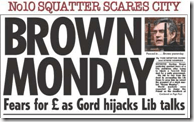
    The Sun really is a ridiculous newspaper.  Their front page today has this nonsense about a ‘Brown Monday’:

    DEFEATED Gordon Brown yesterday sparked fears of a City meltdown after trying to hijack a Tory-Lib Dem deal for a unity government.

    His bid to rise from the dead by persuading the Lib Dems to prop him up raised the prospect of a stock market "Brown Monday".

    World markets were expected to dump the Pound as the deadlock at Westminster continued to cause widespread political and financial chaos.

    A deadline for coming to a coalition deal last night was missed – opening up the prospect of a massive wobble when the markets opened at 7am today.

    Mr Brown made a desperate late bid to get the Lib Dems on side.

    Despite claiming he was acting in the nation’s interests, his meddling was not welcome by City experts as he threatened Nick Clegg’s delicate talks with David Cameron.

    City experts?  Pah..  So how is the Pound?  Here’s The Guardian

    9.49am: Looking at Britain again, and the pound has strengthened against the dollar to a morning high of $1.4984 (from $1.48 last Friday). This has compounded (for now at least) speculation of a ‘Brown Monday’ on the markets as investors ditched the pound because of fears of a Hung Parliament.

    12.04pm: The pound perks up after the Bank of England’s decision to leave interest rates on hold. It rose 1.4% against the dollar to hit the day’s high at $1.5017, but was little changed against the euro.

  • I noticed this nonsense in the SCMP today, and assumed that someone might have spotted the errors and corrected them in the online edition.  No they haven’t…

    Truck drivers in go-slow rally against fee

    About 70 drivers staged a go-slow protest in Yuen Long yesterday to urge Guangdong authorities to cancel the lump sum fee that Hong Kong trucks have been charging to cross the border since 1993. Protest leader Stanley Chiang Chi-wai said the HK$100,000 fee, payable every three years in addition to provincial road fees, was unfair since Macau drivers did not have to. Joyce Ng

  • Prudential’s risky plan to acquire AIA looked as if it was a “done deal”.  Now things seem rather less certain (Prudential must explain AIA strategy):

    The old view here was that Prudential’s proposed $35.5bn (£23.3bn) purchase of AIA is very likely to complete. This was not because the deal is appealing – it’s not, it looks too risky and too expensive.

    Rather, it was because cold cynicism suggested that a company willing to shower $1bn in fees over the City usually gets its way.

    It may be time for a rethink. A senior fund manager within the Pru’s largest investor, Capital Research & Management, owner of 12%, is said to be unhappy with the deal. If that is true (the smoke signals say it is), Tidjane Thiam, the Pru’s chief executive, is in trouble. He needs 75% support from shareholders to secure a green light. Without Capital, the arithmetic becomes tricky, especially as other City fund managers express in private their own misgivings.

    Capital is said to prefer a break-up of the Pru. At the moment, that sounds like wishful thinking. Never mind. The deeper point is that the Pru must explain why betting the firm on one mammoth deal in Asia is an acceptable risk. To many outsiders, the best way to approach the Asian opportunity is via organic growth, where Prudential has enjoyed considerable success. Such a strategy would be lower risk, would save a small fortune in fees and would preserve the break-up option.

    We wait to discover if next week’s prospectus explains why this option was rejected. But Thiam needs to address the question. If he doesn’t, it is easy to imagine how this tentative rebellion could become the real thing.

    The Financial Times points to another big problem with this deal (Pru threatened by mass AIA defections):

    With the long-awaited prospectus from Prudential just days from publication, nervousness is mounting inside AIA, the UK assurer’s $35.5bn (£23bn) takeover target.

    Until a few weeks ago, pan-Asian insurer AIA, which has century-old roots across the region, was sailing towards a Hong Kong listing with a potential market capitalisation of up to $40bn. Now senior AIA executives sit silent, unable or unwilling to give their views on the Pru deal.

    How many senior AIA executives, actuaries and agents remain following a takeover is extremely important for the combined group if it is to deliver the sales increase being flagged to investors to justify the price and the $21bn rights issue that will fund the deal.

    To hit its growth targets, the Pru wants 300,000 new agents to increase its sales force to almost 1m. So any exodus of AIA staff would be painful.

    AIA, which is owned by AIG, the stricken US insurer, has been a fierce rival of the Pru for decades in Asia, home to the world’s fastest-growing markets for life assurance.

    Analysts at CLSA, the Asia-focused brokerage, this month described the situation in evocative terms. “This isn’t a friendly merger,” they said. “It’s more like parents forcing the daughter to marry someone she doesn’t like for money. The integration will be an uphill battle.”

    Indeed it will – but we already knew that (Prudential bold or barmy?).  Oh, and if you can’t negotiate the FT paywall, the same story is over at the New York Times (Pru Takeover May Be Undermined by Exodus). 

  • Sky News presenter to Lord Adonis, the transport minister, about the volcanic ash problem:

    “Do you have a contingency plan for this unprecedented state of affairs”

    Adonis just ignored the question.

  • The SCMP seems to have been hoist by its own petard.

    img004They have a  policy of printing the Chinese characters for people and places.  And another policy of cutting costs.  The unsurprising result is that  sometimes they get things wrong.

    Yesterday they somehow mixed up the Chinese characters for Chinese President Hu Jintao and another Mr Hu (Hong Kong’s SCMP Botches Hu’s Chinese Characters, Apologizes):

    Instead of the Chinese characters for Hu’s name, the English-language Post printed the characters for “Hu Jia” which is the same name of a prominent mainland activist serving a three-and-a-half year jail term for subversion, Radio Television Hong Kong said on its Web site.

    A spokeswoman for the paper said the error occurred due to a mistake in proof-reading carried out by an expatriate who does not understand Chinese, RTHK said.

    img007  Today they have a very prominent but very vague apology, and no further mention of their blunder.

  • Now TV have 9 sports channels.  However, they don’t have enough sport to fill all these channel 24 hours per day and by the time you get to channel 638 (Now Sports 8) there’s usually just a blank screen.  OK, fair enough.

    But hang on, there are several Premier League games tonight.  Shouldn’t one of them be on 638 or 639?  You might think so, but actually Blackburn vs. Manchester United is on channel 898 (TVB Pay Vision Info).  This is not advertised anywhere on their website, and it’s hardly an obvious channel to try.

    It’s possible that if you watched the football on Now Sports 2 they might be explaining (in Cantonese) that this game is on 898, but apart from that viewers are left totally in the dark.  Very puzzling.  

  • Imagine for a moment that you have booked a flight and reserved your seat.  You turn up at the airport ready to check in.  You produce your passport and frequent flyer membership card.  What happens next?

    (a) Check-in is complete in 3 minutes and off you go.

    (b) The check-in agent gives you someone else’s boarding pass.  When you question this, agent says she couldn’t find your booking in the system.

    (c) The agent prints out a boarding pass for a window seat (you requested an aisle seat).

    (d) Long wait

    (e) Agent discusses the problem with supervisor.  You get the boarding pass for the seat you reserved.

    It could more than one of the above options.