Happy New Year.
Ordinary Gweilo
It's not big and it's not clever, it's just a Brit in Hong Kong writing (mainly) about Hong Kong
recent posts
Categories
- Blogs
- Books
- Business and Commerce
- China
- Chinese language
- Corporate life
- COVID-19
- Current Affairs
- Dim Sum
- Economics & trade
- Environment
- Film
- Food and Drink
- Football
- Hong Kong business
- Hong Kong news
- Hong Kong politics
- Hong Kong property
- Life in Hong Kong
- Media
- Music
- News
- Oasis
- Personal stuff
- Politics
- Public Transport
- Rants
- Science
- SCMP
- Sports
- Technology
- Television
- The Apprentice
- The Palazzo
- Things I don't quite understand
- Travel
- Trivia
- UK
- Uncategorized
- Web/Tech
- World events
-
In the early 1980s, British politics briefly became exciting. There were a series of by-elections in which Social Democrat and Liberal candidates won some stunning victories, most notably Roy Jenkins in the distinctly unpromising Glasgow Hillhead constituency. He had earlier lost in Warrington, and there was certainly no guarantee that he would win at his second attempt – but he was willing to take the risk of suffering another defeat.
One of the many problems with the upcoming by-elections in Hong Kong is that no-one is taking any risks. Five legislators from the League of Social Democrats and the Civic Party have resigned in order to force by-elections – which they know they will win, because in a straight fight the democrats always win.
Just to ensure that this is meaningless, the Liberals (no relation to the British party) have decided not to put up any candidates. This seems like a smart move, because they would certainly lose, but it also highlights the fact that the Liberals are probably the most pointless of all the parties we have in Hong Kong.
Amusingly (but predictably) the Liberal Party claim it is a matter of principle because they can’t accept the LSD and Civic Party talking about the by-elections as a de-facto referendum (on democracy) and a "popular uprising". An alternative view is that they are just doing what Beijing told them to do, and somehow that seems a lot more likely than a sudden (and unprecedented) outbreak of principles.
The DAB are likely to do the same thing (for the same reasons), so the five legislators will be back in Legco without even facing any serious opposition.
Actually, it’s hard to see how anyone resigning and standing in a by-election is ever going to prove anything. A recent example in the UK was Conservative shadow home secretary David Davis, who resigned as a Tory MP to fight a by-election, which he duly won – but can anyone remember the issue that caused him to resign? Did it make any difference? Obviously not (except that he is no longer in the shadow cabinet).
I think I might even agree with Priscilla Leung Mei-fun (independent pro-Beijing legislator), who proposed changing the rules so that anyone resigning from Legco would not be eligible to stand in any by-election. This would not have prevented the five legislators resigning, but it might have made them think twice about doing so.
And, yes, the Liberals and Social Democrats had some stunning victories in the early 80s, but when it came to the 1983 General Election, the Tories won a huge majority, and these days the Liberal Democrats are still largely irrelevant in the two party system.
-
I used to think that airline alliances (and particularly code sharing) were just an evil trick played by the airlines. After all, who wants to book a flight on Cathay Pacific only to discover that the flight is actually operated by a “partner”. And when most of the flights on a particular route are operated by one of the global alliances (e.g. Oneworld for Hong Kong to London or Australia), can that really be good for customers?
On the other hand, if you are a frequent flyer there are obvious advantages to these alliances. If you have managed to get Silver on Marco Polo (Cathay’s program) you also get certain privileges with other Oneworld airlines (but no lounge access), and you can earn tier points (needed to get or retain your status in the Marco Polo club). But, of course, that’s only worth anything if there are other airlines in the same alliance that you might be able to use, which is why all of them try to be global.
Right now there’s a battle going on to get the ”new” (post-bankruptcy) JAL to sign up for one of the alliances. JAL is currently in Oneworld, but they are being wooed by Delta, who want to bring them in to SkyTeam (which includes Air France-KLM, Korean Air, China Southern, and, coming soon – try to contain your excitement – Vietnam Airlines). As the Financial Times points out (Rivals want Japanese airline to come aboard):
If JAL abandons Oneworld it would leave Oneworld with just one large member in Asia, Hong Kong-based Cathay Pacific. This would mean both Star and SkyTeam were stronger in mainland China and Japan, two of the most critical markets in the region. It would also hurt American’s position on lucrative transpacific routes.
I’m not sure how JAL switching to Sky Team has any impact in mainland China – and Cathay probably benefit more from JAL’s problems than they would lose from a weakened Oneworld.
Anyway, there has been talk about BA and American making offers to entice JAL to stay in Oneworld, but these seem not to amount to much (Absurd weasel words and useless figures from ‘oneworld’ about Japan Airlines), and you have to question how much any airline would want to spend on supporting a rival. American’s other strategy is to hope that regulators would object to Delta and JAL’s share of the US-Japan route – whilst conveniently forgetting Oneworld’s own dominance on other routes.
One airline that does provide some competition to Oneworld on the London – Hong Kong – Sydney route is Virgin Atlantic, which isn’t a member of any of the big alliances. Instead it has arrangements with various carriers, notably Singapore Airlines (owner of 49% of Virgin), which even allow you to earn tier points as well as mileage. And Virgin generally offer more mileage (both for flights and from hotel and other partners), and they set lower tariffs for reward flights (Hong Kong – London in Business Class is 120,000 miles on Cathay/BA, but only 100,000 miles on Virgin). So it does seem that alliances are not good for the consumer.
Of course Cathay can get away with having a less than generous frequent flyer program because of their dominant position in Hong Kong – they may face competition on most routes, but no airline (or even alliance) comes anywhere close to offering the number of routes they have in and out of Chek Lap Kok.
-
They print so many stupid letters in the SCMP, but this one is spectacular:
Combine two MTR rail lines
There has been much discussion (or rather negative feedback) from East Rail Line passengers after the West Rail Line was extended to Tsim Sha Tsui East while the East Rail Line now terminates at Hung Hom.
The change of terminus has caused problems for East Rail passengers, as it is now at an inconvenient location. Some people would rather change to the Central Line at Kowloon Tong, which makes that route even more crowded.
I think the best solution is for the MTR Corporation to merge the East and West lines. They would form an (almost) U-shaped route, from Lo Wu to Tuen Mun. There would not have to be a terminus in Tsim Sha Tsui East or Hung Hom.
I do not have the technical specifications of the trains, however, I think that modern-day locomotives should be able to run long distances. If the fatigue of the drivers is a concern, then drivers can change in Hung Hom.
The fact that the East Rail Line used to terminate in Tsim Sha Tsui East station, before the West Rail extension was completed, means that the train design and the platform design allow East Rail trains to go through the Tsim Sha Tsui East station and the rest of the West Rail stations.
For the same reason, if West Rail trains can terminate in Hung Hom, they should be able to run through the rest of the stations along the East Rail Line.
Karina Lam, Sha Tin
Well, why not? Could it because East Rail trains are longer and run more frequently? I think it could. If the MTR ran East Rail trains through to Tuen Mun they would be half-empty. It would also cost a lot of money because they would need to purchase a lot of extra rolling stock to extend West Rail trains to the same length as East Rail.
Luckily, the MTR have a different plan. A more logical plan. They will link up West Rail with the other ugly duckling (Ma On Shan Line), and extend East Rail across to Hong Kong island. If there are any journalists left at the SCMP and they have access to the archives they would surely find some stories about this plan, and then they might have thought twice about printing this stupid letter.
-
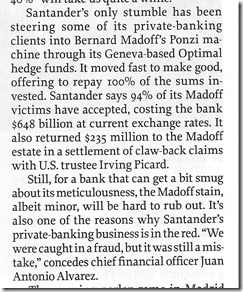
Time magazine has a story about Santander: The Most Boring Bank in the World. Except that it seems not to be so boring:
Santander’s only stumble has been steering some of its private-banking clients into Bernard Madoff’s Ponzi machine through its Geneva-based Optimal hedge funds. It moved fast to make good, offering to repay 100% of the sums invested. Santander says 94% of its Madoff victims have accepted, costing the bank $648 billion at current exchange rates. It also returned $235 million to the Madoff estate in a settlement of claw-back claims with U.S. trustee Irving Picard.
Still, for a bank that can get a bit smug about its meticulousness, the Madoff stain, albeit minor, will be hard to rub out. It’s also one of the reasons why Santander’s private-banking business is in the red. "We were caught in a fraud, but it was still a mistake," concedes chief financial officer Juan Antonio Alvarez.
$648bn is a really big mistake. Talking of mistakes, I wonder if possibly the figure should be $648 million. Just a thought.
-
Thursday’s SCMP had a strange story about the possibility of replacing Easter Monday with a new public holiday for Confucius's birthday. Hard to see that happening – we already have too many of these one day holidays on random days of the week, and Easter is the only Hong Kong holiday that is guaranteed to produce a long weekend (Friday to Monday).
You might think that any story on this subject would be accompanied by some background information about the changes that have been made to Hong Kong public holidays in recent years (of which there have been several). However, all we got was this table:
New general holidays since 1997:
General holidays deleted since 1998:
SAR establishment day: July 1
National Day: October 1
Labour Day: May 1
Buddha's Birthday: the eighth day of the fourth lunar month
Queen's Birthday: a Saturday in June, plus the following Monday
Liberation Day: the last Monday in August and the Saturday preceding it
Sino-Japanese War Victory Day: August 18
The day following National Day: October 2
Not very helpful, I feel.
The Queen’s Birthday and Liberation Day holiday were cancelled when Hong Kong ceased to be a British colony, and to replace them we got SAR establishment day, National Day (originally October 1st and 2nd), Labour Day, and that curious “Sino-Japanese War Victory Day” holiday (well, if you can’t celebrate the end of the Japanese occupation of Hong Kong at least you can remember another war against the same enemy).
Then they had a quick re-think and dropped two of these new holidays, replacing them in 1999 with Buddha’s birthday and (I think) Tuen Ng Festival.
-
Today’s SCMP has this brilliant observation about dead fish:
Making specimen is a lengthy process – it took half a year to turn the largest gar into a suitable specimen.
 A well-prepared specimen can last 250 years and allow researchers to study its body structures in detail, Chong says. However, movements and behaviour of a fish can be observed only when it is alive.
 Well, yes indeed. Being dead would rather limit their movements…
In other SCMP news, readers are apparently being asked to email their columnists to tell them whether they agree with columns that they didn’t actually write:

-
As I seem to be unable to write any posts of my own, I should perhaps direct readers to others who are able to produce some analysis of what is going on in Hong Kong.
Mr Smog had something to say on the weird court case about Procurement by false pretences:
In very brief summary the facts of the case seem to be that a young aspiring model was having no luck with her career and so she approached a self-proclaimed Taoist “master” to see if he could help. This “master” persuaded her to engage in rituals which involved him having sex with her on a number of occasions. And this happened multiple times before she apparently started wondering whether she had been duped.
Mr Ulaca also weighed in with his thoughts:
…the law under which he was charged and convicted, "Procurement of an unlawful sexual act by false pretences" (Crimes Ordinance, Cap 200, s 120), is worded in such a way that it raises many more questions than it answers. The law states, in essence, that it is an offence for a person to procure "another person, by false pretences or false representations, to do an unlawful sexual act".
The major, and very serious problem, with this is that "unlawful" is smuggled in rather than defined, which lends a certain circularity to the law. Moreover, the addition of the word "unlawful" strongly implies that there are circumstances in which sexual intercourse under false pretenses is lawful, and yet these circumstances remain, like the "unlawful", undefined.
Truly a bizarre case.
-
I have been taken to task by Mr Spike for linking to his old site, and I can't deny that a review of my list of Hong Kong blogs was long overdue. It also turns out that Mr Hemlock has finally closed down his old site and moved to WordPress, and a few old favourites have stopped alogether.
Oh, and Happy Christmas.
-
How many millions of pieces of paper have been collected at the airport (and Lo Wu and other ports) since the HKSAR government starting requiring travellers to make a health declaration?
What have they done with them? What has it achieved? Why has Hong Kong persisted with this nonsense long after everywhere else gave it up?
Did they really expect that everyone with a cough or a sore throat would avoid travelling? Well, from today you can do just that without worrying about the stupid forms.
 Ordinary Gweilo