Ordinary Gweilo

It's not big and it's not clever, it's just a Brit in Hong Kong writiing (mainly) about Hong Kong

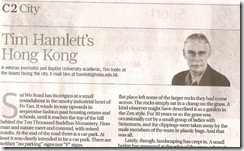
  • Hilariously, Tim Hamlett seems to have filled a whole column in today’s SCMP by writing about the road that runs outside his window:

    scan0001

    A veteran journalist and Baptist University academic, Tim looks at the issues facing the city.

    Sui Wo Road has its origins at a small roundabout in the smoky industrial heart of Fo Tan. It winds its way upwards in serpentine fashion past housing estates and schools, until it reaches the top of the hill behind the Ten Thousand Buddhas Monastery. Here man and nature meet and contend, with mixed results. At the end of the road there is a car park. At least it was clearly intended to be a car park. There are neither “no parking” signs nor “P” signs.

    At certain times of the year the police explicitly forbid parking. Behind this legal ambiguity there is a stretch of grass which runs round the back of the last estate on the left. It is separated from the back wall of the estate by a wide path. Eventually the path turns sharply to the right down the hill, and you come to a lookout point. This is a platform jutting out from the hill, with a pavilion constructed in the traditional Chinese style, if the traditional Chinese style admits reinforced concrete. It is sometimes known as the “Lions Lookout” because a Lions Club paid for it. I would like to name the benefactors, but the two large stones commemorating the original construction and a recent refurbishment have no English outside the Lions logo. They are munificent but monolingual lions.

    The lookout was once of some administrative importance. Official visitors to Hong Kong would be escorted up there to look down on the huge building site in the valley below and would “be briefed” as the press release invariably put it, on the progress of the works. Nowadays the official guides have moved on to more recent wonders and the lookout point is left to morning visitors in search of exercise and evening visitors in search of a quiet place to cuddle in the dark.

    Or for veteran journalists to practice the bagpipes, according to one blogger who may be a neighbour of Mr Hamlett. 

    The stretch of grass continues, now pathless, past more housing estate until it reaches the top of the slope behind Sha Tin College. There are two other landmarks. One clump of bushes by the car park is popular with minibus and taxi drivers looking for a place where they can park and – um – “P”. You can smell it in the summer. Also by the car park the builders who levelled the hill top which became this flat place left some of the larger rocks they had come across. The rocks simply sat in a clump on the grass. A kind observer might have described it as a garden in the Zen style. For 30 years or so the grass was occasionally cut by a small group of ladies with Strimmers, and the clippings were taken away by the male members of the team in plastic bags. And that was all.

    Stop already.  The excitement is too much for me.

  • The SCMP fills its sports pages by selecting stories from the news agencies and foreign newspapers.  Unfortunately, the selection process seems to be somewhat random, such as when they gave readers in Hong Kong the impression that Graeme Souness might be re-appointed as Newcastle manager

    Or this, which appeared on the back page on Thursday:

    Benitez will be gone by Sunday, bookies say

    Agence France-Presse in London
    Feb 26, 2009

    One of Britain’s leading betting firms said last night it had stopped taking money on Liverpool manager Rafael Benitez becoming the next English Premier League boss to be sacked. Willliam Hill said the Spaniard was a 20-1 outsider on Tuesday afternoon to be the next manager to leave his post.

    But despite the fact that both Manchester United and Arsenal were playing in the Champions League on Tuesday, William Hill said Benitez was “backed off the boards” to have left Liverpool by the weekend.  They cut the odds to evens and then suspended betting last night.

    “The level of interest on Rafa getting the sack is unprecedented with over 300 calls logged [yesterday] alone,” said William Hill spokesman Rupert Adams. “We would be very surprised if Rafa is still the Liverpool boss by midnight on Sunday.”

    Well, I’d be very surprised if he wasn’t still in charge on Monday morning, all the more so after Rick Parry announced that he will be resigning as Chief Executive at Liverpool Football Club.

  • This week's Economist suggests that the Kindle might be the saviour of newspapers

    The growing popularity of electronic books could offer hope for newspapers

    THINGS are suddenly hotting up in the rather obscure field of electronic books and their associated reading devices, the best known of which is Amazon’s Kindle. A new, sleeker version of the Kindle was unveiled on February 9th. Just days earlier, Google said it was making 1.5m free e-books available in a format suitable for smart-phones, such as Apple’s iPhone and handsets powered by Google’s Android software. Amazon said it was working to make e-books available on smart-phones as well as the Kindle. Plastic Logic, the maker of a forthcoming e-reader device, said it had struck distribution deals with several magazines and newspapers.

    The iPhone, meanwhile, has quietly become the most widely used e-book reader: more people have downloaded e-book software (such as Stanza, eReader and Classics) for iPhones than have bought Kindles. Might e-books be approaching the moment of take-off, akin to Apple’s launch of the iTunes store in 2003, which created a new market for legal music downloads?

    It's an interesting idea, and I'd happily pay US$10 per month for my daily fix of The Guardian, but there are a few problems to overcome first.  For starters, there's the price of the Kindle ($359) and the fact that it's only available in the United States (and I figure that Hong Kong is unlikely to be high on their priority list).

    However, there is speculation that Amazon will start to offer support for the iPhone (and presumably the iPod Touch as well), so maybe there's some hope.  Or maybe Apple will create an iBooks or iNews application similar to iTunes (using USB synchronization), and some people think they will launch a tablet computer, for which that would be an obvious application. 

    I've been reading newspapers on mobile devices for more that ten years, starting with the Handspring Visor, using Avantgo to download various newspapers (including The Guardian).  By current standards it was very primitive, but at the time I was very impressed to be able to sit on the MTR reading the same day's Guardian (well, parts of it).  The biggest limitations were that the website had to create a special cut-down version (to fit the smaller screen) and Avantgo set a maximum number of kb (though you could pay to increase this). 

    Next came Mobipocket.  The SCMP adopted it because of their stupid paywall, but its best feature was that anyone could write a script to extract content from any newspaper (or any website).  One kind person wrote a script to extract the whole of The Guardian each day.  Which was fine until the website was re-designed and the script would pick up nothing.  Then came Mobipocket Creator, which was supposed to make it easy for anyone to do the extract themselves from any website – and it worked (up to a point), but it also had many frustrating features, and rather than fix them they abandoned the product.  Gee, thanks, guys.

    These days, both Mobipocket and Avantgo take the easy option and use RSS feeds.  Which is all very well, but it isn't the same as reading a newspaper. So I am currently using Sunrise XP and Plucker, which works reasonably well for The Guardian (though I had to create a simple HTML file to serve as a contents page), but it can't handle sites which split articles over multiple pages (yes, that means you, The Times of London). 

    So I'm certainly on the lookout for something better, whether from Amazon or Apple or anyone else.

  • The collapse of Oasis was accompanied by claims that the directors did not agree with each other on certain key issues.  Now we have legal action in prospect:

    Two Oasis founders sued over share sale

    Two founders of defunct Oasis Hong Kong Airlines have been sued over claims that they orchestrated a deal to buy worthless shares in the company’s operating division.  Reverend Raymond Lee Cho-min and his wife, Priscilla Hwang Lee, allegedly gave a green light to a US$4.8 million plan without company approval or an independent valuation of the money-losing unit, according to a writ filed in the High Court.

    The couple, who could not be reached for comment last night, also failed to disclose that they had a personal stake in the deal, said the lawsuit filed by Oasis Mezzanine Funding, the airline’s capital-raising division.

    “Raymond Lee and Priscilla Lee failed to disclose or declare to OMF their conflicting interests” and had a duty not to “engage in secret profiteering or self dealing”, the writ said.  Instead, Mr Lee and his wife “misappropriated” US$4.8 million that was raised based on an “unjustifiable and grossly overstated” US$350 million value for Oasis Hong Kong Airlines, the lawsuit claimed.

    The cash-starved unit ran the airline’s day to day operations, the writ said.  The couple allegedly ordered that Oasis Mezzanine Funding buy shares in Oasis Hong Kong Airlines, the writ said.  But Oasis Hong Kong Airlines’ value in September last year was “not more than zero” and would now be “negative”, the writ said.

    Oasis, the world’s first budget long-haul airline, grounded flights in April after operating for less than 18 months.  About 700 staff lost their jobs and around 50,000 passengers were affected.

    Mr Lee had said the carrier went under because of higher-than-expected costs for jet fuel and planes.  News reports earlier this year suggested that the airline fell apart after investors disagreed with Mr Lee about whether to pump more money into the airline.

    In May, a High Court judge ruled that Mr Lee and other Oasis founders had placed the company in voluntary liquidation to avoid paying a HK$170 million debt owed to the Bank of China.  Meanwhile, the writ said that Mr Lee and his wife, a former executive director at Oasis, had ignored requests for a valuation report or evidence that the company approved the plan.

    “The share purchase transaction was not properly authorised by OMF,” it said.

    Oh dear.  There’s obviously a rule at the SCMP that Oasis has to be described as “the world’s first budget long-haul airline”.  It wasn’t a budget airline in any meaningful sense of that phrase.

    (more…)

  • A few weeks ago I suggested that there aren’t any zebra crossings on public roads in Hong Kong.

    Apparently I need to get out more, because there are a few scattered around.  In fact, last week the sub-Standard reported an accident on one in Shau Kei Wan:

    The driver of a light goods vehicle was arrested after a 70-year-old woman was knocked down and killed on a zebra crossing in Shau Kei Wan.  The incident occurred around 6am yesterday on Oil Lai Street in front of the Aldrich Bay Government Primary School.

    The woman, surnamed Ma, was admitted to Pamela Youde Nethersole Eastern Hospital where she was certified dead at 6.40am.  The 47-year-old driver of the goods vehicle, surnamed Wong, was arrested for dangerous driving causing death.

    Owing to its location near the school, Eastern District Council member Hui Ching-on wants the zebra crossing upgraded to one with traffic lights.

    I suppose it would be asking too much for drivers to learn how to approach zebra crossings.  The problem with having so many crossings with lights is that drivers don’t have to think – they just have to watch the lights (though in my experience even that is sometimes too difficult).

  • Unlike my colleague Mr F, I do quite enjoy Chinese New Year.  So no complaints from me.

    In case you’re not up to speed on these things, today is everyone’s birthday, and you have just over a week left to get your Lai See.

  • How difficult can it be to have Chinese as the default language on your website whilst providing easy access to the English version?

    image

    Well, www.samsung.com.hk starts off promisingly with a front page that has both English and Chinese, but then dumps you on to a page that is entirely in Chinese. 

    If you hunt around you will probably find the button that allows you to change the language (see left).  Maybe you are supposed to guess what it's supposed to do?

    image

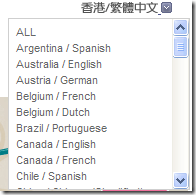
    Next we have the drop-down box for you to select which version of the site you wish to view (see right).  I had problems with this in Google Chrome, but luckily it works OK in Internet Explorer.

    As we can see, this is not really a language selection thingy, it's for you to choose which of their international sites you want to view.  So it ought to have a small globe as its symbol to make its function clear, surely?

    And what would someone who accesses the Hong Kong site be likely to want?  Probably not the Argentinian or Austrian or Belgian versions of the site.  I think they would be most likely to want either the English or Chinese versions of the Hong Kong site.

    So couldn't they just put an "English" button on the Chinese version and  中文 on the English version to allow you to switch languages?  Wouldn't that be simpler?

    There's a final "gotcha" after you select Hong Kong/English: image

  • More poorly thought-out “news” from the SCMP:

    Residential construction at lowest level since 1997

    Flats being built drop to 8,000 as economic crisis takes toll

    Yvonne Liu
    Jan 24, 2009

    Construction and completion of private residential units in Hong Kong last year slumped to the lowest since records began in 1997, underscoring the severe impact the global economic decline is having on the property market.

    The latest figures from the Transport and Housing Bureau show only 8,000 units were being built by the end of last year, 38 per cent fewer than the 12,900 units a year earlier. About 8,800 private project units were completed last year, down 16 per cent from 10,500 units in 2007.

    Really?  When did this economic crisis begin, then?  Early enough in the year to make property developers change their plans?  I think not. 

    Fortunately they have interviewed one expert who seems to understand what really happened:

    Charles Chan Chiu-kwok, an executive director at Savills Valuation and Professional Services, said tight supply was the result of developers becoming more conservative in land acquisitions after property prices jumped sharply in 2007. “They worried the property market would enter a down cycle.”

    Mr Chan expects tight supply in the residential market to continue this year.

    Property developers in Hong Kong are not daft.  They acquire land when they prices are low and hope to sell when prices are high.  However, that’s not a news story, whereas the global economic crisis is.

  • I know portals are ten a penny, and it's easy enough to create your own, but since someone has gone to the trouble of setting up one that lists Hong Kong news and blogs you might as well take a look.  

    Alltop

  • imageToday’s Sunday Morning Post has an article about the way banks rip you off with a “currency-linked deposit” account.  These are widely available in Hong Kong because the interest rates on a standard local currency deposit account are almost zero.

    The article has a small chart which is supposed to show how the Australian Dollar exchange rate has fluctuated over the last twelve months. 

    However, look closely and you may notice two things. 

    • The date range shown is 1-12 January 2008 and 1 January 2009.  Er?
    • Apparently the Australian Dollar went up every day/month.  Yes, that’s “up” from 7.365 on 08/01/08 to 6.7017 on 09/01/08.

    The article is also staggeringly dull, and could be summarised in about two paragraphs (basically the banks penalize you if the chosen currency falls, and don’t reward you if it rises).  However, it appears that “Alan Alanson” is paid by the word:

    Investors bear brunt of risk with little return to match

    [..]

    If you put HK$100,000 in an ordinary term deposit with most banks in Hong Kong for one month, the interest rate, about 0.01 per cent per annum, would come to less than HK$1 a month. If, instead, you purchased a currency-linked deposit in Hong Kong dollars linked to Australian dollars, say, the interest rate offered would be much higher. It would not be unusual for you to be offered a rate as high as 15 per cent per annum. Assuming a deposit period of one month, that would work out at 1.25 per cent, or HK$1,250 a month.

    The “currency link” part of a currency-linked deposit means that although the investor’s deposit is in HKD, it is linked to some other currency, in this case AUD. If the HKD rises against the AUD during the term of the deposit, investors get their deposit back in AUD instead of in HKD. The exchange rate used to calculate how much the investor receives in AUD is not the exchange rate applicable on the day the deposit matures, but an exchange-rate target set at the beginning of the deposit period.

    The exchange-rate target will be at a slight discount to the actual exchange rate when you purchase the currency-linked deposit. Assume the AUD-linked deposit you buy has an exchange rate target of 5.32. So on the day the deposit matures, if AUD buys less than 5.32 Hong Kong dollars, the investor gets AUD instead of HKD at the exchange-rate target, not the actual exchange rate.

    Assuming the deposit is for a month, if one month after you buy this product, the AUD only buys 5 HKD, you buy AUD at the higher rate of 5.32 even though AUD is only worth 5 on that day. That would represent a 6 per cent loss of your original capital, which, netted off against the 1.25 per cent interest that you still get, would mean a loss of 4.75 per cent for the month, which on an annual basis would be a 57 per cent loss.

    On the other hand, if the AUD increases in value against the HKD, the investor will not get the benefit of currency gains. If it rises against the HKD, the investor still just gets back her HK$100,000 and the 1.25 per cent interest. This is where the mismatch between risk and return arises.

    Hey, he finally got to the point after 547 words.  Amazingly there are another 970 words to go.

    By the way, HSBC are currently offering 10.04% “interest” on a deposit in Australian Dollars. 

    [update – 25/1/09].  Today’s SCMP has some readers’ responses to the article.  One points out the two glaring errors in the chart, whilst someone else offers a rather more concise description of this product, which is a deposit account and a currency option contract.  Indeed – the 10.04% “interest” is nothing of the sort, and far higher than you could actually get by depositing Australian Dollars in an Australian bank.