I know portals are ten a penny, and it's easy enough to create your own, but since someone has gone to the trouble of setting up one that lists Hong Kong news and blogs you might as well take a look.
Ordinary Gweilo
It's not big and it's not clever, it's just a Brit in Hong Kong writing (mainly) about Hong Kong
recent posts
Categories
- Blogs
- Books
- Business and Commerce
- China
- Chinese language
- Corporate life
- COVID-19
- Current Affairs
- Dim Sum
- Economics & trade
- Environment
- Film
- Food and Drink
- Football
- Hong Kong business
- Hong Kong news
- Hong Kong politics
- Hong Kong property
- Life in Hong Kong
- Media
- Music
- News
- Oasis
- Personal stuff
- Politics
- Public Transport
- Rants
- Science
- SCMP
- Sports
- Technology
- Television
- The Apprentice
- The Palazzo
- Things I don't quite understand
- Travel
- Trivia
- UK
- Uncategorized
- Web/Tech
- World events
-
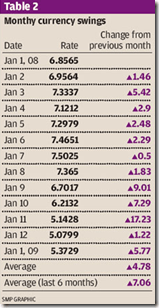 Today’s Sunday Morning Post has an article about the way banks rip you off with a “currency-linked deposit” account. These are widely available in Hong Kong because the interest rates on a standard local currency deposit account are almost zero.
The article has a small chart which is supposed to show how the Australian Dollar exchange rate has fluctuated over the last twelve months.
However, look closely and you may notice two things.
- The date range shown is 1-12 January 2008 and 1 January 2009. Er?
- Apparently the Australian Dollar went up every day/month. Yes, that’s “up” from 7.365 on 08/01/08 to 6.7017 on 09/01/08.
The article is also staggeringly dull, and could be summarised in about two paragraphs (basically the banks penalize you if the chosen currency falls, and don’t reward you if it rises). However, it appears that “Alan Alanson” is paid by the word:
Investors bear brunt of risk with little return to match
[..]
If you put HK$100,000 in an ordinary term deposit with most banks in Hong Kong for one month, the interest rate, about 0.01 per cent per annum, would come to less than HK$1 a month. If, instead, you purchased a currency-linked deposit in Hong Kong dollars linked to Australian dollars, say, the interest rate offered would be much higher. It would not be unusual for you to be offered a rate as high as 15 per cent per annum. Assuming a deposit period of one month, that would work out at 1.25 per cent, or HK$1,250 a month.
The “currency link” part of a currency-linked deposit means that although the investor’s deposit is in HKD, it is linked to some other currency, in this case AUD. If the HKD rises against the AUD during the term of the deposit, investors get their deposit back in AUD instead of in HKD. The exchange rate used to calculate how much the investor receives in AUD is not the exchange rate applicable on the day the deposit matures, but an exchange-rate target set at the beginning of the deposit period.
The exchange-rate target will be at a slight discount to the actual exchange rate when you purchase the currency-linked deposit. Assume the AUD-linked deposit you buy has an exchange rate target of 5.32. So on the day the deposit matures, if AUD buys less than 5.32 Hong Kong dollars, the investor gets AUD instead of HKD at the exchange-rate target, not the actual exchange rate.
Assuming the deposit is for a month, if one month after you buy this product, the AUD only buys 5 HKD, you buy AUD at the higher rate of 5.32 even though AUD is only worth 5 on that day. That would represent a 6 per cent loss of your original capital, which, netted off against the 1.25 per cent interest that you still get, would mean a loss of 4.75 per cent for the month, which on an annual basis would be a 57 per cent loss.
On the other hand, if the AUD increases in value against the HKD, the investor will not get the benefit of currency gains. If it rises against the HKD, the investor still just gets back her HK$100,000 and the 1.25 per cent interest. This is where the mismatch between risk and return arises.
Hey, he finally got to the point after 547 words. Amazingly there are another 970 words to go.
By the way, HSBC are currently offering 10.04% “interest” on a deposit in Australian Dollars.
[update – 25/1/09]. Today’s SCMP has some readers’ responses to the article. One points out the two glaring errors in the chart, whilst someone else offers a rather more concise description of this product, which is a deposit account and a currency option contract. Indeed – the 10.04% “interest” is nothing of the sort, and far higher than you could actually get by depositing Australian Dollars in an Australian bank.
-
As far as I am aware, there aren’t any zebra crossings on public roads in Hong Kong. There are lots of crossings with lights, and some places where there is a central refuge and you can take your life into your hands, and many, many, pedestrian bridges and tunnels.
But the only zebra crossings are on private roads, and so most people seem to be rather confused by these rare beasts.
This is what you do. If there is traffic, you may to have let a few vehicles go, but then you take a step or two forwards (and this is important) whilst making eye contact with the driver of the next vehicle so that he knows you are going to cross. Then off you go.
In the UK, drivers fully expect this, and should be ready to stop. In Hong Kong they often seem rather surprised, but they do stop. Usually.
Locals normally seem to wait for a break in the traffic before crossing. That’s not going to work, because most drivers aren’t going to stop if they can help it.
-
Another fine piece of work from the sub-Standard:
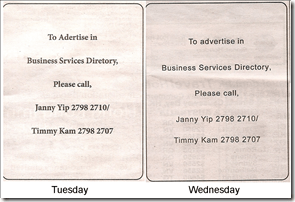
(updated on Wednesday as they did spot their errors, and even removed one of the random capital letters)
-
Sometimes the price of books in Hong Kong is almost beyond belief:
Jamie’s Ministry of Food
Page One, Kowloon Tong HK$474 Cover Price £25.00 HK$292 Amazon.co.uk* (shipped to Hong Kong) £17.97 HK$210 Typical UK bookstore price £12.50 HK$146 £1 = HK$11.68
* Amazon price is £9.99, plus a delivery charge of £7.98 (£4.99 per shipment plus £2.99 per item)
So the price in Page One is more than three times the price you would typically pay in a UK bookstore, and 60% higher than the cover price.
Of course, if you purchase multiple items from Amazon, you could split the shipment charge across all of them, making the books even cheaper.
My last delivery from Amazon took 6 days.
-
There's always a worrying period after a vacancy occurs in the Premier League, when Graeme Souness is linked with the job. This is followed by sighs of relief when someone else (anyone else) is appointed.
It was hard to see why Souness should be linked with the Blackburn job, having jumped ship last time around when he was about to be sacked, and (to be fair) it seems he was as puzzled as everyone else to find his name mentioned.
Even harder to see why Alan Pardew was supposed to be on the short list, what with having just been sacked by Charlton. Yes, he's available, but surely they can't be that desperate…
-
Danny Baker discovered the hard way that you can’t make money out of podcasts. His “All Day Breakfast Show” started off free but closed down only a few months after they started charging a fee. As far as I know, no-one else has tried to do the same thing since then.
Of course, most podcasts are either radio shows re-packaged, or are run by newspapers or magazines to promote their website. However, there are a few notable exceptions:
Herrin and Collings is a very amateur production (it’s recorded on an Apple Mac in Richard Herring’s attic). Journalist and broadcaster Andrew Collins is the straight man to comedian Herring, and they fill an hour or so talking about stories from the day’s newspapers. Apparently Herring used to be a regular guest on Collins’s Sunday show on (BBC Radio) 6 Music, and they seem to have quite a good rapport.
Phill and Phil’s Perfect Ten is rather more professional (it’s recorded in a studio, and they have announcements read out by Stephen Fry), and ostensibly it’s more structured (in that they supposedly answer 10 questions from listeners). However, basically it’s the same concept – two blokes talking away about whatever they want.
Here the two blokes are Phill Jupitus (comedian, longtime team captain on “Never Mind the Buzzcocks”, former presenter of the breakfast show on 6 Music), and Phil Wilding (who was the producer of his radio shows, and previously worked at GLR with Danny Baker). And, yes, they have a website
The theory is that they have exactly 30 minutes to answer 10 randomly selected questions, but they often start with something like “why did you go to Wembley Stadium this weekend?”, which clearly didn’t come from a listener and simply gives them the excuse to talk about anything at all. Entertaining enough if slightly self-indulgent.
Phill Jupitus can also be heard on The Game podcast (from The Times), and Andrew Collins sometimes fills in for Mark Kermode on the Friday film podcast, but I guess they get paid for those gigs.
So why do a podcast for no money?
Herring and Collins did a talk to the Radio Academy about their podcasts, and they said that it does give them each a higher profile for the work they do (probably more for Herring’s stand-up comedy) as well as advertising their availability for a radio show – though it might be hard to accept the constraints of a show on the BBC after the freedom of being able to say whatever you like on a podcast. Maybe it has even worked for Danny Baker, because he now presents 606 once a week (also available as a podcast) and is the temporar.y replacement for Jonathan Ross on Radio 2.
One standalone podcast that isn’t presented by a has-been DJ is Stephen Fry’s Podgram. Far less frequent, shorter, not so funny, and clearly more of a vanity project than anything else – I doubt he is looking for any more work. Of course he has a website
-
Once again the government seems to have made a mess of something that really shouldn't have be so difficult
Two weeks ago, the fare structure for urban taxis was revised, making short journeys more expensive and longer journeys cheaper. However, the fares for New Territories taxis were left unchanged, whereas normally they are kept in line with each other (NT taxis being a little cheaper).
This means that for longer journeys (notably from the airport) it is currently cheaper to take a red (urban) taxi.
The Transport Department were apparently handing out leaflets at the airport showing the fare comparison, highlighting the fact that red taxis would be cheaper for some destinations. Which is true, and it seems fair to let passengers know about it.
However, the green taxi drivers were upset about this and blocked the highway to the airport for a few hours.
So, let's see. The Transport Department knows that red taxis are cheaper than green taxis for longer journey, and might be expected to understand that this might cause trouble, but they didn't think that it might be better to introduce the new fares on the green (NT) taxis at the same time.
The official explanation is that NT taxi associations applied later, and it takes time to process the application. It has been suggested that maybe they wanted to wait and see how the new scheme worked out before deciding whether to apply. Except that in reality they don't have much choice because red taxis can operate throughout Hong Kong and if they are cheaper then of course passengers will chose them.
The real problem is that the government doesn't actually set taxi fares, but simply approves (or doesn't approve) the requests from the taxi associations – who don't agree on whether the new fare structure is a good or a bad thing.
The answer, by the way, is that it's a good thing. Friday's SCMP seemed to confirm this:
Green taxi operator Ng Kwan-sing, who also operates an urban taxi business, said red cabbies' day-time income had risen after the new fare model was introduced on November 30, but night-shift cabbies had not seen a significant increase as illegal discount gangs were still cutting fares to attract long-haul passengers.
Oh, those terrible illegal gangs offering the public better value for money. Put a stop to it immediately!
-
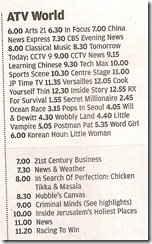
According to the SCMP, tonight on ATV World you can watch chef Heston Blumenthal cooking Chicken Tikka & Masala.
Call me old fashioned, but I think it’s usually called “Chicken Tikka Masala”, and that is indeed how Heston Blumenthal describes it in the programme.
As ever, it’s entertainingly bizarre – Heston heads off to Delhi to find out how to cook the dish, but of course he knows that it’s not really an Indian dish at all. He also tries building a tandoor, but admits that this may not be practical for most people.
But, ATV and SCMP please note, the dish is definitely Chicken Tikka Masala. In search of perfection, indeed.
As luck would have it, I caught part of an episode from the first series on BBC Lifestyle yesterday. He was making fish and chips, and in true Heston style, he added beer to the batter, put it in the fridge – and then put it into a soda syphon.
Well, OK, but what on earth do you do with a soda syphon after you’ve used it to spray batter on your fish?
-
When I used to go on holiday to France, the Michelin Guide was essential reading – when you are somewhere unfamiliar you can't go far wrong choosing a restaurant from the Red Guide Find a place with a red R you are pretty much guaranteed good quality food at a reasonable price, and once you get to the rosettes you are getting exceptional food (albeit at a price to match).
However, the Michelin Guide is a guide to French food in France. I wouldn't take their recommendations for Indian or Chinese food very seriously, and I don't think any of the overseas editions are quite so authoritative. Well, OK, it's probably safe to say that French-style restaurants in the UK that get rosettes are going to be pretty good, but I have visited a few Indian restaurants in the UK that are in the Michelin Guide and not been particularly impressed.
Now there's a guide for Hong Kong & Macau, with predictably hilarious results. They have given three rosettes to one restaurant from Macau and one from Hong Kong, and there are 7 places with two rosettes, and 14 with one rosette (all in Hong Kong).
You can see the list over at Cha Xiu Bao, and frankly I haven't visited enough of the restaurants to make any detailed comments, except to observe that it's a trifle odd to find that two branches from the Lei Garden chain are supposedly in the top 22 restaurants in Hong Kong (a couple more of their branches are also listed).
Perfectly decent Cantonese food (if you like that sort of thing), but nothing exceptional – and I rather doubt that they would be so generous to a restaurant chain in operating in, say, Paris.
As a general rule, I wouldn't ask French people to recommend good restaurants in Hong Kong any more than I would ask a Hong Kong resident for advice on eating in France. I think there may be a moral here somewhere.
 Ordinary Gweilo