Ordinary Gweilo

It's not big and it's not clever, it's just a Brit in Hong Kong writiing (mainly) about Hong Kong

  • It now appears that AIG is going to avoid Chapter 11 bankruptcy, but it’s striking how much power the credit rating agencies have in determining whether it fails or not.

    By threatening to lower AIG’s credit rating, the agencies precipitated a crisis.  This in turn sent AIG’s share price down, which was enough to persuade those very same credit rating agencies to carry out their threat.  This in turn caused the share price to fall again.

    Let’s not forget that these are the very same credit rating agencies who were earlier very happy to give AAA ratings to the exotic financial instruments that caused the downfall of Lehman Brothers, forced Merrill Lynch to sell itself to Bank of America and pushed AIG to the brink.

    You might think that the whole point of having credit rating agencies would be to stop clever bankers sticking some lipstick on a pig and pretending that it’s something altogether more alluring.  Instead the credit rating agencies admired their handiwork and handed out the AAA ratings that they needed.  Then other clever bankers were happy to buy because that was how they got their bonuses, and if it had an AAA rating then that had to be OK, didn’t it?

    Having been so negligent earlier, the credit rating agencies seem happy to force AIG into bankruptcy, despite knowing that if it was given time it could sell off assets and recover.

    One more interesting statistic, from The Guardian: “Figures out today showed hedge funds and other investors that had been shorting Lehman’s stock since March had made $29bn from the firm’s demise.”

  • AIG

    When I searched Google News for news about AIG, guess what was the first story that came up?

    Yes, it was about the sponsorship deal they have with Manchester United…

  • I’m rather liking Google Chrome.  It seems far more intuitive and easier to use that Internet Explorer (OK, that’s not much of a challenge).

    Of course Chrome lacks some features found in IE and other browsers, but Google clearly decided to start with something simple, and that’s got to be a good thing. 

    So far I’ve found a few websites that don’t work properly in Chrome (and one that helpfully tells me to use IE, Firefox or Netscape, but still seems to work), and the built-in Google search is in Chinese and I haven’t figured out how to change it.  But I can live with that in order to have a clean, uncluttered browser.

    My preferred browser is still SlimBrowser (which uses IE as it base, but makes it more usable), though unfortunately it doesn’t seem to be fully-supported any more.  It had tabbed browsing long before IE, and it still has several useful features that are either unavailable or well-hidden in IE, such as opening all links in a new tab, hiding tabs, and displaying multiple tabs simultaneously.    

    What’s interesting is that Google probably don’t care whether Chrome is a success or not – as long as it prompts Microsoft to improve IE.  What matters most to Google is that users can access the web as easily as possible, and not which browser they use.  If the end result is a better version of IE, Google will benefit far more than if Chrome displaces Firefox as the no.2 browser.

  • If you wanted to find out what was on TVB Pearl, you’d look on their website, right?  That should have up-to-date information about what’s on the channel, shouldn’t it?

    Well, not always, it seems.

    Yesterday, they showed Naked Science, but the website shows the information for last week’s episode.  Tonight they have the Celebrity Apprentice, but their website has information about next week’s episode (look away now if you don’t want to know who got fired in tonight’s episode).

    And, best of all (as I mentioned previously), they are showing The Sopranos late on Thursday night, and are providing a synopsis of completely the wrong episodes.  They are showing series 6 part 2 (episodes 78-86), but they appear to think they are showing series 6 part 1 (episodes 66-77), which they actually showed at the start of last year.

    Yes, it is a bit confusing, and it really ought to be called series seven (since it came more than a year after series six part one), but that’s how David Chase and HBO chose to describe it, and one might hope that TVB Pearl could figure it out.  They still haven’t.

    Hong Kong TV guide

  • The big story was the collapse of the Liberal Party in the geographical constituencies, but there were two other things that caught my attention.

    The first was that the pan-democrats were incredibly fortunate with the results.  For example, in NT East they got 57% of the vote and won 71% of the seats, and something similar happened on Hong Kong Island.  The DAB piled up more votes than they needed, and independent (pro-Beijing) candidates such as Scarlett Pong Oi-Lan in NT East and Priscilla Leung Mei-fun in Kowloon West must have taken votes off the Liberal Party.

    The second was that the one party who ought to be really satisfied with their performance were the League of Social Democrats (who are not as moderate as the name might imply).  They won three seats, and who would have predicted that Leung Kwok Hung (“Long Hair”) would get more votes than any of the other pan-democrat lists in NT East?  Yes, by  less than 600 votes, but at one stage the SCMP was predicting that he might lose.

    Ah, opinion polls.  What’s this I see in the SCMP?  Oh, yes – Exit polls largely accurate despite fears about response rate (subscription required):

    The main exit polls appear to have gauged support for many of the candidates accurately despite pollsters’ concerns that a poor response rate could compromise their reliability.

    Questions about exit polls caused some of the biggest controversies of a largely uneventful campaign. Pan-democrats complained that their Beijing loyalist rivals might set up groups to conduct exit polls and use the results to adjust election strategy. They reminded voters of their right to refuse exit pollsters information. Many voters seemed to heed the reminder, and some even said they had lied to pollsters.

    The value of the exit polls, including the one by the University of Hong Kong’s public opinion programme to help broadcasters shape their coverage on election night, was called into question. Some candidates cited leaks of exit poll data when they issued “situation critical” calls to bring out more of their voters.

    Initial results, released yesterday, from two exit polls – by the HKU programme and Hong Kong Research Association – indicated a response rate of about 50 per cent. The association said the 50 per cent level was barely acceptable to produce representative projections.

    While its projections were largely reliable, its results indicated Audrey Eu Yuet-mee, who was second on the Civic Party ticket contesting the Hong Kong Island constituency, stood an “extremely slim chance” of winning. However, Ms Eu won, with her ticket taking 26.4 per cent of the votes cast by the 313,429 electors in the constituency.

    In the New Territories West constituency, its poll gave Selina Chow Liang Shuk-yee of the Liberal Party and Fernando Cheung Chiu-hung of the Civic Party a “relatively bigger chance” of winning. But Mrs Chow won only 5.4 per cent of the vote and Dr Cheung just 7 per cent. Both lost. The association’s data also gave James Tien Pei-chun, of the Liberal Party, a “relatively bigger chance” of winning in New Territories East. He also lost.

    The HKU public opinion programme’s exit poll gave five of the six eventual winners in Hong Kong Island a very high chance of victory. In New Territories East, it gave five of the seven eventual winners a very high chance and in New Territories West correctly predicted five of the eight winners.

    This is obviously a new definition of “largely reliable”.  We got several of our predictions wrong, but some were correct, so that’s OK then.

    Independent pollster Li Pang-kwong, of Lingnan University, who did not conduct exit polling on Sunday, believed the discrepancies were partly attributable to interviewees giving false answers.

    Yes, people sometimes lie when asked how they will vote or have voted, and it’s something pollsters have to deal with.

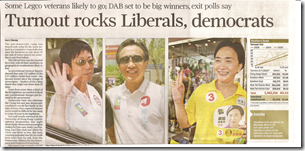
  • SCMP 080908It’s quite amusing to read this morning’s newspapers with their predictions of doom for the pan-democrats in the Legislative Council elections.  The Standard went with “Disaster Hits Democrats”, and the SCMP changed their headline during the night from “Turnout rocks pan-democrats” to “Turnout rocks Liberals, democrats”.  Well, half right.

    image_thumb[2]In fact it was the Liberal Party that had a really bad night, with James Tien and Selina Chow losing their seats, and Michael Tien failing to make much impact in Kowloon West.  That meant the Liberal Party didn’t win a single seat in the geographical constituencies (though they retained 7 out of 8 of their seats in the Functional Constituencies).

    The pan-democrats actually managed to gain a seat in the geographical constituencies, taking advantage of the Liberal Party’s problems by taking 5 out of 7 in New Territories East, though this was balanced by the loss of three seats in the functional constituencies.  Certainly not a disaster. 

    Nor were the DAB the “big winners” (as the headline says).  They actually ended up with one seat fewer than 4 years ago.

    The conventional wisdom is that the pan-democrats suffer when turnout is low and that, together with the results of an exit poll, was what prompted both The Standard and the SCMP to publish those front-page stories that now look rather silly.  This is from the SCMP’s front page story:

    The pan-democratic camp was braced early today for the worst settback in a Legislative Council election since the hand over as only about 45 per cent of voters tumed out yesterday to cast their ballots.  The Liberal Party was also headed for a rout, with all their candidates in geographical constituencies likely to lose.  [..]

    Exit poll results released by the University of Hong Kong’s public opinion programme last night showed pan-democrat heavyweights Audrey Eu Yuet-mee, Emily Lau Wai-hing, Lau Chin-shok and Albert Ho Chun-yan likely to lose. But early counting indicated that Ms Eu could beat rival Choy So-yuk, from the Democratic Alliance for the Betterrment and Progress of Hong Kong.

    The worst-case scenario would see the pan-democrats win 15 seats in the geographical constituencies and four functional constituency seats. The pan-democrats won 25 seats in the 2000 election, 18 of which were returned by direction election.  The camp secured 22 seats in 2000.

    We now know that the exit polls were wrong – although Lau Chin-shek did lose in Kowloon West, the rest of the pan-democrats mentioned above all won fairly comfortably, and their overall result was far better than the ‘worst-case scenario’ that the exit polls seemed to imply.  Back to the drawing board. 

  • The Legco elections take place today, and I have to admit that I’m having trouble taking them seriously.

    The first problem is that we are not electing a government – oh no, that isn’t the way things work here.

    That leads directly to the second problem – politics in Hong Kong is more about posturing than policy.  It is meaningless for a party to promise smaller class sizes, higher welfare benefits, or lower taxes, when they won’t have the opportunity to implement the policies (one might say the same about the Liberal Democrats in the UK, but at least they pretend they could form a government). 

    So in broad terms we have two groupings: the pan-democrats and the pro-Beijing parties.  Those labels are not very helpful, because not many people in Hong Kong are either anti-democracy or anti-Beijing, but I suppose we all understand what they mean.  Another way of looking at it is that the pro-Beijing parties (the DAB and the Liberal Party) tend to be more supportive of the Hong Kong government, and the pan-democrats normally oppose the government, but again that’s not terribly useful.          

    The third problem is the voting system.  Hong Kong has 5 large constituencies, each electing between 5 and 8 legislators.  If this system was used in the UK it would produce a more representative House of Commons because the Liberal Democrats would be guaranteed at least one seat in almost all the constituencies. In Hong Kong it also produces a fairly representative Legco, with the main advantage (cynics say) of ensuring that the pro-Beijing parties are well-represented in Legco – at least in part because the “pan-democrats” are generally not as organized or disciplined as the pro-Beijing parties. 

    Take New Territories East, which has no less than 10 different lists.  There are two lists for the “pro-Beijing” parties: the DAB expect to win two seats and the Liberal Party’s James Tien would expect to win another.  That leaves four more seats, and you might expect the pan-democrats to win all of them.  The problem is that they have five different lists (unlike last time when there was a single “7.1 United Front” list). The Democratic Party alone has two lists, the second one apparently being for their younger members.  Then there’s The Frontier (Emily Lau Wai-Hing), and the Civic Party (Ronny Tong Ka-Wah), who were also on the “7.1 United Front” list 4 years ago.  There’s also the League of Social Democrats (Leung Kwok Hung, aka ‘Long Hair), who wasn’t.

    The problem for the pan-democrats is that the result is largely going to depend how the votes are split between these five lists, and it is quite possible (based on opinion polls) that Scarlett Pong Oi-Lan (running as an independent, but regarded as ‘pro-Beijing’) could edge out either Emily Lau or ‘Long Hair’.  On the other hand, the pan-democrats could get five seats. 

    The biggest weakness of the ‘party list’ system is that if a list gets get too few votes to elect a single candidate, none of those votes really count.  Equally, if a list gets enough votes to elect one candidate, but not enough to elect a second candidate then again the excess votes also don’t count.  The solution is STV (single transferrable vote) , which has the added advantage that voters could choose their preferred candidates rather than being stuck with the party lists.  You’d like to vote Liberal but can’t stand James Tien?  Well, you would be able to do just that – but don’t hold your breath waiting for that to happen.

    The fourth problem is that it all seems much more showbiz that serious politics.  Some candidates have been using empty-headed celebrities to promote their election bids, and the debates (shown on Cable TV) have seen a lot of shouting but very little serious discussion – which is hardly surprising when they are conducted in a public open space and the 30 or so candidates are flanked by noisy supporters.  It’s almost as if they really don’t want us to take it too seriously.    

  • A glorious rag-bag of policies from one of the candidates who isn’t going to win a seat in Legco on Sunday. 

    I love the sheer randomness of the policies – some good, some bad (cancelling petrol tax), and some just a bit baffling (what exactly is the current toilet ratio?).

    Legco leafletilet 

  • Well, well.  The BBC are reporting that Keegan and Newcastle part company, which must be the the least surprising football news of the year.  The only surprise would be that he lasted a full eight months.

    Back in January I said (Mad):

    This really is the gift that keeps on giving…

    I thought Newcastle's board were going to spoil the fun when they said that they would take their time finding a manager and might consider appointing a foreigner.  Gérard Houllier was mentioned, and then Didier Deschamps was suddenly installed as favourite.  They even turned down Alan Shearer's bid for the job.  So far, so good.

    Then last night they announced (drum roll) that, er, Kevin Keegan is returning as manager.

    That's more like it.  The best part is that in a few months Keegan will get upset about something and resign, and the whole circus can start up again.

    Apparently the thing he doesn't like this time is that he hasn't been able to buy all the players he wanted. 

    [Update: the BBC are now reporting that Keegan has not been sacked but that his future is "unclear".]

  • These days we have a huge choice of channels in Hong Kong (mainly thanks to Now TV), but how is anyone supposed to know what is on them all? 

    Logo2In my opinion, the SCMP does a fairly poor job of keeping viewers up to date with what is on, and you can’t even rely on the websites of the various channels (TVB apparently think they are showing the Sopranos Series 6 part 1 late on Thursday nights, but they showed that last year, and they are now showing the second part of Series Six).

    So please give a big welcome to www.myhktv.net.  Previews of what’s on TV in Hong, news about TV, a list of channels, and other useful stuff.  Enjoy.