• Hong Kong streets and shopping centres are strangely quiet and traffic is light. 

    Yes, we’ve been here before, but last time (just a couple of months ago) it was the protests whereas now it’s Novel coronavirus (2019-nCoV). 

    Many local people are choosing to spend more time at home (with some employers telling staff not to come into the office), there are far fewer visitors from the Mainland, and Carrie Lam has said that Hong Kong’s Foreign Domestic Helpers should stay at home on their one day off every week.  That’s fair, right?  

    There have been long queues in supermarkets, with some panic-buying of food and cleaning products.  As far as I can tell, although some food items are temporarily unavailable at times, there are no actual shortages (so far).

    Surgical masks are a different matter.  They started disappearing off the shelves in early January and now there are long queues for any that become available, and some crazy prices in less reputable pharmacies.

    Alcohol hand rub is also very hard to find (even Cathay Pacific seems to have run out). 

    It’s a sensible precaution to wear a mask on public transport and in shopping centres (or anywhere that is crowded), but in the last couple of days I’ve even seen people wearing them outside in places where it would be almost impossible to be in close contact with anyone for more than a few seconds.

    But we all remember SARS, and so it’s totally understandable that’s there’s an excess of caution.       

    The New York Times has a timeline here: As New Coronavirus Spread, China’s Old Habits Delayed Fight

  • In the early weeks of the protests, damage generally got cleared up very quickly so everything could return to normal.  MTR stations re-opened the next morning and services ran normally.  Damaged traffic lights were repaired within a few hours.

    By September, things had changed.  The MTR started closing stations near to protests (both planned as well as ongoing).  In October large number of shopping centres were shut, which made life very inconvenient.   

    Then we moved to the next phase. 

    • The whole MTR network closed early every night. 
    • There were large signs to say that MTR facilities had been vandalized (even when actually they were still working).
    • Traffic lights were left unrepaired, often causing gridlock and extensive delays.
    • The Festival Walk shopping centre in Kowloon Tong has been completely closed for weeks, and damaged facilities in other malls have been repaired very slowly.    

    Presumably the idea was that the silent majority would blame the protestors.

    That didn’t work.

    However, the reality is that the government has the power to do whatever it chooses, and Hong Kong people can’t do much about it.

    The proportional voting system for the Legco elections, coupled with the large number of legislators who are not directly elected, mean that it is unlikely that opponents of the government could ever get a majority.  And we have seen that there an endless number of ways that Legislators can be disqualified, and by-elections can be delayed indefinitely, further reducing the ranks of the opposition.

    On top of that, many large companies in Hong Kong are reluctant to do anything that might offend the PRC government.  Early in the protests Cathay Pacific was the most prominent example (mainly because of their subsidiary Cathay Dragon), and the MTR is not only 75% owned by the HK government but it also operates the Shenzen Metro (and parts of other metro system in the PRC). 

    If Hong Kong people can’t effect change by marching in vast numbers, by the protests, or by voting, what is left? 

    Well, the Hong Kong Institute of Asia-Pacific Affairs (at the Chinese University of Hong Kong) say that 42% of Hong Kong people want to emigrate (pdf), up from 34% last year

    Over 3 million are entitled to the currently useless BNO passport (which looks like a British passport, but doesn’t give the holder the right to settle in the UK, which is quite some limitation).

    There is the possibility that the British government might do something about that.  However, Foreign Secretary Dominic Raab (did someone say “useless”?) apparently thinks that might “antagonize China and fall foul of the ‘one country, two systems’ approach”.  

    That could be very annoying for the PRC government.  Troublemakers leaving, to be replaced by an inexhaustible supply of shiny new citizens from the Motherland.  Yes, that would be a bad outcome, definitely.

    Of course there are plenty of others here with real passports for Australia, Canada, New Zealand, the United States, and, yes, the UK.  Many of these were acquired back before the Handover when prospects looked bleak. 

    But the handover went smoothly, and the talk of Chinese troops being sent in to quell the protests has (at least so far) proved to be nothing more than rumour.

    The story of the last 22 years has been of Hong Kong slowly becoming more like Mainland China.  Putonghua (Mandarin) is now widely used, and there is a quota of 150 “one-way permits” per day for PRC citizens to settle in Hong Kong.  That’s 50,000+ per year, and more than one million since the handover in 1997.

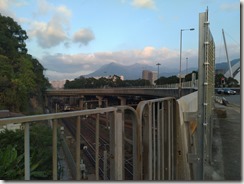
    Fences over the railway near to the Chinese University of Hong KongOn top of that, many thousands come to Hong Kong for the day, and they are very important for the retail sector.  In fact, one of the biggest economic impacts of the protests was the absence of those visitors. 

    Which might help to explain why building fences to protect the railway (see right) is a higher priority than repairing traffic lights.

  • Marketplace by Jasons (your actual upmarket Wellcome) started stocking Sainsburys products less than three years ago (early 2017). 

    It doesn’t seem to have been a big success. According to this link, they now only stock 10 of their fresh and frozen products, and only 100 items in total (compared with at least double that in 2017).  

    The good people at Dairy Farm (owners of Wellcome, Market Place, Olivers and 3hreeSixty) have moved on, and are now seeing other foreign retailers: 

    • French cheeses, meats and, er, pasta from Monoprix (France) at better prices than the disappeared Sainsburys products
    • and IKEA meatballs, salmon, etc.  Yes, really.  But not so surprising when you realize that Dairy Farm operate the IKEA stores in Hong Kong.

    Meanwhile, ParknShop have started stocking products from Woolworths (Australia), and of course they also have been selling French and British supermarket brands (Casino & Waitrose) for quite a long time.        

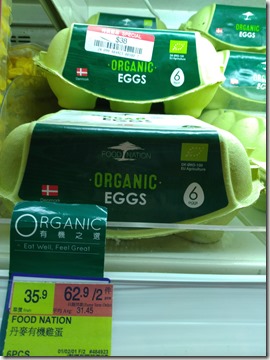
    ParknShop do seem to be making rather tentative attempts to develop their own brand, Food Nation (including those “Special Offer” eggs).  But for now, both they and Wellcome seem to have far more faith in other retailers’ own brands than their own.

  • Special offer!IMG_20191202_181814

    Half a dozen eggs for HK$35.90

    Or a dozen eggs for HK$62.90

    Or a special offer of HK$38 for one carton.

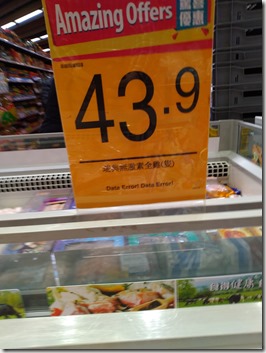
    Or there’s this mysterious item:

    IMG_20191215_112737

    Who doesn’t love a Data Error?  So good they named it twice.

  • Imagine for a moment that you have to decide whether the District Elections should go ahead.  The protests give you the perfect excuse to postpone them, but that would certainly make things worse, so you need to think carefully.

    You’re not actually in Hong Kong, of course, but you have the benefit of advice from both the Hong Kong Liaison Office and the puppet government  (including its first-rate Chief Executive Carrie Lam Yuet-ngor). 

    They tell you that the “silent majority” hate the protests and so they won’t vote for those troublemakers in the pan-democrats, and not to worry because the (pro-Beijing) DAB is really well organized and very active in local communities, so they will be fine.

    Based on this excellent advice, you decide that it would be a really bad look to cancel these elections (nasty, messy, unpredictable things though they are), and you’re looking forward to a good result that will strengthen Carrie Lam – at least until you let her resign.

    Hong Kong people, on the other hand, were expecting the elections to be cancelled, right up until very last minute.  Or there was the theory that there would be some excuse to end voting early before most of the pan-democrat supporters had got to the polling stations.

    After all, why would they risk things going wrong?  Surely it was obvious to anyone who was paying attention that the majority of voters would take the opportunity to express their feelings – of (qualified) support for the protestors and contempt for Carrie Lam and her administration. 

    But, no, the election went ahead, and vast crowds turned up from early in the morning right through until the evening.  People were happy to queue up for an hour or more.  

    • By 11:30 am, one million people had voted.  It took until 6.30 pm for the same number of votes to be recorded in 2015.
    • By 3:30 pm it was over two million.  That’s about one-third more than the total number of votes in 2015.
    • The final total was just below 3 million.  A turnout rate of 71%, compared to 47% last time.

    The result was a landslide victory for the pan democrats.  17 out of 18 councils, 60% of the votes, and nearly 400 of the 452 seats.  On the pro-government side, the DAB won just 21 seats, compared with 119 four years ago. Plenty of big names lost their seats, including Junius Ho Kwan-yiu, Michael Tien Puk-sun,  Holden Chow Ho-ding, Horace Cheung Kwok-kwan, Vincent Cheng Wing-shun and Edward Lau Kwok-fan.

    One big factor is that District Council seats are decided under the “First Past the Post” system, whereas of course the more important Legislative Council elections use a form of Proportional Representation that would not produce a “landslide victory” based on 60% of the votes.

    The question is what happens next.  Will it force Carrie Lam (or the people who give her instructions) to try to find a solution now that they know what the “silent majority” really think?  

  • Having promised not to provide a running commentary on the Hong Kong protests, here are a few thoughts on recent developments.

    The latest government strategy seems to be to make life as inconvenient as possible for everyone, in the hope that this will turn people against the protestors.

    The MTR has been closing stations that would have been useful for protestors, which was bad enough, but then last night they closed the whole network and today there is only one line open (the Airport Express) and that is only serving two stations.

    On 1st October they closed many shopping malls, and the same trick has been repeated today.

    In Hong Kong, we often walk through shopping centres to get from one place to another, and many subways under or over main roads are either part of an MTR station or a shopping centre.  So even though there are buses operating, you may not be able to get to the bus stop. 

    Oh, and they closed Kowloon Park as well.

    Hong Kong people are not stupid.  They know that all of this is being done by the government.    

  • Visitors to Hong Kong are expecting chaos at the airport and all over the city, and are shocked to find that there’s nothing to see (and delighted by the low low prices charged by hotels).

    The protests are still very much happening, but most last only a short time, and there’s hardly any evidence of them afterwards (with everything cleared up within hours).   Even the one at the airport didn’t last too long, and on the second day flights were still taking off long after it was reported that everything had stopped.  

    I’m not going to risk any analysis, but the following are worth following on Twitter: @HongKongFP @HongKongHermit @Lok. Renaud Haccart (sadly, I’m not getting anymore “helpful” tweets from PRC media organizations to give me a more balanced view).

    And Hemlock is usually worth a read.

    This article is quite good:  'We must defend our city': A day in the life of a Hong Kong protester

    This, on the other hand, is terrible:

    The World Is Reaping the Chaos the British Empire Sowed

    Locals are still paying for the mess the British left behind in Hong Kong and Kashmir.

    BY AMY HAWKINS | AUGUST 13, 2019, 4:14 PM

    There was a time when the sun never set on the British Empire. That’s long gone, but the grubby legacy of imperialism remains in Asia, where two seemingly distinct crises—in Hong Kong and Kashmir—share the same legacy.

    Hong Kong is in its 10th week of demonstrations, as hundreds of thousands of people from all walks of society call for greater democratic freedoms in their city. The police have responded brutally while Beijing now describes the protests as “terrorism.”

    Where to start?  The UK wanted to introduce more democracy to Hong Kong in the 1950s, but were told by the Beijing government that this was not acceptable and that they would invade the territory if there was any attempt to change the status quo. 

    Then in 1982 (when Margaret Thatcher was Prime Minister) the Foreign Office apparently believed that China could be persuaded to allow Britain to continue to run Hong Kong in return for acknowledging Chinese sovereignty.  The response from China was (predictably enough) that it was going to take control on 1 July 1997 come what may, and if necessary they would use troops to make it happen.  There was very little that the UK could have done about that, but both sides wanted an agreement, and one was duly reached. 

    Of course we know that Chris Patten did introduce greater democracy in the 1990s when he was Governor, and ignored similar threats from Beijing.  Needless to say, when China took control they changed the voting system, so Patten’s reforms achieved very little.

    Yes, you can say that the UK could have done more in the first hundred years it ruled Hong Kong, but that wouldn’t have changed the fundamental problem that the New Territories was leased from China. 

    Or you could say that all imperialism is wrong and the UK should never have had any involvement in Hong Kong.  Which is fair enough as a general principle, but totally misses the point of the protests, which are actually about wanting Hong Kong to be different from the Mainland. 

    Today’s Cantonese expression is 加油 “gaa yau”, which means “add oil” and can be used when you want to offer encouragement to anyone (it’s widely used to give support for the protestors).

  • When I opened my wallet I realized that my credit card was missing. 

    After a few moments of panic, I remembered that I must have left it inside a self-service till.  Indeed I had – unfortunately it was 50 miles away in a different city (at a branch of the UK’s worst high street retailer). 

    When I returned to the store, the manager asked me to choose from a selection of cards that had been left in the machine, which made me feel a little bit less foolish (though not much).  This was a few years ago, and contactless cards (and Apple Pay, Google Pay, etc.) now make things easier.  But there was still that annoying message, which can be roughly translated as "Hey, someone is trying to steal something." 

    Apparently Tesco have changed it to something less aggressive, but I still don't like machines talking to me, thanks all the same. 

    It's taken a while, but now they are appearing all over Hong Kong, and in a surprising development the self-service tills recently installed in most ParknShop stores in Hong Kong keep quiet about what they think I might be stealing.  

    It's not all good news.  ParknShop apparently think it would be amusing to make the customer identify any loose fruit and vegetables by searching through a series of flashcards that are placed next to the till.  Small children are, needless to say, attracted to them much as moths are to a bright light, with equally untidy results.  Wouldn't it be easier to just have images on the screen like everyone else?

    So it's safe to say that self-service tills are here to stay.

    Spare a thought, though, for Howard Schneider, who developed some of the earliest self-service tills, but who sold his company for a fraction of what it is worth today.  If you want to know more, this podcast from Planet Money is worth a listen.

    And today's Cantonese is the name of that ubiquitous supermarket chain: 百佳 baak3 gaai1 (which can be translated as "100s of good things").  No parking, no shopping.

  • Spike is back in Hong Kong, having been forced to retire from his job in the Philippines because of the local laws.  Which was quite a surprise to him (and to most people, I guess)

    He had to go to the hospital: One of the Dumbest Things I’ve Ever Done

    I was surprised that a visit to the emergency ward now costs HK$180 (roughly US$23.50). Of course that’s just a fraction of what it probably costs in the U.S. but even so, five years ago I’m sure it was just HK$100. That’s a big jump in 5 years. Have people stopped betting on the horses? Are HK hospitals charging retaliatory tariffs to U.S. patients?

    Obviously the last part isn't true.  That's the rate for holders of a Hong Kong ID card (others have to pay HK$1,230).  But he's right that it was increased from HK$100 about two years ago.

    I confess to not fully understanding the charges for healthcare in Hong Kong.  Visiting a GP seems quite expensive, especially considering the "three-minute-visit/five-bags-of-pills policy".   But last time I visited a specialist (in a private hospital) it cost less than Spike paid for his visit to an emergency room.  I suppose that a visit to the hospital pharmacy would increase the total cost, but I was paying for this myself, and I know a better solution for that.

    And I can add to my list of places in Hong Kong where the commonly used Cantonese name is totally different from the English name – St Teresa's Hospital (聖德肋撒醫院) is known as "faat gwok yi yun" (法國醫院).  Look it up.

  • Honest Bee, sorry that you are closing down.
    I placed several orders with you
    But items were always missing
    Or the wrong item was delivered
    So, honestly, I'm not surprised

    My last order was for five products. They only delivered one of them. One!

    Then there was the time when I happened to go to the supermarket a few days after another order had been delivered (with several products missing), and miraculously I was able to find most of those items on the shelves.  

    To be fair, I only used Honest Bee to order Tesco products (from uSelect).  And they only ever had a partial selection of Tesco products available.  

    But why didn't they have the full range of products? Why didn't they know what was actually available?  Why were some products frequently shown as available when there was no stock?  But, hey, sometimes I took advantage of this by ordering these products to reach the minimum order value.

    Another obvious flaw with their system was that if (for example) I placed an order on Wednesday for delivery on Saturday, I couldn't order anything that was out of stock on Wednesday, and they couldn't deliver anything that was out of stock on Saturday.  And there was no way for me to request a product that was out of stock on Wednesday but actually available on Saturday.