• One of the things you have to admire about George Adams is that he is always willing to admit that he was wrong.  He used to complain that blogs were trivial and inconsequential, and then he started putting photographs of his girlfriend (and all sorts of other trivia) on to his own website – though he can’t quite bring himself to use the b word.

    He took part in a phone-in on RTHK and predicted that Spike magazine would fail because the Internet was the future.  Apparently he was also wrong about that, because he has now deleted all the content from his website and started publishing a print magazine instead (well, he deleted everything on the main page apart from a long plug for the print edition, but has now added a couple of new stories). 

    I haven’t seen the magazine (distribution up in the wilds of the New Territories is patchy to say the least), but it is apparently available in dozens of branches of Park’n’Shop, which is owned by Li Ka Shing, who George accused of blocking his website (though others felt that it was actually a technical problem with his web host).  Obviously he’s changed his mind as well.

    It’s hard to believe that he can sell enough copies even to cover his costs.  Or maybe this is all an elaborate joke.  Does he do jokes (apart from hugely amusing one about all bloggers being fat)?

  • scan0006There’s an excellent editorial in today’s Sunday Morning Post (Burning iPhone envy? Don’t believe the hype):

    Undeniably, since its inception in the 1970s, Apple has revolutionised the way we use personal computers and listen to music. iPod’s impact today has been as great as the Sony Walkman, if not greater. Its worldwide popularity forces music companies to rethink their business models or risk going under. But is the new iPhone comparably revolutionary, as claimed? Yes, it is – a revolution in the sublime art of marketing hype.

    Wise words, indeed .

    SCMP 080712Now then, which newspaper had a front-page story yesterday (Saturday) with a picture of the lucky, lucky, person who bought the first iPhone 3G from Hutchuson Telecom, and then followed it up with more nonsense about this non-story covering virtually all of the front page of the City section:

    Could it possibly have been the South China Morning Post?  I think it could.  There were also a couple of stories on Friday:

    It’s a good thing the SCMP didn’t fall for the hype, then, because that would have made their editorial on Sunday look rather silly.

  • I recently found myself in a taxi driven by one of the winners of the Transport Department’s ‘Quality Taxi Driver’ scheme.  I knew this because the information was inscribed on the identity card in the cab, albeit somewhat faded.


    As, unfortunately, was the quality of the driving.  In fact, it was one of the least comfortable taxi journeys I have had for quite a long time.  Not much quality in evidence, I’m afraid.  What is the point of this scheme, anyway?


    In doing a little research, I found this highly amusing press release on the Transport Department’s website:

    In the short film, Mr. Robert Footman, Commissioner for Transport is playing the role of a quality taxi driver – The boss FOK. He always keeps his taxi clean and tidy, polite and has the initiatives to offer assistance to passengers. The first passenger in the short film is the famous talk-show star Mr. Paul CHENG. After Paul CHENG has got into the taxi, he immediately praised the well equipped liquefied petroleum gas (LGP) taxi driven by the boss FOK, on which a taxi meter, talking functions, Braille and tactile taxi registration number plates have been installed for the convenience of the passengers who have visual impairment(video 1).

    Another passenger in the short film is a female passenger carrying a piece of large luggage. When the Boss FOK sees this, he immediately gets off the car to assist her, and places the luggage at the boot of the car (video 2). Then, the third passenger is a passenger who speaks Putonghua and is hurrying to the Quality Taxi Services Forum. As this is the first time that the passenger comes to Hong Kong, the Boss FOK introduces some snacks of Hong Kong in Putonghua for him, including dim sum, bean curd dessert and won ton noodle. When the boss FOK adds some LPG gas at the gas station in the evening, he meets other taxi drivers. During the chat, he knows that one of the drivers hands the mobile phone left by a passenger to the Police Station. The Transport Department also issues a letter to compliment the good act done by the taxi-driver (video 3).

    The last scene of the short film is taken in a Chinese restaurant. The boss FOK is dining with fellow taxi-drivers. After the meal, as it was raining, they can only stay in the Chinese restaurant. The short film has covered the joy and sorrow of the taxi-driver. As the boss FOK has a ‘long journey passenger’, he obtains more than six hundred dollars in half day’s work. On the contrary, another taxi driver called ‘Ah Keung’ does not pay attention to the cleanliness of his taxi, and he is also impolite to the passengers, therefore his income is very limited.

    Another taxi driver is played by the Chairman of Ad Hoc Quality Taxi Services Steering Committee Jeffrey LAM. Mr. LAM. points out that as the Hong Kong economy is in a downturn, taxi drivers can only spend more efforts in providing quality services, as though they are Tourist Ambassadors. Recently, the Government has relaxed control on many restricted areas; the income of taxi-drivers should improve gradually.

    Subsequently, a driver flipped the pages of a car magazine, various taxi drivers sketched an ideal model of a luxurious taxi in which genuine leather seats, octopus system and mini screen behind the headrest are installed. The taxi driver can also introduce himself through the screen, remind the passengers to fasten the seat belt, explain the taxi fee charges and so on(video 4).

    Marvellous stuff.
  • The BBC recently upgraded its website.  This is “upgraded” in the sense of making it flashier and brighter and generally less useful.


    It also has adverts, which I suppose we can’t complain about because the funding comes from people in the UK who pay for a TV licence (i.e. almost everyone), and those of us in the rest of the world are freeloaders.


    Another annoyance is that there is lots of video (on the sports pages at least), which is not available to non-UK residents.  The puzzling part about this is that firstly they ask you to choose a UK or international version, and they also check your IP address, so why not just hide the content you can’t watch?


    It’s the design that really annoys me.  More on the sports page than for news, presumably because they are trying to provide coverage for several different sports, and in the summer there are various major events (Euro 2008, Wimbledon, Tour de France, Open Golf, and of course the Olympics).  Unfortunately it all gets so cluttered, and I can never find the information I want.


    You can see an archived copy of the old version here.

  • It’s week 8, and we see the teams saying nice things about Sir Alan.  Thanks, BBC producers. 

    This week’s task is to make some food to sell at a farmer’s market.  We see Raj frying an egg (for breakfast, one might assume), and then they get a phone call from Frances, telling them to be ready in 10 minutes.  They are whisked off the Viglen assembly plant, by which time it is afternoon, and Sir Alan is brandishing some computer bits and pieces.  “This is a microprocessor with a fan, a hard drive, a power supply.”  This is going to be a lesson about making things.  “What we have to do is put them all together and we have one of these.”  It’s a computer without a side panel.  Yes, this is a lesson on how to buy cheap bits and pieces from Asia and make an expensive computer and get rich, so that you can appear on TV.

    The teams have to buy raw produce and add value.  James nominates Ben to be the project manager again because thinks it all went so well last time.  Is this a cunning plan? 

    (more…)

  • Since digital TV was launched in Hong Kong I have been waiting for a personal video recorder (PVR) that uses the electronic programme guide (EPG).


    They are now available. I came across a curious device in one shop from Picazzo, which claims to “support digital TV recording”, but it lacks a hard disk and reviews suggest that it is not user-friendly.  At least the price is reasonable, unlike the other one I have found. 


    This is the Magic TV MTV5000 box, which can record high definition TV, but at HK$4,900 for a single tuner PVR it seems awfully over-priced. 


    In the UK, you can buy a dual-tuner PVR for digital TV for £150.  This will not have 500gb of disk, so we can add about £50 for that.  That’s £200 (excluding VAT), or about HK$3,100, though admittedly it does not support HD.  I therefore predict that the MTV 5000 will be reduced to less than HK$3,000 and they will come up with a dual-tuner version (so you can watch one channel and record another).


    A cheaper solution is to use your PC – just buy a USB tuner for about HK$500, which should come with software allowing you to view and record digital TV, and maybe a bigger hard disk (internal or external).  Unlike the awful Windows XP Media Centre this combination will allow you to create a DVD to watch on your TV, or you could even attach the computer directly to your TV.   


    Which, I suppose, also begs the question of whether anyone even needs this type of device when the future is in downloading (legal or otherwise). 

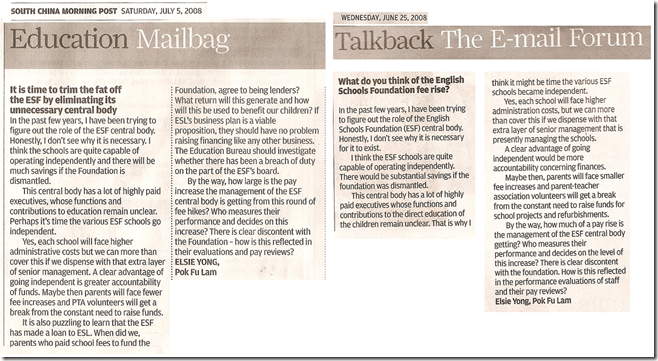
  • Unless I am very much mistaken, this is the same letter printed twice in the SCMP – once in Talkback on June 25, and then about 10 days later in the Education Mailbag. 

    Though, to be fair, they have edited it slightly differently each time:

    SCMP do it twice

  • Well, Wimbledon is over for another year.  Star Sports seem to do a fairly competent job of covering the championships, with live coverage every evening, a highlights show in the morning, and extended highlights in the afternoon.


    However, I can’t help feeling that they could do better.  In a multi-channel world it seems a little odd that we don’t get a choice of games (as the BBC provides in the UK through digital TV), especially when Star Sports choose Tamarina Tanasugarn in preference to Roger Federer.  It seems to be possible to show multiple Champions League matches live, so why not Wimbledon?


    I’m also puzzling over why Star Sports sometimes take the BBC commentary, and other times have their own team.  I’d far rather hear what John McEnroe and Virginia Wade think about the game, and it’s also slightly frustrating when the camera picks out someone in the crowd and the Star commentators ignore it completely (as happened frequently in Federer vs. Nadal).


    If you really wanted the BBC commentary for the mens and womens finals you had to watch TVB Pearl – which made Star’s claim (in a newspaper advert) to have exclusive coverage look very silly.


    Meanwhile, with Star Sports and TVB Pearl both showing Wimbledon, where was the British Grand Prix?  Nowhere to be seen.    

  • Last year I made fun of the SCMP for somehow implying that an HD TV set would enable viewers to watch the BBC series Planet Earth in HD even though (1) digital TV had not been launched at the time, and (2) it was on TVB Pearl, which was not planned to be (and is not now) available in HD.


    However, it seemed inevitable that TVB would eventually get around to broadcasting it on their HD service, and that is what they are currently doing on Sunday mornings.


    Not that readers of the SCMP will know about this, since there are no listings for any of the digital-only channels in that fine newspaper.  Going to the TVB website isn’t much help either, because it’s all in Chinese (apart from TVB Pearl).  You could visit http://schedule.tvb.com/hdjade but there’s no English listings even for the English language programmes! 


    Thankfully, the electronic programme guide (EPG) is available in English.

  • One of the weirder things that our government has decided to do to celebrate the Beijing Olympics is to waive charges for public leisure facilities.  However, the SCMP reported on Wednesday that people didn’t seem to be aware of this concession (Swimmers surprised they can use pools for free – subscription required)

    Many swimmers got a pleasant surprise yesterday at the Victoria Park Swimming Pool – free admission.  The pool is in the Leisure and Cultural Services Department’s free-admission scheme, announced on May 9, which allows the public to use government leisure facilities – such as swimming pools and squash, tennis and badminton courts – at no charge from yesterday to September 30.

    The scheme aims to encourage the public to exercise more regularly and to promote next month’s Beijing Olympic Games.  About 70 people lined up at the Victoria Park pool before the afternoon session opened at 1pm. The first in line were secondary-school students Jeff Poon and Dickson Pun, who had heard of the free admission. They arrived at about 12.30pm.

    “I will visit the pool more often because of the free admission,” Dickson said. “But I do not think it would make me more interested in the Olympic Games.” Jeff said the two went to swim because no badminton courts were available – all Hong Kong Island courts were fully booked for the coming three weeks, he said.

    But the two boys were in the minority who knew the swimming pool was free yesterday. Many swimmers were surprised when told there was no need to pay to use the pool – and some even asked the staff why.

    Jack Holworthy said he did not know about the scheme although he went to a public pool three times a week. It was a good way to encourage people to participate in sport.  A Mrs Chan took her seven-year-old daughter, Sandy, to the pool yesterday and said she would visit it more often now that she knew the service was free.

    A department spokesman said the effectiveness of free admission would be evaluated today after officials totalled up the number of people who used pools yesterday.

    Today’s SCMP has a different angle on the story (a short item in City Digest):

    Free admission sees pool patronage jump

    The public responded enthusiastically to the free admission scheme for public facilities managed by the Leisure and Cultural Services Department, with the number of swimming pool admissions recorded on July 1this year up 40 per cent on the same day last year. More than 80 per cent of the facilities available under the scheme, which runs until September 30, had been booked in advance, a spokesman said.

    Well, if swimming pool admissions were up by 40% that kinda suggests people knew about it, doesn’t it?

    Personally, I think it’s a rather daft idea.  Anyone who has been to a public swimming pool in the summer months will know how overcrowded they can get, and allowing more people in free of charge is only going to make things worse during the busy times.  Why not reduce the charges or offer some other incentive (such as buy one, get one free).