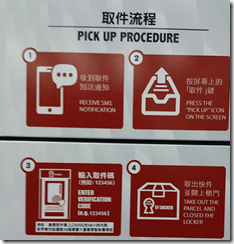
• imageThe instructions are in English.

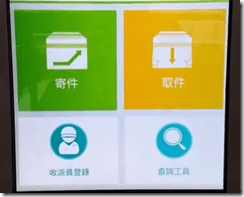
    But the touchscreen isn’t.

    So, that icon on the ‘pick up procedure’ with an arrow pointing up…

    This one:

     image

    Don’t see anything like on the touchscreen.

    imageGotta be the green one with an arrow pointing up?

    No.

    It’s the orange one with an arrow pointing down.

    Now, yes, since you mention it, the Chinese characters 取件 do appear in the instructions and on that orange button.  So if you can recognize Chinese you can get this far.

    There are, of course, more screens to navigate – all of them in Chinese.  Trial and error seems to work.  Eventually.

  • Poundworld in the UK has closed down.  The closest equivalent here is Japan Home Centre, which used to be the "10 dollar shop", but quietly dropped that concept (in 2001, apparently).  When Poundworld tried to do something similar in 2016, it didn’t go well:

    Not so penny-wise: the last days of Poundworld

    “Each week we would be rolling out new shelving bays as ‘manager’s specials’, where prices were written by hand, and customers would say: ‘I thought this was supposed to be a pound shop.’”

    …and maybe that was the beginning of the end.  Of course, the concept made a lot more sense 20 years ago:

    [Chris] Edwards [who launched Poundworld] writes in his book of a trip to China in 1997: “I would see stuff I had bought from wholesalers in Britain for 55p and it would be for sale to us for 25p. It was exciting!”

    Two obvious problems here: £1 in 1997 is equivalent to around £1.78 today, and the RMB is 33% higher than it was 21 years ago.  So it should be "the £2.37 shop".  Well, maybe not.

    Yes, you can sell smaller packs at the same price (which they did), but that’s an expensive change to make (and customers may notice this and complain, whereas small price increases are not so obvious).

    To be fair, their similarly named rival is still in business, though they have also faced challenges.

    At one point, Poundland almost had to stop stocking reading glasses, one of its biggest sellers. “We had to work very hard with our supplier,” says Nick Agarwal, a consultant at the chain. “They took out metal parts from the spring hinge in the arms and changed production to produce the plastic in each pair in one go.”

    In Hong Kong, Living Plaza sell reading glasses (and most of their other products) for HK$12.  Not quite so snappy as 10 or 1, but I suppose it works for them.

    Or you can go crazy at the "Ten Dollar Store" and pay HK$89.90 (but, hey, you also get a plastic case).  Oh, and that annoying jingle played in a continuous loop.

    And (from that same Guardian article) this is hardly a new idea:

    In 1884, a Polish-Jewish migrant called Michael Marks opened Penny Bazaar in Leeds. His slogan was: “Don’t ask the price, it’s a penny”. Marks joined Tom Spencer, a bookkeeper, and, by 1900, Marks & Spencer had 36 Penny Bazaars. Eventually, the pair began moving away from fixed pricing and began trading under their own names.

    If you want to know more about the history of M&S, try here.

  • imageMore than 18 months ago I complained about The Gulu.  They’re still at it, forcing you to upgrade the app when all you want to do is book a table.

    This time they excelled themselves by making the old version of the app disappear from the Home Screen.

    So first I have to find the app (good luck with that – it used to be called “Food Gulu” but then they renamed it to “The Gulu”, which means absolutely nothing to me). 

    Then they ask me to setup a user ID and password.  Why do you need that when you already have my phone number? 

    Then I discover that they have cleverly hidden my list of favourite restaurants, and the search engine has never heard of the name I entered.  Ah, stupid me, I had included a space between two words, so obviously that’s not going to work.

    I just want to book a table.  How hard can that be?

  • Whilst having Dim Sum today I watched the lady at the next table carefully cleaning all the cups, bowls and chopsticks (using the tea and hot water provided by the restaurant).

    The problem is that once you notice people doing this you can’t help but observe that most people who do this (and many restaurant staff) handle cups, bowls and chopsticks quite indiscriminately.  So we have to hope that their hands are really clean.  

    I wrote about this several years ago, and these were the explanations offered in the comments:

    1. There’s a lot of TB in Hong Kong.  Which is true:
    2. Restaurants use bleach to wash everything, and it needs to be rinsed off.

      Another comment was that a brief wash with hot water is unlikely to kill many germs, which must be correct (for that you’d need water that is actually boiling).

      So if you are really a germaphobe you should probably stay at home.

        1. Two years ago I complained about President’s horrible Ambassador product (I can believe its not butter) and here it is in an SCMP report

          Almost 20 spreads sold in Hong Kong ‘could increase your risk of cancer’

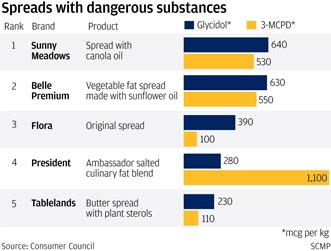
          GlycidolAt least 18 margarine products sold in shops in Hong Kong contain glycidol, a substance thought to cause cancer, and at least 16 carry a by-product [3-MCPD] that can harm kidneys and male fertility, the Consumer Council said on Monday.

          The watchdog revealed the findings from tests done last October on 30 items – nine types of butter and 21 products containing margarine. The latter comprised 16 margarine spreads, four blended spreads and one sample of shortening.

          [..]  The European Food Safety Authority (ESFA) is set to publish its standards for glycidol intake this year. Last year it recommended that the intake of the by-product 3-MCPD should be no more than 120 micrograms per day for adults.

          3-MCPD comes about when refining edible oils and is found in noodles, chips and even infant formula.

          Among the samples, President’s Ambassador Salted Culinary Fat Blend contained the most 3-MCPD at 1,100mcg per kg.

          As I said two years ago, I really don’t understand why a respectable company such as President is selling this product in packaging that looks just like butter (and that was when I knew it contained trans fats, but didn’t know about the glycidol and 3-MCPD).  Seriously, what’s wrong with them?

          Having said that, the risk is quite low:

          But a person would still have to eat 24 teaspoons of the fat blend in a day to exceed the ESFA’s guidelines, the council said.  “With normal consumption, the impact on health is minimal,” Wong Kam-fai added.

        2. I don’t normally read the South China Morning Post, but I came across an actual printed copy so I glanced through it, and what a delight it continues to be.

          Oxfam Haiti sex scandal arose from arrogance, but cuts to funding are not the answer

          The Oxfam sex scandal has highlighted sexual abuse and exploitation by staff at the British-based charity in Haiti, after an earthquake ravaged the country in 2010. It also exposes the arrogant culture and lack of accountability in the aid sector.

          The reason the sector is so vulnerable to such allegations is that it is too often consecrated. Oxfam uses “ending poverty” as slogan to rally for funding and support. As a charity, it is often seen as a representation of the “good” and “sacred”. It was not expected to do harm to society. This explains why it has fallen so far from grace recently.

          Such an incident reveals not only that aid workers have been sexually abusive in local fields, but that they are using their position to exploit the most vulnerable.

          Believe it or not, this is not an isolated incident.

          I was expecting some revelation here.  There is nothing.

          When aid workers from the developed world are sent into the developing world, this possibly breeds a sense of exceptionalism. Coming from the “better” outside world, as well as under the aim of “saving the world”, aid workers are inclined to do things differently than they otherwise would do back home.

          Well, that’s hardly a revelation.  I am sure many people behave differently when away from home.

          Some even believe that they are godlike saviours for the locals, reinforcing the image of white fantasies with the mission of civilising the global south. They are left to their own devices to operate freely in such yet-to-be-liberated spaces. Some even perceive themselves as above the local norms and laws.

          I wouldn’t be surprised if they did.

          Amid such a power hierarchy, incidents such as these are probably only the tip of the iceberg.

          Probably.  Probably!

          Still, a few black sheep do not justify cutting off funding to Oxfam and the entire sector. Cutting off funding will not help curb sexual exploitation by workers on the ground, but mostly affect the vulnerable populations who require help.

          This under-supervised industry requires a structural overhaul. It is also important to realise the overhaul shall not be based on an event, but be a long-term process of constant evaluations.

          The way forward is not only to improve the transparency of the organisation and sector, but for the management in these organisations to articulate new and renewed commitments, to their process, the core vision and values.

          Neville Lai, Ho Man Tin

          Why does the SCMP print letters from people who have no particular insight into a subject?  What’s the point?

          And then there was this:

          Hong Kong reaps HK$380 million bonanza thanks to overseas visitors at Sevens

          …and even more visitors could be among the 40,000-strong crowd each day this weekend (April 6-8) as the Cathay Pacific/HSBC-sponsored showpiece is sandwiched between Easter and Cheng Ming Festival when many Hongkongers tend to travel abroad.

          The Rugby Sevens are after Ching Ming (which is on Thursday).  So, not sandwiched at all.  Do carry on.   

          [..] Tickets sold out for the 13th year in a row despite initial fears over the event’s proximity to major public holidays.

          “We had a few concerns over the Easter break [March 30 to April 1] and Cheng Ming Festival [also known as Tomb Sweeping Festival, April 2],” said McRobbie after the unveiling of an enormous “floating” rugby ball in Victoria Harbour. “But it has not been as negative as we thought it would be at one point.

          That’s Thursday 5th April, by the way.  And it’s normally called Ching Ming.

          Then there was this totally baffling headline:

          EFFORTS TO REACH
          DEAL WITH HOLY
          SEE STILL ON

          That’s just a random jumble of words (if you need a clue, “Holy See” means the Vatican). 

          In the online version they abandoned all efforts to write a snappy headline and went with the extremely verbose "Controversial bishops deal could still be on track after Beijing signals it hopes for progress in Vatican talks" which even I can understand.

        3. I am not sure whether the SCMP simply doesn’t understand (see also the so-called “Sha Tin to Central” link) or whether they really love clickbait. 

          Fees at ESF schools in Hong Kong could rise by as much as 25 per cent next year

          South China Morning Post | 28 March 2018 | Peace Chiu

          The biggest group of international schools catering to English-speaking children has proposed fee increases of up to 24.7 per cent as the loss of its government ­subvention affects Primary Three level.

          This means that the English Schools Foundation could charge parents of Year Three pupils HK$111,200 for the school year starting in August, compared with HK$89,200 this year.

          It’s nonsense, of course.  The actual increase is about 4.5%.

          Why?  Because you need to compare the fees for students who are currently in year 2 with fees for the same students when they transfer from Year 2 to Year 3 at the start of the new school year in August.

          If you compare students in next year’s Year 3 with current Y3 students then, yes, they are paying higher fees.  That’s because of the long-drawn out way that the government is withdrawing the subvention.  But no student will be paying 25% more than they are currently paying.  The SCMP report does go on to mention what’s really happening:

          CEO Belinda Greer explained in a letter to parents that HK$17,300 of the planned increase was due to the loss of the subvention, which started being phased out two years ago and will last for a period of 13 years.

          Indeed.  But that HK$17,300 “increase” is something that all parents will have known about when they enrolled their children in an ESF school.  Not a surprise at all. 

          The ESF runs 22 international schools for about 17,700 pupils from more than 60 nationalities.

          “[The] government subvention will continue for all students in Years Four to 13 in 2018-19,” she said.

          “A new fee structure applies to students who joined ESF Year One in August 2016 and August 2017, and to students joining ESF Year One in August 2018.”

          For Years One and Two of its primary schools, including the Jockey Club Sarah Roe school, the foundation plans to raise fees from HK$106,500 to HK$111,200. For Years Four to Six, the proposed increase is from HK$89,200 to HK$93,900. For Years Seven to 11 of its secondary schools, including the Jockey Club Sarah Roe school, the foundation plans to raise fees from HK$122,900 to HK$128,400. For Years 12 and 13, the proposed increase is from HK$129,100 to HK$135,000.

          Greer told parents: “I want to assure you that our financial planning takes careful account of the need for financial prudence, as well as the impact that any fee increase has on our parents.”

          She said the average increase was at the minimum level needed to meet rising costs while maintaining the quality of education.

          Oh, and then there are the comments.

        4. Green taxiRather confusingly, there are several red taxis driving around Hong Kong dressed up as green taxis.

          In Hong Kong we have red “urban taxis” that have higher fares and can operate everywhere except the south part of Lantau island.

          Green taxis can only operate in the more northerly parts of the New Territories (such as Tai Po and Tuen Mun), and the east (Ma On Shan and Sai Kung, but excluding Tseung Kwan O).  Here's the map (pdf).

          They can also go to a few special locations (e.g. Tsing Yi and Tseun Wan MTR stations, the airport, some hospitals, Disneyland, Sha Tin racecourse) and on some highways.  Details are here.

          end of New Territories taxis operating areaIf you look closely when you are travelling around Hong Kong, you might notice the signs showing roads that are prohibited for green taxis.

          Apparently there are only 75 blue Lantau taxis (operating on Lantau Island and Chek Lap Kok).

          It’s an odd system.  If you live at the edge of the New Territories taxi zone and want to go out of that zone, you either have to wait for a red taxi, take a specific route (e.g. to Tseun Wan MTR), or negotiate with the driver of a green taxi to take you somewhere he’s not supposed to go.  Or take a minibus.     

          So it’s rather strange that an advertiser is allowed to turn a red taxi into a green taxi.

        5. A small follow up to my post on HKTVMall. 

          Just to say that their customer service really isn’t great.

          I ordered something that was supposed to be available within 4-7 working days.  Then just two days later I noticed that they had updated the order with a delivery date – the following day, at a time when no-one would be home.  So I contacted their customer service.

          I opened the chat window and entered my question.  And waited.  And waited.  It took about 25 minutes for someone to respond.

          Me: I notice you are planning to deliver this item tomorrow.
          HKTVMall: The item will be delivered within 4-7 working days
          HKTVMall: Monday to Friday
          Me: That’s fine, but your website shows that it will be delivered tomorrow and no-one will be home
          HKTVMall: Please wait, I'm checking the item.
          HKTVMall: The item hasn’t arrived in our warehouse.
          Me: So the information on your website is meaningless?
          HKTVMall: The item hasn’t arrived in our warehouse.

          That might look like a brief conversation, but it actually took 20 minutes (after the 25 minute wait for someone to appear).  To achieve precisely nothing.

          Someone must have decided that they were planning to deliver it the next day, but apparently this information isn’t shared with their Customer Services team.

          Needless to say, they did try to make the delivery the following day, and no-one was home.

          I’ve had other deliveries that have been later than the (4 hour) timeslot, and others that have been several hours early.  And the previous time I tried to contact their Customer Services it took one hour for them to respond, by which time I had given up (but I hadn't closed the chat window, so I know how long it took). 

          Quite a lot of work to be done on customer service, then.    

        6. In Hong Kong your supermarket “choice” is largely between shops owned by Li Ka-shing (ParknShop, International, Fusion, Taste, and the Great Food Hall) and Jardines (Wellcome, Market Place by Jason, Threesixty and Olivers). 

          It’s no surprise that this lack of competition leads to high prices and poor service, so alternative options are always welcome.

          HKTVmall is a mini-Amazon, selling products from a wide range of suppliers, including some good quality imported produce at reasonable prices (e.g. frozen grass-fed beef and lamb, frozen wild-caught salmon, fresh cherries from Tasmania, fresh papaya from Hawaii, etc.), vitamins and supplements at much better prices than Watson or Manning (that duopoly again) and some electronic products.

          They also provide free delivery if you spend HK$400 (or HK$250 if you’re a “VIP”).  I remember when ParknShop offered free delivery if you spent HK150, but now their minimum is a hefty HK$800 (Wellcome's minimum seems to be $500).  

          The HKTVmall website and app are super annoying and although they do try to keep you informed on the status of your orders, the English versions are often confusing and incomplete:

          • “Our delivery team has picked up products in order xxxxx and will arrange delivery soon.”  Except that I had to collect it from their store.
          • “Product arrived at HKTVmall logistics centre, will be delivered soon.”  Not really sure how this one helps me – why not just send me a message when it’s actually ready for collection?

          It’s entirely possible that the Chinese versions of these messages make more sense.  For example, Cantodict tells me that 送 can mean “send”, “deliver” or “dispatch”, which might help to explain the confusion.

          But any competition for the ParknShop and Wellcome duopoly has got to be a good thing.


          This is part of a series (of sorts).  The previous post was Tesco, Waitrose, Sainsburys, M&S in Hong Kong (with updates here)