• I received an email from Spotify (entirely in Chinese).  Ignored it.

    Turns out that it was telling me that I have to change my password.

    But no English translation!!

    This is what it says (courtesy of Google translate):

    Please update your Spotify account password

    Hello Spotify the User:

    To protect your Spotify account, we have reset your password. This is because you use the same password for other services data leakage accident occurred, so we think your Spotify have hacked possible.
    do not worry! It is only a preventive measure Yet no one else entered your Spotify account, your data is still safe.

    To create a new password to be able to continue to sign in the future Spotify, please just press the green button on the big side.

  • Interesting article from the BBC about red minibuses in Hong Kong

    Things I already knew: red minibuses don’t follow fixed routes, and are very dangerous.

    Things I learned from this: red minibuses first appeared in 1967; green minibuses started in 1980; the government wants to phase out red minibuses and replace them with the more regulated green version.

    Hop aboard Hong Kong Kong’s wildest ride

    In a city with one of the world’s best public transport networks, the cheap, fast, accident-prone red minibus survives.

    The former British colony has the world’s largest fleet of double-decker buses, 18,000 taxis, and a spotless, efficient subway system known as the MTR. And yet, every day, thousands of people opt to ride one of the 1,138 red-topped, 16-seat Toyota Coaster minibuses that are notorious not only for their speed, but for their eccentric drivers, unregulated fares, and tendency to smash into other vehicles.

    It’s a system that dates back to 1967, when the Cultural Revolution spilled over the border from China. Left-wing agitators were intent on overthrowing the colonial British government, and Hong Kong was crippled by protests, strikes and riots. When drivers from the city’s major bus companies went on strike, shared taxis that had long served the rural New Territories began to illegally pick up passengers in the urban areas of Kowloon and Hong Kong Island. The colonial government decided to legalize this additional service.

    Today, the government mandates the number of seats and the type of vehicle that may be used as minibuses, which it refers to officially as “public light buses.” Other than that, drivers are free to determine their own routes and fares. Drivers are free agents who rent the vehicles for a shift — the going rate is HK$800 per day — which gives them extra incentive to drive quickly and pick up as many passengers as possible.

  • Well, not really – the Airport Express is generally very good.

    The trains now terminate at Asiaworld-Expo, which is odd for an airport express, but it brings the MTR some additional revenue and normally it doesn’t create a problem

    Except when, after a concert, the trains arrive at the airport full of passengers.

    That means standing room only, and sometimes barely even that.

    That’s not good enough when you are paying a premium fare.  A one-way Airport Express ticket to Hong Kong station costs $100.  Fares for events at Asiaworld-Expo are significantly cheaper (e.g. $36 each way to Hong Kong station if you use your Octopus card and make a return trip, which is what most people will do).

    OK, the Airport Express do offer many different discounts, but the best deal from the airport is still around $70 – double the AsiaWorld-Expo price (and many people either don’t qualify for discounts, or don’t know about them).

    And, yes they did recently increase the price of group tickets by around 12%.  They seem to have kept that quiet.

    Given that there is plenty of spare capacity, couldn’t they run extra trains, starting at the airport?  Or restrict the Asiaworld-Expo passengers to one half of the train and put airport passengers in the other half?  They have done that in the past when there were big exhibitions (though that is different, because you don’t get a surge of people at one time).

    Not only are the trains full, but there are then very long queues for taxis at AE stations – which is not what you want when you have spent several hours traveling to Hong Kong.  The solution for that should be even simpler – surely taxi drivers would respond if they knew there was demand?

  • Monday's SCMP clickbait headline:

    Chinese airlines are consistently late for this one surprising reason.

    – It's not a surprising reason (spoiler alert: it's the military closing the airspace)

    Wednesday's rather boring story in the paper, with a clickbait headline online

    How developer Rykadan turned a Hong Kong basketball court into tiny flats for big profits.

    Except that it wasn't a Basketball court!  From Google Street View, it looks more like a public toilet:

    Kwun Chung Street

  • After the woman who tried to push past me and fell into the gap between the train and the platform, another pleasing outcome…

    A woman is walking along, typing something into her mobile phone.  I walk past her and into the lift.  The doors close (I didn’t touch the button, honest).  She is left outside.  She is not happy.   

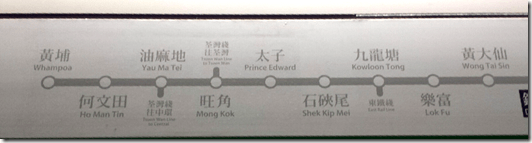
  • I’m always interested in other views of the MTR, including this one:

    hong kong metro: five transfers??

    I jumped onto Google looking for hotels that would be convenient to the rail line from the airport.  Yikes!

    Is it my imagination, or am I seeing that:

    • Only three stations in the city are on the Airport line.
    • Only five additional stations can be reached in one transfer.
    • Some parts of the system (e.g. the Ma On Shan (MOL) line in the northeast) are five transfers from the Airport.

    Don't airport lines, where people are hauling luggage, need to be designed so that they plug into the network with relatively few, well-designed transfers.

    Not in London, where the Heathrow Express only takes you to Paddington.  OK, so Crossrail the Elizabeth Line will offer better (but slower) connections throughout Central London, when it opens in 2018. 

    Not in Bangkok, either, which doesn’t even have one convenient connection.  Does Shanghai?

    That’s a strange map of the MTR system, though.  The terminus of the Airport Express (Hong Kong station) is connected to Central station through an underground walkway.  This offers plenty of easy ways to get to the rest of Hong Kong island and most of Kowloon.

    If you don’t mind waiting, the so-called Sha Tin to Central link will provide more simple interchanges – and if they ever finish the new train terminus in West Kowloon, it should be easy to walk from Kowloon station to Austin (on West Rail). 

    Also, most major hotels can be reached through free shuttle buses from either Kowloon or Hong Kong station.  Or taxis are a good, reasonably priced option (although there can be long queues at Hong Kong station).

  • It’s fascinating how the “low carb” diet is finally being taken seriously by the establishment.  I have written about this many times, being unconvinced by the Atkins diet but interested in alternatives

    The TV series “Doctor in the House”, shown here recently on BBC Earth, featured “low carb” diets as an effective way to deal with diabetes.  Then I found this in New Scientist:

    Fat vs carbs: What’s really worse for your health?

    David Unwin, a doctor practising in Southport, UK [..] suggests to his patients with type 2 diabetes or who want to lose weight that they do the opposite of what official health advice recommends. He advises them to stop counting calories, eat high-fat foods – including saturated fats – and avoid carbohydrates, namely sugar and starch. Telling people to avoid sugar is uncontroversial; the rest is medical heresy.

    But crazy as it sounds, Unwin has found that most of his diabetes patients who follow this advice are getting their blood sugar back under control, and that some are coming off medication they have relied on for years. Those who are overweight are slimming down.

    If you want to read more, I recommend “The Great Cholesterol Myth” by by Jonny Bowden and Stephen Sinatra

  • Another excellent “Long Read” from The Guardian, by Tom Lamont – the same writer as the one about pubs that I highlighted last year.

    The big gamble: the dangerous world of British betting shops

    In total, there are around 9,000 licensed betting shops in the UK, around half of those operated by Ladbrokes and William Hill. The two corporations are great and bitter rivals, tracing a contempt for one another back to the 1930s. Difficult as it is to credit now, both companies once shared a snotty attitude about the idea of bookmakers having shops.

    “I don’t think it would be very nice,” said Mr William Hill, founder of William Hill, in 1956, “to see at every street corner a betting shop.” There was never a Mr Ladbrokes; the company was named for a country house where its founders trained horses in the 1880s. Up to the 1960s it reckoned itself too posh for street-level trade.

    […] Once Ladbrokes and William Hill could not ignore the potential profits any longer, they began to open branches, or take over existing ones, and from the mid-1960s on, the two companies’ spread was rapid and aggressive. Between them they absorbed dozens of smaller now-forgotten firms – Solomons & Flanagan, JJ Simonds, Ken Munden, Fred Parkinson.

    […] [Then] around the turn of the millennium, [came] the first modern gambling machines – “fixed-odds betting terminals”, or FOBTs (pronounced fobtees), offering a digitised version of roulette as well as other arcade-style games that could be gambled on.

    […] Many shop workers I spoke to had stories about looking on, impotent, as the machines under their charge were angrily destroyed by the customers who had been playing them. Worse, somehow, was when a machine was calmly destroyed. The deputy manager of a William Hill in Hull said: “You just watch, there’s nothing else to do. It’s normal. It’s normal for people to smash up the shop.” (A representative of William Hill said this was “rare”.) A woman working at an Oxfordshire Ladbrokes told me she had watched all four FOBTs in her shop get wrecked by a man swinging a stool; by the next day’s trade, she said, her ruined machines had all been replaced. According to figures I have seen, the number of incidents of damage to machines in Ladbrokes branches rose steadily between 2010 and 2015.

    A senior figure at Ladbrokes during this period became increasingly concerned by the situation at shop-level “getting silly, getting crazy”. They told me it was their belief that with the introduction of the machines, betting shops had more or less become “mini casinos”. And how many casinos, they asked, got by without bouncers to cope with aggrieved gamblers? How many were run by individuals on their own?

    As with his story on the pub trade, Tom Lamont highlights the impact on some of the people working in betting shops.  Sadly, this time there’s no happy ending.  Very far from it.

  • As previously noted, LeTV won the Hong Kong TV rights to the English Premier League for three seasons (starting in August 2016), and then did a deal with PCCW’s Now TV – so both will be showing the games for the next 3 years.

    Here’s a comparison on Premier League TV Packages in Hong Kong