Ordinary Gweilo

It's not big and it's not clever, it's just a Brit in Hong Kong writiing (mainly) about Hong Kong

  • Another excellent “Long Read” from The Guardian, by Tom Lamont – the same writer as the one about pubs that I highlighted last year.

    The big gamble: the dangerous world of British betting shops

    In total, there are around 9,000 licensed betting shops in the UK, around half of those operated by Ladbrokes and William Hill. The two corporations are great and bitter rivals, tracing a contempt for one another back to the 1930s. Difficult as it is to credit now, both companies once shared a snotty attitude about the idea of bookmakers having shops.

    “I don’t think it would be very nice,” said Mr William Hill, founder of William Hill, in 1956, “to see at every street corner a betting shop.” There was never a Mr Ladbrokes; the company was named for a country house where its founders trained horses in the 1880s. Up to the 1960s it reckoned itself too posh for street-level trade.

    […] Once Ladbrokes and William Hill could not ignore the potential profits any longer, they began to open branches, or take over existing ones, and from the mid-1960s on, the two companies’ spread was rapid and aggressive. Between them they absorbed dozens of smaller now-forgotten firms – Solomons & Flanagan, JJ Simonds, Ken Munden, Fred Parkinson.

    […] [Then] around the turn of the millennium, [came] the first modern gambling machines – “fixed-odds betting terminals”, or FOBTs (pronounced fobtees), offering a digitised version of roulette as well as other arcade-style games that could be gambled on.

    […] Many shop workers I spoke to had stories about looking on, impotent, as the machines under their charge were angrily destroyed by the customers who had been playing them. Worse, somehow, was when a machine was calmly destroyed. The deputy manager of a William Hill in Hull said: “You just watch, there’s nothing else to do. It’s normal. It’s normal for people to smash up the shop.” (A representative of William Hill said this was “rare”.) A woman working at an Oxfordshire Ladbrokes told me she had watched all four FOBTs in her shop get wrecked by a man swinging a stool; by the next day’s trade, she said, her ruined machines had all been replaced. According to figures I have seen, the number of incidents of damage to machines in Ladbrokes branches rose steadily between 2010 and 2015.

    A senior figure at Ladbrokes during this period became increasingly concerned by the situation at shop-level “getting silly, getting crazy”. They told me it was their belief that with the introduction of the machines, betting shops had more or less become “mini casinos”. And how many casinos, they asked, got by without bouncers to cope with aggrieved gamblers? How many were run by individuals on their own?

    As with his story on the pub trade, Tom Lamont highlights the impact on some of the people working in betting shops.  Sadly, this time there’s no happy ending.  Very far from it.

  • As previously noted, LeTV won the Hong Kong TV rights to the English Premier League for three seasons (starting in August 2016), and then did a deal with PCCW’s Now TV – so both will be showing the games for the next 3 years.

    Here’s a comparison on Premier League TV Packages in Hong Kong

  • The MTR is a world-class public transport system.  The passengers – not so much.  Leading to everyday frustrations, with the occasional moment of madness.

    Case one – trying to get off a crowded train.  Doors open.  I say “Mh Goi”, but no-one moves, so I have to force my way out through a crowd of bodies.

    Case two – waiting to get off a very un-crowded East Rail train heading for Lo Wu.  Doors open.  Two passengers try to push past me.  I stand my ground. 

    One of them actually fell down into the gap between the train and the platform.  I’m still not sure how they managed to do that, but I hope they had a safe journey back home.

  • Netflix has indeed launched in Hong Kong – and most of the rest of the world (apart from China).

    Initially, House of Cards wasn’t available.  Yes, that’s right – the series for which Netflix is best known wasn’t available on Netflix.  Along with a lot of other shows.

    The good news is that Netflix Hong Kong does now have the Netflix series House of Cards1.  Good work, Netflix people.

    As pointed out below, they currently only have the first 3 series, which in no way diminishes the achievement by Netflix Hong Kong in securing the rights to a Netflix owned drama series.

  • imageIt certainly looks like butter – and the shelf label says “salted butter plus vegetable oil”, though apparently the official name is "President’s Ambassador Salted Culinary Fat Blend" (which really sounds delicious, doesn't it). 

    What is the first ingredient?  Hydrogenated vegetable oil.  There is some butter, but it’s the third ingredient, so probably less than 20%.

    President should be thoroughly ashamed of themselves for selling this product in Hong Kong.

    Yes, it does contain trans fats.

    [See also a later post about this product containing glycidol and 3-MCPD]  .

  • OK, it’s Christmas, but the Sunday Morning Post is supposed to be an English language newspaper.

    Debate over MPF protection rages on

    Jennifer Ngo | Sunday Morning Post | Sunday, 27 December, 2015

    The row over the Mandatory Provident Fund’s offsetting mechanism continues as civil society criticised the government’s lack of commitment in dealing with the problem which had caused a lot of those in the lower-working class to lose their retirement savings.

    The offsetting mechanism – where employees’ retirement funds are used to cover their severance or long-service payments by the employers when their job is terminated, or ends – saw 43,500 employees lose a total of HK$3 billion in 2014, according to statistics in the public consultation on retirement protection.

    But Wong Shek-hung, advocacy officer at Oxfam Hong Kong, criticised that the government still refuse tto commit to cancelling the mechanism, despite of it being obviously detrimental to helping employees save up for retirement.

    “As long as the offsetting mechanism exists, the working class employees will continue to suffer,” said Hung, in a radio show yesterday.

    An average of 94 per cent of the employers’ contribution to MPF used up in offsetting, the consultation revealed. And for employees who have a monthly income of HK$7,100 or less – which mean they don’t need to contribute to MPF, only their employers do – this would mean when they leave their job, they leave with no retirement funds saved up at all, because the funds are used to pay off severance or long-service payments.

    However, the government stated in the consultation that offsetting is “a complicated matter”, and “cannot be simply retained or done-away with”, and said that the consultation was to “see if employers and employees can come to a compromise and balanced decision”.

    Wong said the unjust system had costed the lowest tier of the working class to lose even their meagre retirement savings kept in the MPF system, and said the government should work towards completely abolishing the mechanism.

    Chief Secretary Carrie Lam Cheng Yuet-ngor denied that the government is shirking away from the offsetting mechanism debate, and that the government “has the determination to deal with the issue”, but that it would take a long-term discussion and examination over whether abolishing it would create big problems for employers.

  • Elvis Costello & The Brodsky Quartet

    The Amadeus Centre, London W9

    1 July 1992

    This is inspired by reading Unfaithful Music & Disappearing Ink, Elvis Costello’s recently published autobiography

    imageExactly a year after the Hammersmith Odeon gigs, where Elvis Costello was overweight, bearded and apparently angry, what a transformation…

    The Amadeus Centre could scarcely be a more different venue.  It was originally a Welsh Presbyterian chapel, and has been converted into an arts centre (and, apparently, a wedding venue).  The main space was set out with tables and chairs (with food and drink being served), and many of the guests were Costello’s friends and relatives.  I was in the cheap seats upstairs, and for the interval we repaired to the pub across the road for refreshments.

    Elvis Costello looked much happier, minus the beard and the excess weight of a year earlier, but I had no idea what to expect – would it be his songs played with a string quartet? 

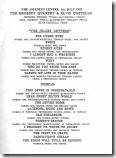
    1992-07-01_LondonsetlistNo.  He had written 20 or so songs with different members of the Brodsky Quartet (Michael Thomas and his sister Jacqueline, Ian Belton, and Paul Cassidy).  The idea came from a newspaper article about a Veronese professor who decided to answer all the letters addressed to Juliet Capulet. The five of them worked together to develop ideas for letters, which were then set to music.

    Once we had a title and had settled on the letter as our lyrical form, the variations came to us very easily: a child’s note, a postcard from a regretful lover, the reply of an eccentric aunt to a begging letter from scheming relations.

    Everything about it was astonishing.  Costello’s vocal performance, the lyrics, the musical accompaniment, the venue, the atmosphere.  Costello was clearly reinvigorated by working in a totally different medium (and having to learn to write four-part musical scores).  Fortunately this was just one of many collaborations over the coming years.

    Apparently the “classical” critics were rather unenthusiastic at the time, but subsequently it has been performed and recorded by other string quartets, and adapted for other mediums including a jazz quartet and a dance performance.

    For me, of course, it will always be about that first performance in London nearly 25 years ago.

  • This is ridiculous (from The Guardian):

    Processed meats rank alongside smoking as cancer causes – WHO

    UN health body says bacon, sausages and ham among most carcinogenic substances along with cigarettes, alcohol, asbestos and arsenic

    Bacon, ham and sausages rank alongside cigarettes as a major cause of cancer, the World Health Organisation has said, placing cured and processed meats in the same category as asbestos, alcohol, arsenic and tobacco.

    The report from the WHO’s International Agency for Research on Cancer said there was enough evidence to rank processed meats as group 1 carcinogens because of a causal link with bowel cancer.

    It places red meat in group 2A, as “probably carcinogenic to humans”. Eating red meat is also linked to pancreatic and prostate cancer, the IARC says.

    The IARC’s experts concluded that each 50-gram (1.8-ounce) portion of processed meat eaten daily increased the risk of colorectal cancer by 18%.

    Really – they found “a causal link with bowel cancer”?  I don’t think so.  What they found was that people who eat more processed meat have a higher incidence of cancer.  It’s easy to play around with the data and identify some correlation between two items, but if you want to go on to establish a causal link you need to do a much better study that eliminates most of the other variables. 

    And “Bacon, ham and sausages rank alongside cigarettes as a major cause of cancer”.  Well, not really.  The Q&A (issued with the press release) says that:

    this does NOT mean that they are all equally dangerous.  The IARC classifications describe the strength of the scientific evidence about an agent being a cause of cancer, rather than assessing the level of risk.

    I think it’s that weasel word “alongside” (used by The Guardian in their headline as well as the body of the article), with its implication that they are somehow equivalent.  Which they aren’t

    We know beyond all reasonable doubt that smoking causes cancer, we certainly don’t know that about sausages, ham and bacon.  Plus, all they are saying is that your risk of these cancers might go up from 5% to 6%.

    Other journalists have added their own speculation.  There was a cover story in Time magazine that included the suggestion that it could be the nitrates / nitrites (probably not, as the body produces nitrites) or the process of cooking (grilling, frying, BBQ) – but I’m sure that theory was debunked.   

    I can think of two simple explanations.  People who eat a lot of sausages and bacon might have a generally unhealthy lifestyle and could well be overweight, or could it just be the quality of the meat that is used in cheap sausages and ham?  But neither of those would really be news. 

  • From scmp.com

    image

    Doctors make mistakes on maths tests because they are exhausted?