 Today’s Sunday Morning Post has an article about the way banks rip you off with a “currency-linked deposit” account. These are widely available in Hong Kong because the interest rates on a standard local currency deposit account are almost zero.
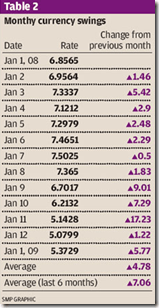
The article has a small chart which is supposed to show how the Australian Dollar exchange rate has fluctuated over the last twelve months.
However, look closely and you may notice two things.
- The date range shown is 1-12 January 2008 and 1 January 2009. Er?
- Apparently the Australian Dollar went up every day/month. Yes, that’s “up” from 7.365 on 08/01/08 to 6.7017 on 09/01/08.
The article is also staggeringly dull, and could be summarised in about two paragraphs (basically the banks penalize you if the chosen currency falls, and don’t reward you if it rises). However, it appears that “Alan Alanson” is paid by the word:
Investors bear brunt of risk with little return to match
[..]
If you put HK$100,000 in an ordinary term deposit with most banks in Hong Kong for one month, the interest rate, about 0.01 per cent per annum, would come to less than HK$1 a month. If, instead, you purchased a currency-linked deposit in Hong Kong dollars linked to Australian dollars, say, the interest rate offered would be much higher. It would not be unusual for you to be offered a rate as high as 15 per cent per annum. Assuming a deposit period of one month, that would work out at 1.25 per cent, or HK$1,250 a month.
The “currency link” part of a currency-linked deposit means that although the investor’s deposit is in HKD, it is linked to some other currency, in this case AUD. If the HKD rises against the AUD during the term of the deposit, investors get their deposit back in AUD instead of in HKD. The exchange rate used to calculate how much the investor receives in AUD is not the exchange rate applicable on the day the deposit matures, but an exchange-rate target set at the beginning of the deposit period.
The exchange-rate target will be at a slight discount to the actual exchange rate when you purchase the currency-linked deposit. Assume the AUD-linked deposit you buy has an exchange rate target of 5.32. So on the day the deposit matures, if AUD buys less than 5.32 Hong Kong dollars, the investor gets AUD instead of HKD at the exchange-rate target, not the actual exchange rate.
Assuming the deposit is for a month, if one month after you buy this product, the AUD only buys 5 HKD, you buy AUD at the higher rate of 5.32 even though AUD is only worth 5 on that day. That would represent a 6 per cent loss of your original capital, which, netted off against the 1.25 per cent interest that you still get, would mean a loss of 4.75 per cent for the month, which on an annual basis would be a 57 per cent loss.
On the other hand, if the AUD increases in value against the HKD, the investor will not get the benefit of currency gains. If it rises against the HKD, the investor still just gets back her HK$100,000 and the 1.25 per cent interest. This is where the mismatch between risk and return arises.
Hey, he finally got to the point after 547 words. Amazingly there are another 970 words to go.
By the way, HSBC are currently offering 10.04% “interest” on a deposit in Australian Dollars.
[update – 25/1/09]. Today’s SCMP has some readers’ responses to the article. One points out the two glaring errors in the chart, whilst someone else offers a rather more concise description of this product, which is a deposit account and a currency option contract. Indeed – the 10.04% “interest” is nothing of the sort, and far higher than you could actually get by depositing Australian Dollars in an Australian bank.


 Ordinary Gweilo
Leave a reply to Peech Cancel reply