Front page of today’s Bangkok Post. Left-hand sidebar – story about Pizza Hut selling pizza by the slice…in the US. WTF?

It's not big and it's not clever, it's just a Brit in Hong Kong writing (mainly) about Hong Kong
Front page of today’s Bangkok Post. Left-hand sidebar – story about Pizza Hut selling pizza by the slice…in the US. WTF?
A few weeks ago the Spotify (Windows 7) application started working normally. Then it started freezing again (and when that happens you can’t restart it without restarting Windows).
Now, to add to my frustration, the web app can’t create playlists. Or rather it creates them, but they “contain no playable tracks”. Which makes them useless.
What a hopeless organization.


The South China Morning Post published this story in Saturday’s paper.

It includes the following two paragraphs:
Police said it appeared the couple had a good relationship but had been having arguments over a health issue involving the husband.
“He believed he had cancer even though tests showed he did
not," an officer said. “We suspect he might have had some sort of
psychiatric problem”.
You will note that the last sentence is repeated in extra large type, even though it is nothing more than speculation.
Then read the same story on their website, without the comments from police sources, and without the name of the man:
A 43-year-old man leapt to his death this morning after stabbing his wife while she was asleep at home in Tseung Kwan O – the second domestic violence case reported within 24 hours.
The woman, 39, was attacked by her husband shortly before 6am inside their 12th-floor apartment at Lohas Park on Wan Po Road.
The woman jumped out of bed and ran out of the apartment, but her husband chased her with a chopper in his hand, according to police.
She ran to the sixth-floor platform above the building’s car park and sought help from another person there, saying “My husband chopped me,” a police officer said. She suffered wounds to her head, face and hands.
The husband, who was following her, then jumped from the platform, the officer said, and was later found lying unconscious six floors down on the ground. The knife was next to him and had snapped in two. He was taken to Tseung Kwan O Hospital, where he was declared dead.
So why can they publish a reasonably responsible story on their website, but it becomes sensationalist nonsense once it gets into the printed newspaper?
This week Google finally made the Nexus devices available in Hong Kong – but at ridiculous prices. For example the Nexus 7 16gb Wi-Fi is HK$2398 (US$309), compared to the US price of US$229. The new Nexus 5 16gb is HK$3,198 (US$412) compared with the US price of $349.
Apple sell their devices in Hong Kong at the same prices as in the US.
When did websites start playing audio without asking first? I can’t be bothered to find what I have to do to stop the noise, so I just close the page. Is that what they want?
Google Play now offer e-books in Hong Kong (from Tech in Asia). That’s the good news.
The bad news is that I can’t find a way to get it to display books in English only, so it’s a frustrating experience. As ever, not all titles are available, and whereas Amazon has a reasonable idea what I might want to buy, Google doesn’t:
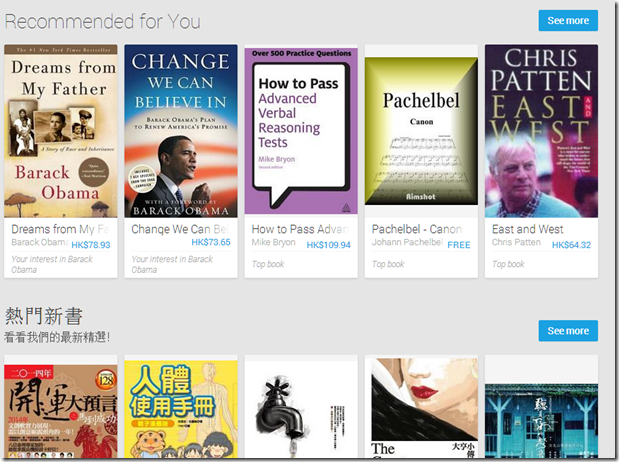
Meanwhile, Amazon is still charging their US$2 penalty for non-US customers. Rumour has it that they drop it when Apple is competing with them in a territory. But not Google, apparently.
So the English Premier League is back on Now TV. It seems to be the pattern now for it to alternate between PCCW’s Now TV and Wharf Group’s Cable TV every three years.
Of course they charge you extra for the EPL. You might think that a Now Sports Megapack would cover everything, but rather than using the old channel numbers they have created new numbers (from 621 upwards) that are only available in the Super Sports Pack. And, yes, you need to subscribe for two years.
They also charge extra for Premier League TV, which is a 24 hour channel in English that is originated from the UK and available worldwide to all broadcasters who have EPL rights. One of the presenters is John Dykes, once of ESPN Star Sports. I have so far refused to pay for this because I objected to them quoting me a price for EPL coverage and then calling me a few days to ask for more money for one of the channels.
Good thing about Now TV? The video on demand service (which cable TV don’t have). They also claim to have “Super HD” but it seems that my existing decoder doesn’t support it – so again I would have to pay extra for that.
In other Now TV news, Eurosport is now available in HD, and they showed the recent US Open tennis. They also have English rugby league and French rugby union, cycling, and some odd bits of football.
Meanwhile, Goal TV has closed down. They stopped providing coverage of the Championship last season, but still had programmes from several club TV channels (Manchester City, Chelsea, Liverpool, Real Madrid and Barcelona).
There was a letter in the SCMP from someone complaining that ITV Choice is no longer on Now TV. The only time I ever watched it was once when I was surprised to discover that it was available in a hotel in Bangkok, but the programmes were old and very second-rate. So, no big surprise that PCCW chose not to continue offering the channel.
Buy an iPhone, iPad, or iPod in Hong Kong and you will pay no more than the US price – so they are cheaper here because Hong Kong has no sales tax. But try to buy a Nexus 7 and you will pay 20% more, because they are all “parallel imports”.
English books are usually around 25% more than the US price (they usually convert at HK$10 = U$1). Hence the popularity of sites such as Book Depository or Fishpond (though the latter is very confusing, as they have their own made up list prices). Or you can buy your books in Thailand (reasonable prices) or India (very reasonable prices).
There’s also the nonsense of Amazon charging an extra US$2.00 for sending (some) Kindle titles to customers in countries where they don’t operate. Yes, that’s a charge for sending files over the Internet.
 Alternative medicines are typically 100% more in Hong Kong. For example, Blackmores Echinacea Forte is sold in Watsons in Hong Kong for around HK$150 whereas in Thailand it is around 600 baht. The catch is that in Hong Kong the pack only contains 30, whereas in Thailand you get 60. So the unit cost is double.
I found another product in Mannings, and went online to check the UK price. Again, it was almost exactly half the Hong Kong price. So I tried to order it online from the manufacturers. They don’t allow you to order from Hong Kong, but instead they direct you to the retailers here who stock their products.
Fortunately there are other companies (such as ChemistDirect) that will ship the same products to Hong Kong, and in many cases the discounts offset the delivery charge, so you are paying the UK retail price with “free” delivery.
Which is about half the price you would pay in Hong Kong.
Today’s SCMP on how the Hong Kong media reports suicides:
Reckless media reports encourage suicides, say experts at HKU centre
Experts from HKU centre say irresponsible reporting may trigger epidemic of people taking their lives and put pressure on families
Jennifer Ngo | South China Morning Post | Sunday, 08 September, 2013
Irresponsible media reporting of suicides encourages copycats and may even trigger an epidemic, warn experts from the University of Hong Kong’s Centre for Suicide Research and Prevention. It also caused additional hurt and put pressure on victims’ families, a seminar heard yesterday. [..]
The centre yesterday released a guideline for media, developed with the Hong Kong Press Council, on how to report suicide cases ethically and avoid becoming a catalyst for copycat suicides.
Apple Daily is probably the worst offender, but the South China Morning Post (which presumably likes to think of itself as a respectable newspaper) is also guilty of reporting suicides in an irresponsible way, with information that can only have come from the police and speculation about why the individual chose to take their own life.
Surprisingly, The Standard seems to be more responsible than the SCMP, managing at least to keep its reports more factual.
I have been told that the reporting of suicides has improved compared to a few years ago, but it still falls a long way short of the guidelines that have been adopted by most British newspapers. The story does not state whether any newspaper has committed to follow these new guidelines.
Guidelines for Reporting Suicides
Reporting Approach
1. Editing
- A suicide incident should not be placed on the front page of a newspaper or a media website unless it is in the public interest or is of grave public concern.
- Avoid using a large headline when reporting a suicide incident.
- Media websites should avoid cross-references with other suicide incidents reported on the website. Cross-references should instead be made to websites providing mental health services.
- Avoid reporting past suicide incidents repeatedly.
- Extra care should be taken when handling suicide incidents that involve notable persons, as their behavior is likely to be replicated because many view them as heroes or role models.
2. News Content
- Avoid a detailed description of the suicide method or process.
- Avoid using an emotional or glorifying tone to describe the suicidal behavior.
- Avoid describing suicide as a solution.
- Avoid presuming the reason for the suicidal behavior or simplifying the reason behind the suicide.
3. Use of Photographs
- Avoid printing sanguinary, violent, revolting and/or pornographic photos.
- Handle photos of the suicide victim or the suicide scene with care, and pixelate or blur the picture when appropriate.
- Do not use made-up conversation or plots to describe the suicide process, consequences of or reason for the suicide.
- Avoid using computer graphics or animation to describe the process, consequences of or reason for the suicide.
- Avoid enlarging photos of suicides or suicide attempts, such as photos depicting a person jumping off a building.
Appreciation of Privacy
- Respect the victim’s family privacy to avoid adding to their pain and sorrow.
- Consideration should be given to the victim’s friends and family. Avoid the over reporting of a suicide incident, as it might affect their emotional recovery.
Education and Prevention
- Consider including the signs of suicidal behavior in news reports to alertpeople who could offer help to people at risk of suicide.
- Provide solutions and ways to seek help whenever possible in news reports,such as through comments and opinions from psychologists, social workers and teachers.
- Provide information on and contact details for mental health and counseling services in news report to assist and support at risk people and their families.
It’s hard to believe that Apple Daily would sign up for this, but surely the South China Morning Post could do so.
It’s very kind of them to make Spotify available in Hong Kong, but their stupid software doesn’t work. I am running Windows 7 (64 bit) and the Spotify application works for anything from 30 seconds to a few minutes before crashing – and it’s impossible to close it and restart it.
The Android app works, but is hardly usable because it drains the battery within a few hours.
Which just leaves the web version, but that only seems to work in Chrome – and requires Flash Player, which I had disabled.
Well, at least Google and Apple aren’t competing with them. Oh, hang on, yes they are.
 Ordinary Gweilo