Ordinary Gweilo

It's not big and it's not clever, it's just a Brit in Hong Kong writiing (mainly) about Hong Kong

  • I've had a credit card with them for years.  I still have the Samsonite luggage they gave me as an introductory gift.  But I am getting seriously annoyed with them.

    A while back they persuaded me to upgrade to a Platinum card.  I only had to pay half of the normal fee for the first year, and they offered me some ridiculously large number of points if I spent a fairly modest amount on the card in the first 6 months.  Here's a strange thing, though – they forgot to credit me with the free points!  Easy mistake to make, but it was sorted out in one phone call.

    At the end of the first year I cancelled the Platinum card and went back to my old account.  Two (or is it three?) years later, I am still getting a statement each month informing me that I have a few cents credit and suggesting I call them to get a refund.  I call them every few months and they promise to sort it out, but the statements keep arriving.

  • I’m still not quite sure what to make about the curious controversy about changes to the food labelling laws in Hong Kong.

    Anyone who has been into a Hong Kong supermarket in recent weeks will have noticed the campaign against the new law, on the basis that some food items would be banned from Hong Kong, mainly because they make claims (such as ‘zero trans fat’ or ‘low sodium’) that do not conform with Hong Kong standards. 

    Last week a government amendment (to exempt products that sell in small volumes) was defeated in Legco (actually the vote was 26-25 in favour, but somehow that isn’t good enough).  These products will now have to carry nutrition labels specifying “energy, trans fat plus six core nutrients, namely (i) protein, (ii) carbohydrates, (iii) fat, (iv) saturated fat, (v) sodium and (vi) sugars on their food labels, as well as any nutrient for which a claim is made”.  Which really shouldn’t be a problem, because the US and Canada already require the same information, and although there is currently no legal requirement in the UK to list trans fats, most manufacturers do provide this information (and most products are now free of trans fats).

    I suspect that a lot of the campaigning on this has either been based on a misunderstanding of the new rules.  For example, the SCMP (subscription required) quoted the president of the American Chamber of Commerce in Hong Kong, Richard Vuylsteke as saying

    “We offer information about the nutrient’s percentage by serving size, but Hong Kong requires the percentage by overall size. It is difficult and costly for the US food industry to meet Hong Kong requirements.”

    That’s simply not true, as you can see if you read the original proposals or the new legislation.

    Also, I can’t find any reference to Omega-3 in the regulations, so it would seem that it is not illegal to claim that a product is “high in Omega-3”, although this appears in another SCMP report (subscription still required) based on a claim by ‘big retailers’.  Maybe they mean that they would have to tell us how much Omega-3 it contains, but I don’t think the claim itself would be illegal.

    (more…)

  • These were the government’s proposals on labelling (the full document is here):

    c) Requirements on Labelling Format

    12. There is no standard format for expression of energy and nutrient value in the food labels among different jurisdictions (see Annex 1). For some countries, energy value could be expressed in kilocalorie and for others, in kilojoule. Likewise for nutrient value, some countries allow the labelling in per 100 g/ml format while others require the labelling in per serving format. Some countries further require the labelling of energy and/or nutrients in both formats and some allow flexibility for the food traders to choose either one.

    13. We see merits in the different approaches. For labelling of energy value, while kilocalorie is more commonly understood or used by Hong Kong people, kilojoule is the International System of Units (SI units) of energy. For labelling of nutrients, labelling in per 100 g/ml will facilitate comparison by consumers but labelling in per serving format is more easily understood by laymen.

    14. Since different labelling methods are adopted by different jurisdictions and stipulating a rigid format will necessitate re-labelling of the food products of certain countries (even though the information on core nutrients are all there in the packages and are true and accurate), we consider that we should allow flexibility in this area. We therefore propose to allow the labelling of energy in either kilocalorie or kilojoule format and the labelling of nutrients in either per 100 g/ml or per serving format.

  • The new rules about Trans fatty acids state:

    The word or words “Free” or “不含”, “Zero” or “零”, “No” or “無” or “Without” or “沒有”or any other word or words of similar meaning or symbol denoting a similar meaning [are allowed if]: 

    (a) The food is solid food and contains—

    (i) not more than 0.3 g of trans fatty acids per 100 g of food;
    (ii) not more than 1.5 g of saturated fatty acids and trans fatty acids combined per 100 g of food; and
    (iii) saturated fatty acids and trans fatty acids, the sum of which contributes not more than 10% of energy.

    OR (b) The food is liquid food and contains—

    (i) not more than 0.3 g of trans fatty acids per 100 mL of food;

  • Sorry, I'm a bit late with this.  The first series of The Apprentice continues on BBC Knowledge on Monday nights, and this is week two.

    Usual introduction.  This time Sir Alan tell us that Nick and Margaret are going to stick to the teams like glue.  Hmmm, that could be tricky.  Anyway, the task is to design a toy and Matthew thinks that the boys are "going back to their strengths.  What are they?  We are men.  The toys we are designing should be aimed at boys."  Right.

    Lindsay is the girl's project manager.  She's going to talk to the team about how she sees her role as project manager.  Well, that sounds promising. 

    Both teams go to a toy company called Vivid Imaginations and meet the marketing director.  Miranda feels the need to ask a question.  "Your designers, when designing a new toy, do they tend to stick with an adaptation of a classic toy or do they completely kind of throw the boundaries open and really start, yeah, start trying to come up with something 100% original?"

    Toy company woman goes into patronising mode: "It's a really good question" she says (of course it isn't).  "The toy industry is a really good mix of both of those."  Unlike every other industry, then?  Lindsay starts pointing pointedly at her watch.  "Sometimes there are classic games and play patterns that are timeless and culturally will work across the world, so you can use those. But ideally you are always looking for innovation."  Well, gee, thanks.

    The boys choose Raj as their team leader.  The girls are running around an unidentified town looking for a toy shop (this seems to be what passes for research).  Saira is on the phone to Lindsay with their recommendations:  "Something trading so people can swap things with.  We are looking at something magnetic.  Something very puzzly that appeals to both boys and girls and the prices are under $10".

    "Interesting, interesting" says Lindsay (who has obviously picked up some tips on giving patronising answers).  "We've got something along those lines.  If they do, we never get to hear any more about it.   

    The boys are still in the toy company offices, brainstorming.  Their idea is an electronic version of Top Trumps.

    The girls have lots of ideas.  Something that plugs in like an electric plug, and does different things depending upon which way you plug it in (how many ways are there to plug in a 3-pin plug?).  Text messaging for young children using ten different cards with flags on them.  A kit for building robots that then fight with each other, and bits fall off.

    Saira likes the robot idea.  They all like the robot, and the electric plug.  Lindsay looks at her watch again.  Then she tells them how they voted (as if they somehow didn't know) and says that they are going to spend the next half hour talking to an expert.  Hey, Time Management skills.

    Nick isn't an expert, but he thinks it's extraordinary that they should be designing a toy that looks like a 3-pin plug when children are always told not to play with electricity.  Do you know, I think he may be right.

    Rachel is now talking to the expert, and wants to know "if it would be possible, or dangerous, potentially, to have live electricity flowing through that toy."   Miriam wonders if there might be health and safety issues.  Well, er, yes. 

    Did they really need to ask those question?

    (more…)

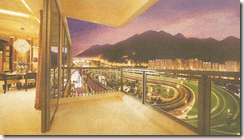
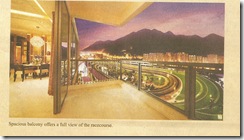
  • scan0009 Another week, another advert for The Palazzo in the SCMP on Sunday.

    This time the focus is back on the racecourse, with the claim that the "apartments command panoramic views including the breathtaking view of the International Sha Tin Racecourse."

    Well, I daresay that some apartments do have a view of the racecourse, but it isn't the one that their artist has conjured up for this advert.

    Why not? 

    Well, the apartments in The Palazzo are not that close to the racecourse itself, and are instead opposite the Jockey Club staff quarters and the site of the equestrian events in the Olympics (which will have reverted back to being the Sports Institute by the time anyone moves in).   

    scan0010Also, the apartments are next to Route 9, so any apartment with fantastic view of the racecourse would also have a fantastic view of a great deal of traffic.

    So whilst these "incredibly spacious" apartments do probably have a view of some horse racing, you will need binoculars to see any horses.

    Mind you, I suppose I should point out that this image does at least acknowledge that there is quite a lot of development on the other side of the Shing Mun river, something you might not have expected if you believed their other flight of fancy.

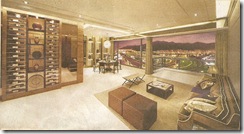
    Amusingly, this advert has a legal bit at the bottom that says that "the above artist rendering of the clubhouse and show flat photos are enhanced by computer graphics and for reference only."  You don't say…

  • I know I'm very late on this one, but having followed the rise and fall of Oasis I was interested by this fact check from David Webb, in response to a letter in the SCMP by Tony Tyler of Cathay Pacific, who wanted to assure everyone that (ahem) Cathay welcomed competition and claimed that "We never objected to any of Oasis' applications".  David Webb thinks otherwise:

    Um, that's not quite true, is it Tony? While SCMP's first statement [that Cathay had earlier objected to the airline's application for an air operator's certificate from the Civil Aviation Department] was false, it wasn't far off the mark, and the second one ["Cathay Pacific…opposed Oasis' attempt to enter the market"] was true.

    Fact: Cathay opposed Oasis' application to the Air Transport Licensing Authority (ATLA) for Air Services Licences (to provide service on particular routes) on the grounds that Oasis must first acquire an Air Operator's Certificate before applying for licenses. ATLA rejected Cathay's submission in its judgement published on 30-Nov-05, in which Cathay is named as the "Opponent".

    At that time, Cathay's spin machine called it's opposition a "representation" rather than an "objection", but the practical effect of Cathay's opposition to the application was to delay the issue of licenses, which were first applied for on 26-Apr-05, until the ATLA ruling on 30-Nov-05. Two other companies formally objected, but withdrew their objections before the hearing.

    Mr Tyler concluded:

    "We take no pleasure from the demise of an airline, as we believe competition is good for the aviation industry, as it is for all businesses"

    Spare us the crocodile tears, Mr Tyler. Competition is of course good for consumers, but bad for business owners, as any self-respecting member of Hong Kong's cartels will tell you.

    Cathay knew that "making representations" might have had the effect of delaying the issue of a licence to Oasis, and must have known that this would not be helpful to a potential competitor.  Oasis duly put this forward as one of the explanations for their cashflow problems, claiming that a deal they had to lease some aircraft fell through and they were forced to buy instead. 

    Does any airline really genuinely welcome competition?  I doubt it.

  • “As far as I am concerned, what I have in front of me here, are 14 of Britain’s best prospects.  Quite a few thousand people applied for this job.  A job with me” says Sir Alan.  Sebastian smiles ruefully, and wonders whether he (or any of them) really want to work for the man they are sitting opposite.  “A job that is going to bring you a six-figure salary.  But to get that job you’re going to have to demonstrate to me your skills in leadership, business acumen, shrewdness.  The lot.”

    Sir Alan lays it on the line: “Never ever underestimate me.  I know everything.  I don’t like liars, I don’t like cheats.  I don’t like bullshitters, I don’t like schmoozers, I don’t like arse lickers.”  Oh, hang on, this is being censored by some nice people in Singapore, so it becomes “I don’t like ————-, I don’t like schmoozers, I don’t like —- lickers.”  In fact, the man with bleeper is kept quite busy.  I’m not sure why they bother with a warning about swearing, since all of it has been bleeped out.

    As usual, it’s boys against girls.  The girls argue for rather longer than really seems strictly necessary to arrive at a team name that we will never remember.  There is talk of oceans and water and waves crashing.  Team leader Saira feels that they need a name that captures the fact that they are a group of strong individuals.  Who all have different ideas about which name to choose.  The boys quickly agree on ‘Impact’, which seems suitably meaningless.  But rather better than ‘First Forte’, which is what the girls eventually agree upon.  What’s that supposed to mean?

    So who are these outstanding people who are desperate to work for the man who brought us the e-mailer (a  phone that also sends and receives emails)?  Look, there’s one on the boardroom table.  Oh, look, there’s one in the lovely riverside house where the teams will live.  No product placement here, then.

    There’s always at least one oddball, and this time around it seems to be Matthew, who admits to being the co-founder of the Tall Society.  He’s tall, don’t you know, and we see him crashing into door frames just to demonstrate the point.  We also see him on his own nursing a drink whilst everyone else is chatting away.  He claims to have lots of entrepreneurial ideas.  He stresses the importance of thinking outside the box, and draws a box in the air with his fingers in case we don’t know what a box looks like.  Later he admits that he can be abrasive and “doesn’t treat fools gladly”, and that he probably does argue too much.  Well, yes, Matthew I think you do.  He has also has a nice line in hats, which is always a worrying sign.

    (more…)

  • BBC Knowledge is finally bringing the UK version of The Apprentice to Hong Kong (Mondays at 9.20 pm starting tonight).  I have mentioned this version of the show once or twice before (notably here), and I have to say that I prefer it to the Trump original (much more on The Apprentice here).  The US version got carried away with its initial success, and the 3 hour live special at the end of series two (or three?) was a sign that all was not well.  It got cancelled (no, no, of course what I meant to say was that Trump quit) and then they changed their minds and did a 7th series, with, er, celebrities.  I believe that is coming to TVB Pearl soon.  I can hardly wait.

    The UK version is more solid and (so far at least) free from gimmicks.  It benefits from a total lack of Donald Trump, his bad-taste apartment, his business chums and his idiot children. 

    Alan Sugar is also annoying, but in a different way.  He started out as a market trader, and made his fortune in consumer electronics, mainly by finding ways to make “hi-fi” equipment as cheaply as possible.     

    Amstrad (Alan Michael Sugar Trading) was also one of the early manufacturers of home computers, but whilst the likes of Sinclair and Acorn were being innovative, they created ingenious products such as the PCW8256, which was basically a dedicated word processor (with a printer attached), using obscure 3″ floppy disks that Sugar apparently got on the cheap.     

    I can understand someone wanting to work for Donald Trump, but why anyone would want a job working for Alan Sugar is a bit harder to comprehend.  The “six figure salary” is actually a job for one year on a salary of £100,000.  Not bad, but not exactly life-changing – though giving up a high-paid job to be on the show might just be. 

    Anyway, the first task for the two teams is to buy £500 worth of flowers at a wholesale market, and then sell them in a street market (or door-to-door).  The problem at the beginning is that there are so many contestants – and generally the ones who stand out do so for all the wrong reasons, what with being idiots and all that.  We shall see. 

  • Palazzo ad 080517The artist employed by Sino Land is obviously hard at work trying to come up with new and imaginative ways to depict The Palazzo.

    Yesterday’s SCMP had this effort (see right), which is actually not too bad.  Yes, The Palazzo has grown in size, and yes it has been twisted round by about 90 degrees, but you can still see the industrial estate in the background, and the racecourse has its stands.

    The rugby stadia have gone, and in their place we have a number of equestrian venues (which will all have gone by the time anyone moves in).  Mind you, the Jockey Club staff quarters have disappeared, presumably trampled underfoot by The Palazzo when it turned around to face the racecourse.

    Some might quibble about the portrayal of the Shing Mun river and also the throngs of happy people strolling along the river bank (and where are they going, anyway?) but this certainly isn’t as far-fetched as their main picture.

    Then came today’s picture, and we are firmly back in the world of fantasy – where everything is green and verdant.

    Of course the Hong Kong Sports Institute has also disappeared, along with those rugby stadia, again to be replaced with more green stuff.  No more Jockey Club staff quarters either.

    The clubhouse has also moved so that it is adjacent to the finishing straight of the racecourse.  Of course it isn’t there at all, and if it was then it would have its view of the horses blocked by the spectator stands. 

    Oh, yes, the stands – where have they gone?  Where is the giant screen?  The dirt track has also turned an attractive beige colour.   

    What about the public tranport interchange?  Oh, right, if we have demolished the spectator stands we don’t need that, do we?

    Then there’s all the developments on the opposite bank of the Shing Mun river.  They have been shrunk down to a ribbon of low-rise buildings along the water’s edge.  How delightful that place must be.  Oh, it’s City One Sha Tin, you say?  Really?  I never knew…